Hi, what do you want to do?






Curated OER
Find the Speed of a Protist
Students identify protists under a microscope, and using a stopwatch calculate the speed of a protist from a pond water sample. They use distance and time to identify the speed of a protist, and create a distance versus time graph to...

Curated OER
World of Protists
Students observe a jar of pond water and predict how much life they think exists in the jar and watch a "Bill Nye: The Science Guy" video regarding protists. They participate in an online virtual pond dip where they begin to familiarize...

Curated OER
Naked to the Eye
Sixth graders conduct a variety of experiments that enable them to investigate bacteria. They use microscopes, prepared slides, video, moldy bread and pond water to observe types of bacteria and how bacteria interacts with the...

Curated OER
Inquiry-based Investigations into Pond Water Microorganisms
Students become familiar with common microorganisms and experience exploring the microbial world.

Curated OER
Pond Life Identification Kit
Students explore ecology and biodiversty. They use the wet-mount procedure to make several slides to view using the microscope and draw what they see.

Curated OER
Kingdom Protista
In this kingdom protista worksheet, students conduct an experiment by placing a handful of grass in to a jar and filling the jar with pond water. Then they place the jar in a dark place for 3 days and observe the contents. Students also...

Curated OER
Protozoans
In this protozoans worksheet, students observe pond water using a microscope to identify the four classes of single-celled organisms including sarcodines, ciliates, flagellates and sporozoans.

Curated OER
A Survey of Plankton Communities
In this biology worksheet, students identify and define the vocabulary terms listed and make a prediction about the outcomes of the experiment. Then they complete the chart of the observations of the plankton diversity in drops of pond...

Curated OER
Plankton of Tyson Lagoon
In this plankton key worksheet, learners use drawings of phytoplankton and zooplankton to identify macro- invertebrates, diatoms and algae from a pond water sample.

Curated OER
Life in a Drop of Water
Students observe the wealth of living organisms in a drop of water from our freshwater ecosystems. They classify the types of organisms observed as single-celled or multi-cellular and use a key or chart to identify and name the organisms...

Curated OER
Protist Internet Lab
In this protozoan worksheet, students use the internet research 20 short answer questions about micro-organisms from Amoebas to Parameciums. They also read a poem and write there own based on the researched information.

Curated OER
The Euglena
In this euglena worksheet, students read information about these unicellular organisms. Students then color in the different structures of the euglena on a diagram. Students complete 10 short answer questions.

Curated OER
Protozoans
Pupils examine protozoans and their advantages and disadvantages. In this chemistry lesson students explain what a protozoan is then draw and label one.
Microscopy UK
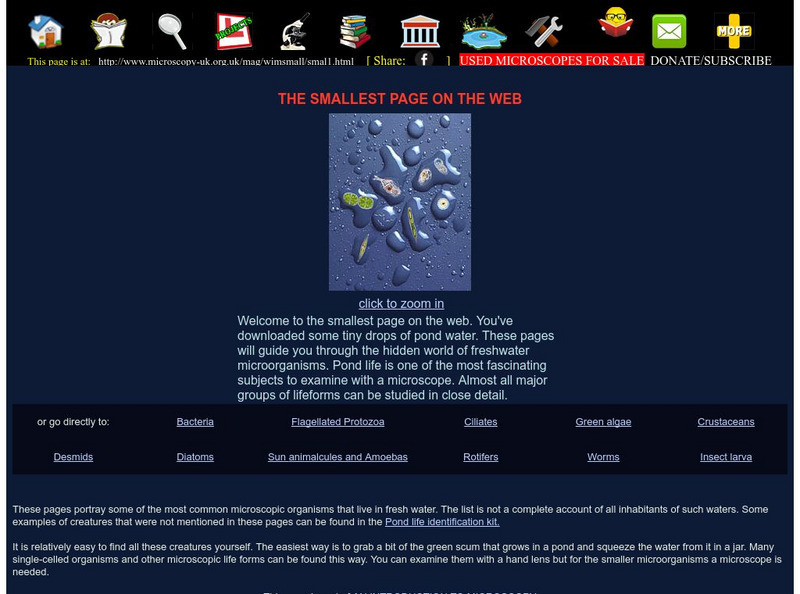
Microscopy Uk: The Smallest Page on the Web
Dive into a single drop of pond water to discover the microscopic world of freshwater organisms. Learn about protists, bacteria, and other tiny inhabitants that can only be seen under a microscope.
Microscopy UK
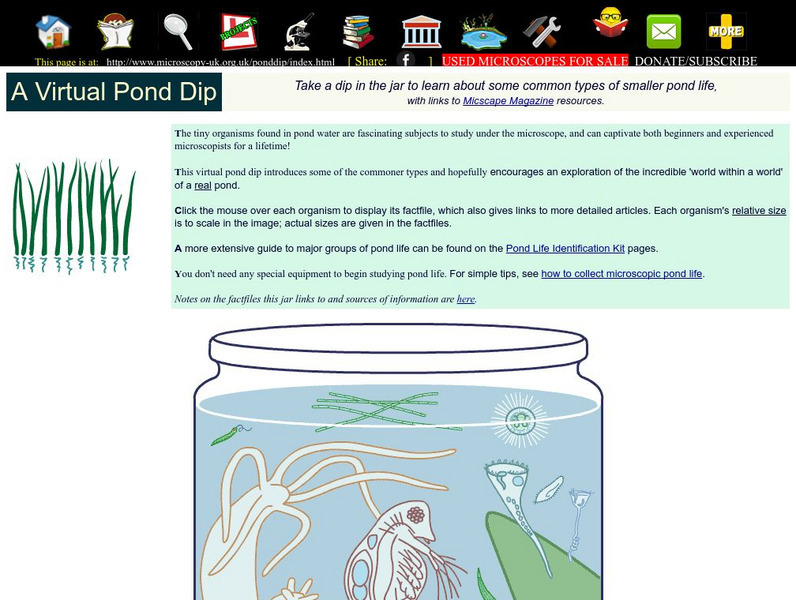
Microscopy Uk: A Virtual Pond Dip
In this site, you will be introduced to some of the more common organisms found in a pond. Contains a thorough guide to small and microscopic pond life with links to other descriptive sources.
Other
North Dakota State University: Blue Green Algae Poisoning Threatens Livestock
Article discusses the role blue-green algae plays in stagnant pond water. Also includes information about toxins from algae.