Hi, what do you want to do?





Texas Instruments
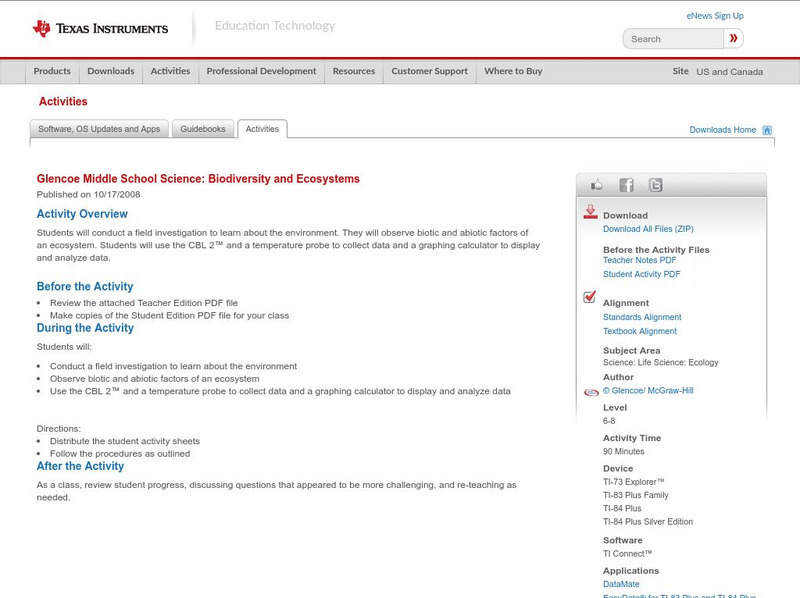
Texas Instruments: Glencoe Middle School Science: Biodiversity and Ecosystems
Students will conduct a field investigation to learn about the environment. They will observe biotic and abiotic factors of an ecosystem. Students can use the CBL 2 and a temperature probe to collect data and a graphing calculator to...
![Population Connection: Population and Environment[pdf] Article](https://static.lp.lexp.cloud/images/attachment_defaults/resource/large/FPO-knovation.png "Population Connection: Population and Environment[pdf] Article")
Population Connection
Population Connection: Population and Environment[pdf]
A paper from the Population Connection that outlines the consequences to the environment if humans continue on the path of overpopulation.
Concord Consortium
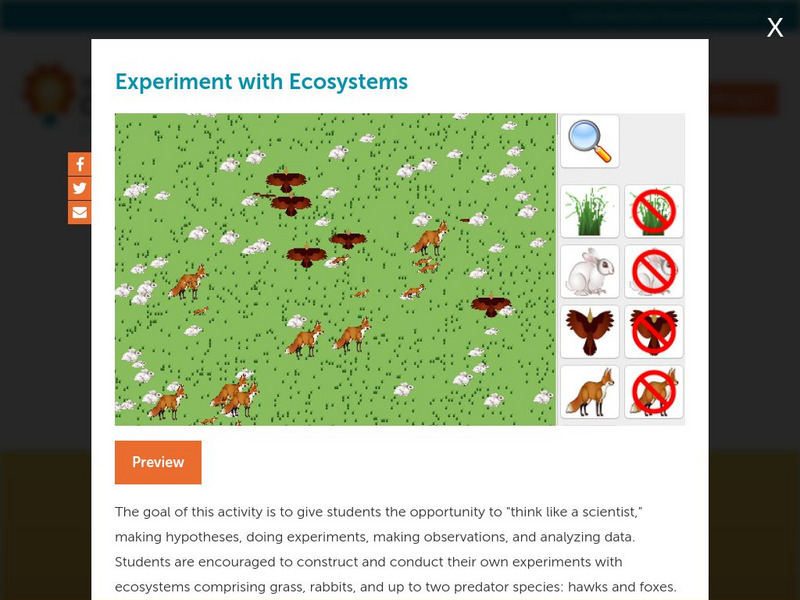
Concord Consortium: Stem Resources: Experiment With Ecosystems
Learn what happens to different populations of organisms as their ecosystem changes. Design your own experiment and make your own guesses with what the result will be with this virtual ecosystem. Also experiment with producer/consumer...
SMART Technologies
Smart: Energy Flow in an Ecosystem
Students learn about Abiotic and Biotic Factors and how they affect the ecosystem in which an animal might live in.
PBS
Pbs Learning Media: How Disruptions Affect Animal Populations
Students explore the effects that ecosystem disruptions can have on animal populations. They learn about the disruptions that have driven three species-the Madagascar fish eagle, the Iberian lynx, and the rowi kiwi, to the brink of...
Concord Consortium
Concord Consortium: Stem Resources: Predators and Prey
Did you ever want to be a hawk? In this virtual ecosystem, students will take on the role of a hawk and try to catch rabbits on a snowy field. Students will see which rabbits have adaptations that allow them to blend into the environment...
PBS
Pbs: River Rewilding: Grand River Restoration and Revitalization Project
A unit for students to look at the economic opportunities associated with a river. Students will explore the Grand River Revitalization & Restoration Project. In this unit, they will also learn about two species impacted by the...

Scholastic
Scholastic: Study Jams! Science: Ecosystems: Population Growth
Population in areas is most often determined by environmental factors. This video and the test will help ensure understanding of the trends of population growth with scientific evidence.
Bio Topics
Bio Topics: Measuring Population Sizes
Read and understand the concept of ecological population counts and sizes. Hover the mouse over questions to reveal the answers as you sharpen your skills.

Alabama Learning Exchange
Alex: Endangered Species
This is a biology or environmental science lesson plan that incorporates technology. This project-based plan is designed to be used as students study the factors that affect the dynamic equilibrium of populations and ecosystems. This...
Science Education Resource Center at Carleton College
Serc: Environmental Interactions: Connectedness of a Natural System
A field experience where learners undergo an exploration in a natural environment. They are introduced to the concepts of species, population, community, ecosystem, niche, and biosphere.
American Geosciences Institute
American Geosciences Institute: Earth Science Week: Sea Level and the Terrapin
Students build a model ecosystem to simulate the life and limiting factors of the Terrapin turtle.
Concord Consortium
Concord Consortium: Stem Resources: Variations and Adaptations
Experiment with variations in grass to see which size grows best with different amounts of water. Understand that grass that can live in different levels and change to its environment has a better chance of surviving. Also, experiment...
Sophia Learning
Sophia: Population: Lesson 2
This lesson will describe the properties of populations. It is 2 of 8 in the series titled "Population."
Sophia Learning
Sophia: Population: Lesson 3
This lesson will describe the properties of populations. It is 3 of 8 in the series titled "Population."
Sophia Learning
Sophia: Population: Lesson 4
This lesson will describe the properties of populations. It is 4 of 8 in the series titled "Population."
Polk Brothers Foundation Center for Urban Education at DePaul University
De Paul University: Center for Urban Education: Changing the Ecosystem: Q & a [Pdf]
"Changing the Ecosystem: Q & A" is a one page, nonfiction, reading passage about how the loss of the prairie to farming and population growth impacts the ecosystem. It is followed by questions which require students to provide...
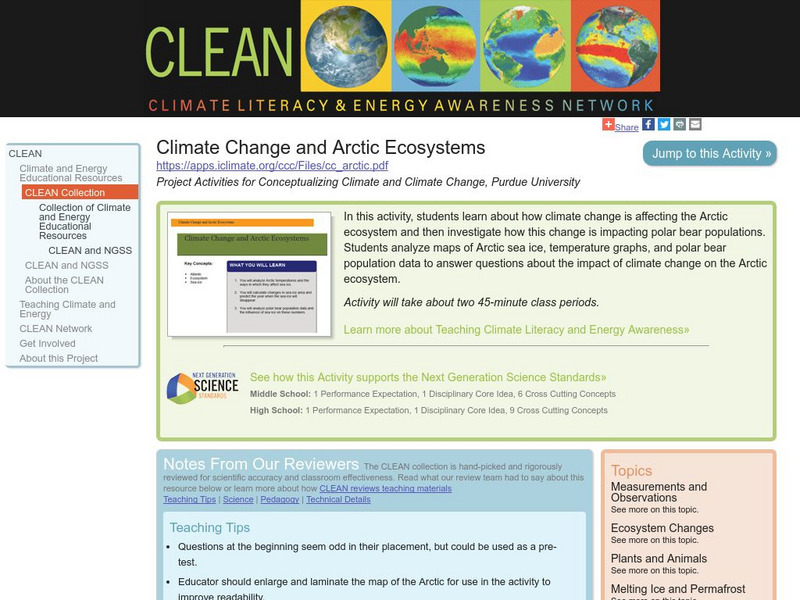
Climate Literacy
Clean: Climate Change and Arctic Ecosystems
Students learn about how climate change is affecting the Arctic ecosystem, and then investigate how this change is impacting polar bear populations. Students analyze maps of Arctic sea ice, temperature graphs, and polar bear population...
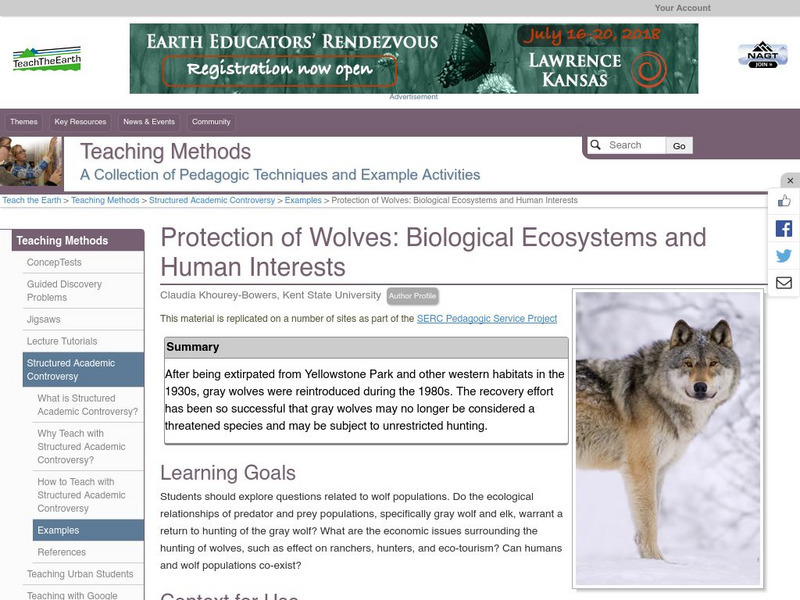
Science Education Resource Center at Carleton College
Serc: Protection of Wolves: Biological Ecosystems and Human Interests
Students will exam the different perspectives on why the gray wolf was reintroduced into many western states during the 1980s, the success of the reintroduction, and the benefits and problems from the recovery of the gray wolf...
Science Education Resource Center at Carleton College
Serc: Eagles in the Ecosystem Classroom Jigsaw Activity
In this in-depth jigsaw activity, students investigate the role bald eagles play in the ecosystem, why they were listed as endangered, the effects of DDT on eagles, and the effects of lead on eagles. Furthermore, students will then graph...
BBC
Bbc: Gcse Bitesize: Adaptations, Interdependence and Competition Aqa
The abundance and distribution of organisms in an ecosystem is determined by biotic and abiotic factors. Animals and plants have adaptations to allow them to compete for resources.
Scholastic
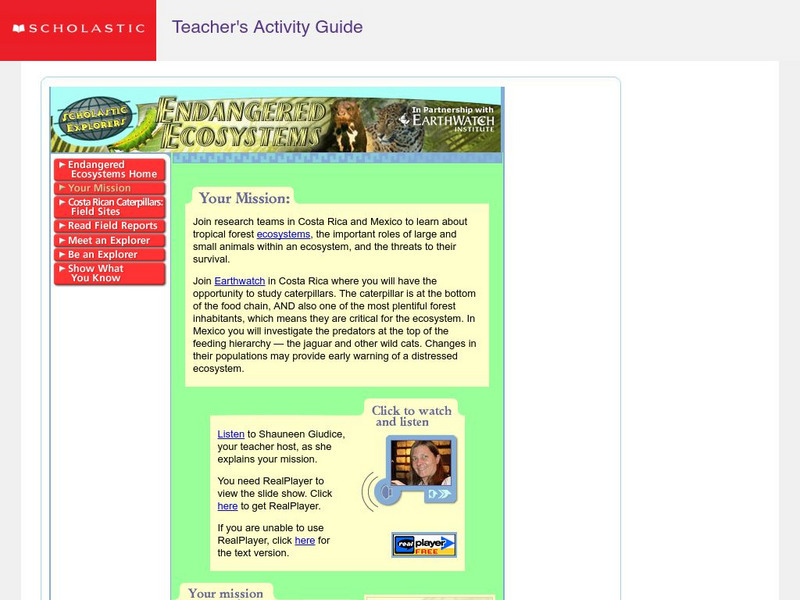
Scholastic: Endangered Ecosystems: Costa Rican Caterpillars
Go on a mission to Costa Rica and Mexico, and explore the state of tropical rain forest ecosystems by examining Costa Rican caterpillars. Learn what the change in this animal's population means for the rest of the ecosystem.
Georgia Department of Education
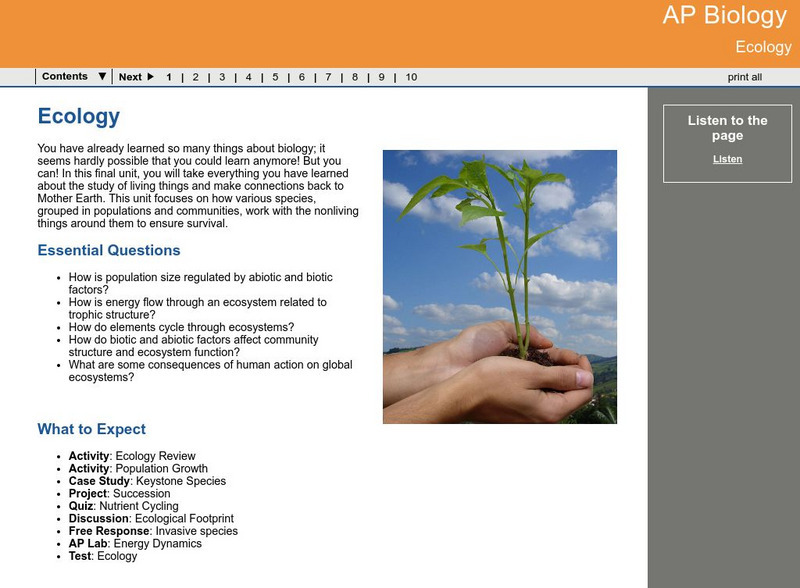
Ga Virtual Learning: Ap Biology: Ecology
Students review the study of living things and make connections back to Earth's systems. This unit focuses on how various species, grouped in populations and communities, work with the nonliving things around them to ensure survival.

ClassFlow
Class Flow: Understanding Ecosystems: Part 1 of 4
[Free Registration/Login Required] Students will get an introduction to ecosystems. They will be able to distinguish nonliving and living thins in a habitat.