Hi, what do you want to do?






College Board
Evaluating Sources: How Credible Are They?
How can learners evaluate research sources for authority, accuracy, and credibility? By completing readings, discussions, and graphic organizers, scholars learn how to properly evaluate sources to find credible information. Additionally,...
Library of Congress
Loc: Teachers: Personal Stories and Primary Sources
Young scholars will explore the value of personal stories and first-hand accounts when exploring history, in this case, the events of the early twentieth century, which included World War I and the Great Depression. Through this...

Internet History Sourcebooks Project
Fordham University: Medieval Sourcebook: History Through Primary Sources
This site from the Medieval Sourcebook answers the question: Why Study History Through Primary Sources? It provides complete information, a list of review questions, and bibliography information.
Lumen Learning
Lumen: Finding and Evaluating Research Sources
This lesson focuses on how to find, evaluate, and use primary and secondary sources using printed and online sources. It provides practice writing activities such as examining the same topic through primary and secondary sources and...
Library of Congress
Loc: History Firsthand: Primary Source Research
History Firsthand has been designed to provide elementary children with experiences which enable them to begin understanding primary sources. Students move from personal artifacts to the vast American Memory collections and learn how...
Other
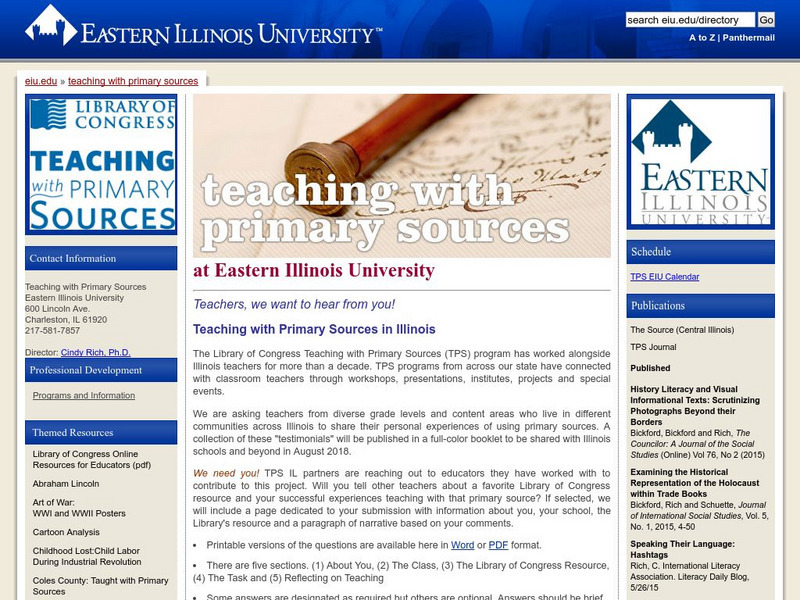
Library of Congress: Teaching With Primary Sources
This website is an excellent resource for teaching with primary sources. This resource features Holocaust lessons, lesson plan strategies, and podcasts.

University of California
Cal Heritage Collection: Using Primary Sources
This resource covers what primary sources are, where we can find them, and how we can assess them in the classroom.
Lumen Learning
Lumen: Research Process: Finding Sources
This lesson focuses on how to find sources including information on research strategies: preliminary, intermediate, and advanced. It provides a variety of resources available in each level including videos: " How To Google Like A Pro!...
Thinkport Education
Thinkport: One Person Can Change the World
In this module, students will read primary and secondary sources about events from the Reformation movement. They will identify the central ideas of the texts, and cite evidence from the text that supports the central idea.
Thinkport Education
Thinkport: Protecting the Rights of the People
Find relationships among primary and secondary sources that identify where information from different sources converges and where it differs.
TeachEngineering
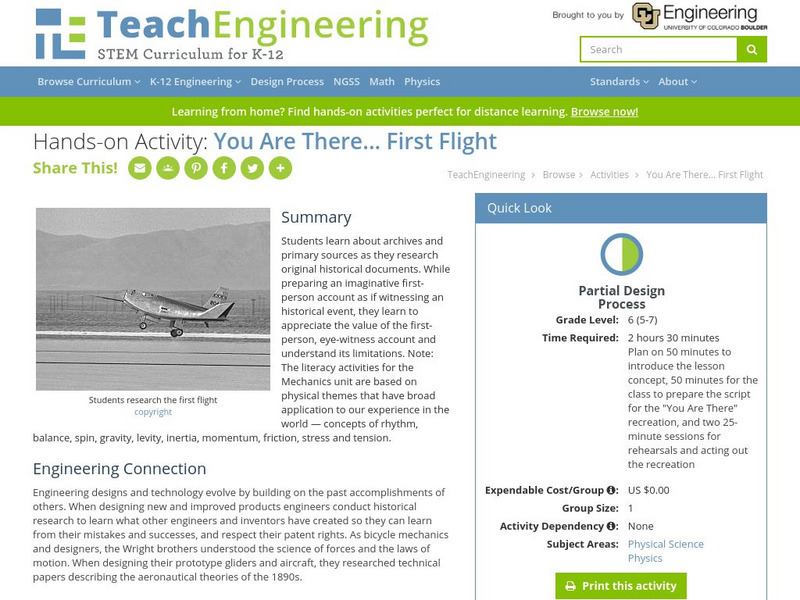
Teach Engineering: You Are There, First Flight
Students learn about archives and primary sources as they research original historical documents. While preparing an imaginative first-person account as if witnessing an historical event, they learn to appreciate the value of the...

National Humanities Center
National Humanities Center: America in Class: The Columbian Exchange
Lesson on the Columbian Exchange and the unintended consequences that resulted. Lesson includes teacher's notes, primary or secondary sources, background, strategies for analysis and Close reading, follow-up assignment and vocabulary.
Library of Congress
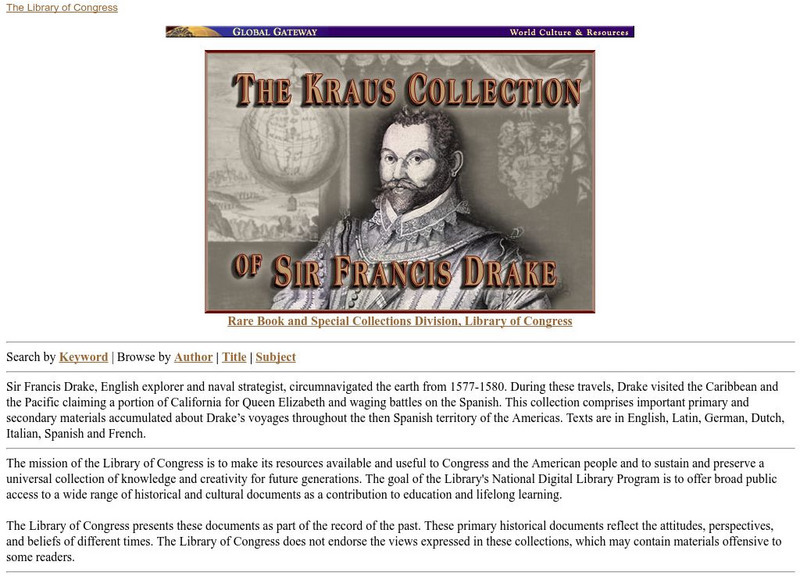
Loc: Global Gateway: Kraus Collection of Sir Francis Drake
From the rare book and special collections of the Library of Congress, presents important primary and secondary source materials by and about Sir Francis Drake.
Other
The Carlisle Indian Industrial School: Research Pages
This is the home page to an extensive site dedicated to the Carlisle School. The site contains primary and secondary source materials. Contains a history of the school, biographies of students, and of the school's most famous student -...
Better Lesson
Better Lesson: Ruby Bridges a Firsthand Account
In this instructional activity, we will read and understand the story "Through My Eyes" by Ruby Bridges. We will then compare and contrast this first-hand account with the secondhand account of "The Story of Ruby Bridges" by Robert Cole....
Curated OER
Mc Graw Hill: Part 1 Reading: Literature: Summarize
Summarizing is a key skill needed in reading comprehension. This page describes how to summarize main ideas in a text. Click on Model button for a model with explanation and then click on Practice (Bottom Right)
E Reading Worksheets
E Reading Worksheets: Patterns of Organization: Compare and Contrast
This learning module provides an explanation of the compare and contrast text structure. An explanation of the compare and contrast text structure is provided, and the compare and contrast text structure is demonstrated in a video...
ReadWriteThink
Read Write Think: Text Features: Non Fiction [Pdf]
Compare the printed page to an electronic web page and use this activity to discuss the similarities and differences. A cross-curricular tie-in with ecosystems. Could easily be adapted to another subject area.