Hi, what do you want to do?






Curated OER
PRIMATE CLASSIFICATION: Evolution, Cladograms,
Learners transfer examples (names) of primates from their location in an outline hierarchy of primate groups into a set of nested boxes reflecting that same hierarchy. A cladogram can then be drawn illustrating how these groups are...

Curated OER
Where Do We Come From? An Introduction to Primate Biology
Seventh graders explore skeletal biology. Through a discussion and video observation, 7th graders investigate how the anatomy is adapted to the environment. Students study primates and explore their characteristics and behaviors.

Curated OER
Molecular Sequences & Primate Evolution: Amino Acids, Hemoglobins in Evolution
Students compare differences in amino acids in the beta hemoglobin from representative primates, complete a matrix of those differences, and from these data, construct and interpret cladograms as they reflect relationships and timing of...

Curated OER
Classification of Intertidal Organisma
Students categorize animals. In this animal classification instructional activity, students group animals by their characteristics. Students break into groups and work together to classify the animals. Students fill out a graphic...

Curated OER
Primate Classification 2006
Students examine groups of hierarchy and see how primates are categorized. For this primate classification lesson students view video and slides then examine the taxonomy of primates.

ARKive
Primate Evolution- Family Ties
If humans evolved from apes, why are there still apes? Using captivating pictures and videos of our primate cousins, young biologists examine evidence to dispel one of the most common misconceptions about human evolution. Depending on...

Curated OER
Nuts & Bolts: is Classification, Arbitrary, Or Not?
Students, in groups, classify furniture, share their categories and rationales, then note how their different schemes vary, perfectly logical and useful, but completely arbitrary.

Curated OER
Invertebrates and Vertebrate Evolution
Students explore the major characteristics of the major animal phyla. They describe adaptive features that have contributed to the success of animals on land. Students explain how primate evolution provides a context for understanding...

Curated OER
What's A Mammal?
Students examine mammals understanding what a mammal is and reviewing the eleven mammal groups. In this science lesson, students play a game known as Mystery Mammal Game. Yet, first students research about the mammal and then give...

Curated OER
Hominoid Skull Comparison
Students are provided with evidence used to support evolutionary theory. They are introduced to classification by using primates as an example. Students read article related to Hominoid Skull Comparison and write a summary about the...

ARKive
Natural Selection- the Peppered Moth
Can human activity cause animals to evolve? Your budding biologists will find out the answer to some of the big questions in natural selection with a peppered moth activity. They will watch a few short videos, look at pictures, and...

Curated OER
Studying Fossils: Hominoid Skull Comparison
High schoolers collect data on the differences in Hominid skulls using acrylic casts of fossil skulls. They measure a series of structures on skulls from six different species then use the data to determine evolutionary relationships...

Curated OER
Cladistics Is a Zip...Baggie
Middle schoolers explore how the grouping of organisms based on their shared derived characters forms the basis of a cladogram.
National Health Museum
Nhm: Restriction Maps to Cladograms Lesson
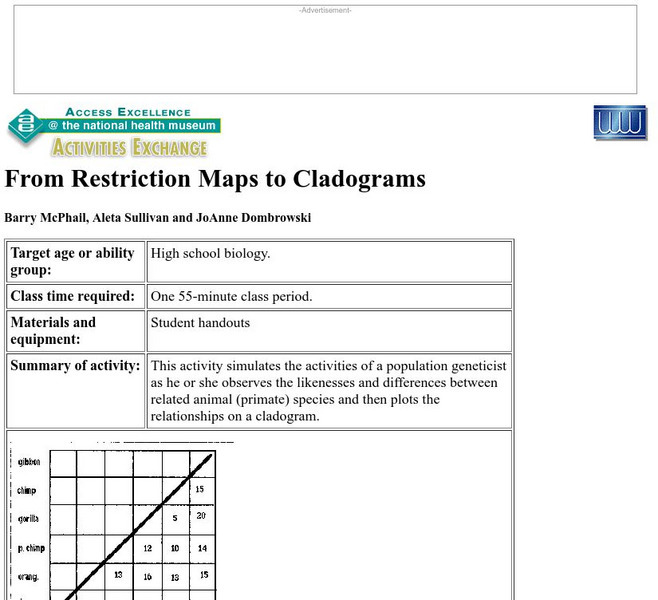
This lesson plan requires young scholars to analyze DNA restriction maps to determine the differences in the sequence for several primates and humans. They then use the information to create a cladogram.