Hi, what do you want to do?





Sophia Learning
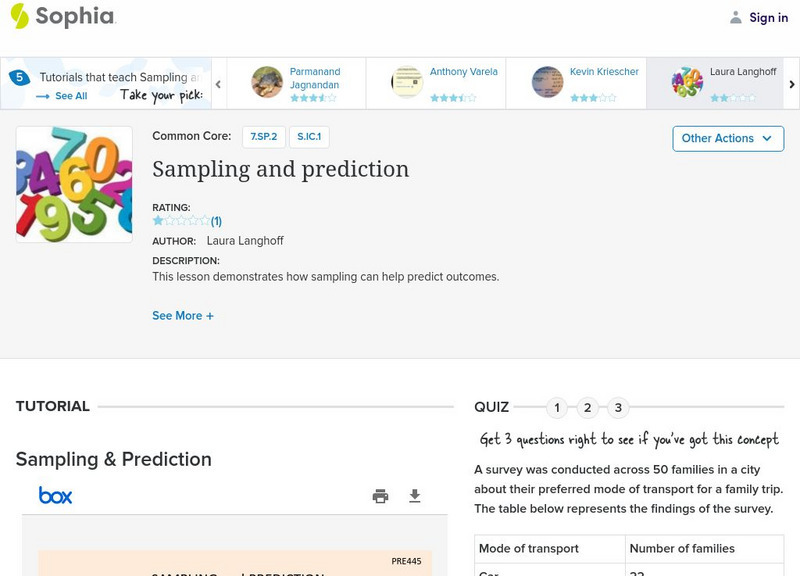
Sophia: Sampling and Prediction: Lesson 1
This lesson demonstrates how sampling can help predict outcomes. It is 1 of 2 in the series titled "Sampling and prediction."
Houghton Mifflin Harcourt
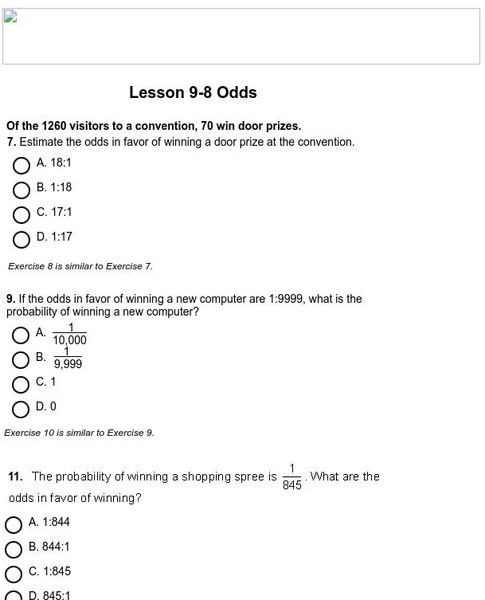
Holt, Rinehart and Winston: Homework Help Independent Practice: Odds
Get independent practice working with odds. Each incorrect response gets a text box explanation and another try. Correct responses are confirmed.
![Pbs Lesson Plan: Chances Are Talking Probability (Pdf) [Pdf] Unknown Type](https://statictemp.lp.lexp.cloud/images/attachment_defaults/resource/large/FPO-knovation.png "Pbs Lesson Plan: Chances Are Talking Probability (Pdf) [Pdf] Unknown Type")
PBS
Pbs Lesson Plan: Chances Are Talking Probability (Pdf) [Pdf]
An introductory lesson in probability for students in grades three to five. The concepts presented in this lesson are interwoven, over time, into a current unit of study. Students examine closely the "language" of probability as used in...

ClassFlow
Class Flow: Odds
[Free Registration/Login Required] In this flipchart students learn to compute odds for and against an event.

ClassFlow
Class Flow: Probability: What Is It?
[Free Registration/Login Required] This flipchart explores the probability that events will occur. Integration of video and graphic arts used to get kids interested in the activity. Practical applications to everyday situations, math...
E-learning for Kids
E Learning for Kids: Math: Fisher Boat: Chance
Captain Jack is going out fishing. Can you help him catch some fish?
Annenberg Foundation
Annenberg Learner: Against All Odds: Inside Statistics
The video series shows students the relevance of statistics in real-world settings. The resource includes 26 half-hour videos. Topics include normal distributions, probability, random variables, experimental design, and describing data.
Illustrative Mathematics
Illustrative Mathematics: 7.sp Rolling Twice
A fair six-sided die is rolled twice. What is the theoretical probability that the first number that comes up is greater than or equal to the second number? Aligns with 7.SP.C.8.
Illustrative Mathematics
Illustrative Mathematics: 7.sp Red, Green, or Blue?
This is a lesson plan for a probability game for two people. Aligns with 7.SP.C.8.
Illustrative Mathematics
Illustrative Mathematics: 7.sp Sitting Across From Each Other
Angie, Bridget, Carlos, and Diego are seated at random around a square table, one person to a side. What is the theoretical probability that Angie and Carlos are seated opposite each other? Aligns with 7.SP.C.8.a.
Illustrative Mathematics
Illustrative Mathematics: 7.sp Stay or Switch?
You are playing a video game. At the end of every level, there are three boxes. One contains 10,000 points, and the other two are empty. You are allowed to choose one of the boxes, but before the one you choose opens, one of the other...
Illustrative Mathematics
Illustrative Mathematics: 7.sp Waiting Times
Suppose each box of a popular brand of cereal contains a pen as a prize. The pens come in four colors, blue, red, green and yellow. Each color of pen is equally likely to appear in any box of cereal. Design and carry out a simulation to...
Better Lesson
Better Lesson: Survey Skills: Assessment
Today we become Gallup Poll central as students take a set of collected data and create a visual representation using the skills that have been taught over the past few lessons.
Better Lesson
Better Lesson: Our Own Surveys
Operation Independence! Students will now take what they have learned from previous data lessons and put it into action. The students will work in pairs of two to decide on a survey question and then collects classmates' responses to...
Better Lesson
Better Lesson: Testing Trail Mix
Create a snack for testing week while practicing division and multiplication.
Better Lesson
Better Lesson: Powerful Protein
The ability to making informed decisions about nutrition is built on using multiplication, division, and an understanding of grams and portion size.
Illustrative Mathematics
Illustrative Mathematics: 7.sp.6 Heads or Tails
Each of the 20 young scholars in Mr. Anderson's class flipped a coin ten times and recorded how many times it came out heads. Aligns with 7.SP.C.6.
Illustrative Mathematics
Illustrative Mathematics: 7.sp.8 Tetrahedral Dice
Many games use dice which are six-sided and fair (meaning each face on the die is equally likely to land face up). Many games also use the sum of two dice rolled at the same time to determine movement of game pieces. However, not all...
Illustrative Mathematics
Illustrative Mathematics: 7.sp.6 Tossing Cylinders
Think about a cylindrical (or cylinder-like) object, such as a bottle lid or a roll of tape. Some possible objects are shown in the picture below. Suppose you were to toss one of these objects into the air and observe their landing...
Illustrative Mathematics
Illustrative Mathematics: 7.sp.7a How Many Buttons?
Look the shirt you are wearing today, and determine how many buttons it has. Then complete the following table for all the members of your class. Aligns with 7.SP.C.7.a.

National Council of Teachers of Mathematics
Nctm: Figure This: Wheel of Fortune's Frequent Letters
Did you know that letter guessing on Wheel of Fortune is based on probability? In this challenge taken from one of TV's most popular game shows, discover what consonant or vowel should be guessed next based on letters already given. A...
Sophia Learning
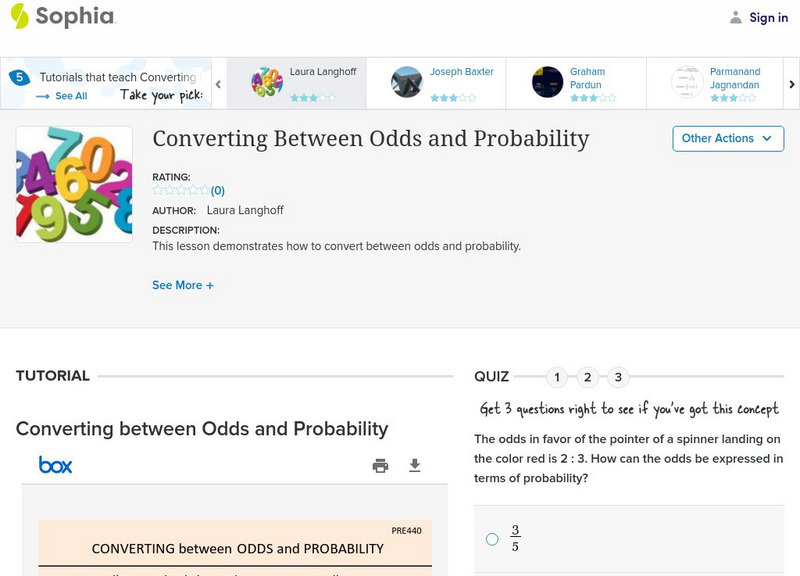
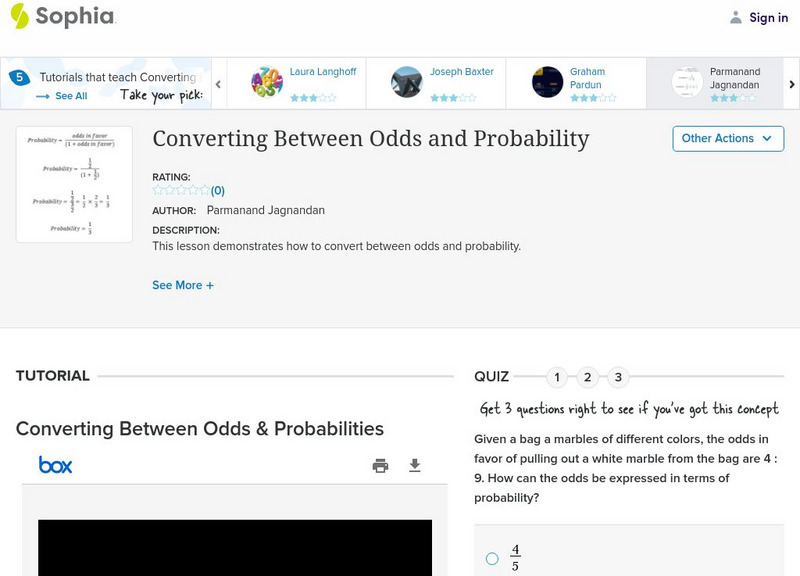
Sophia: Converting Between Odds and Probability: Lesson 1
This lesson demonstrates how to convert between odds and probability. It is 1 of 5 in the series titled "Converting Between Odds and Probability."
Sophia Learning
Sophia: Converting Between Odds and Probability: Lesson 4
This lesson demonstrates how to convert between odds and probability. It is 4 of 5 in the series titled "Converting Between Odds and Probability."
National Council of Teachers of Mathematics
Nctm: Illuminations: Random Drawing Tool
Students are able to to visualize the difference between theoretical and experimental probabilities with this computer based tool.