Hi, what do you want to do?





CK-12 Foundation
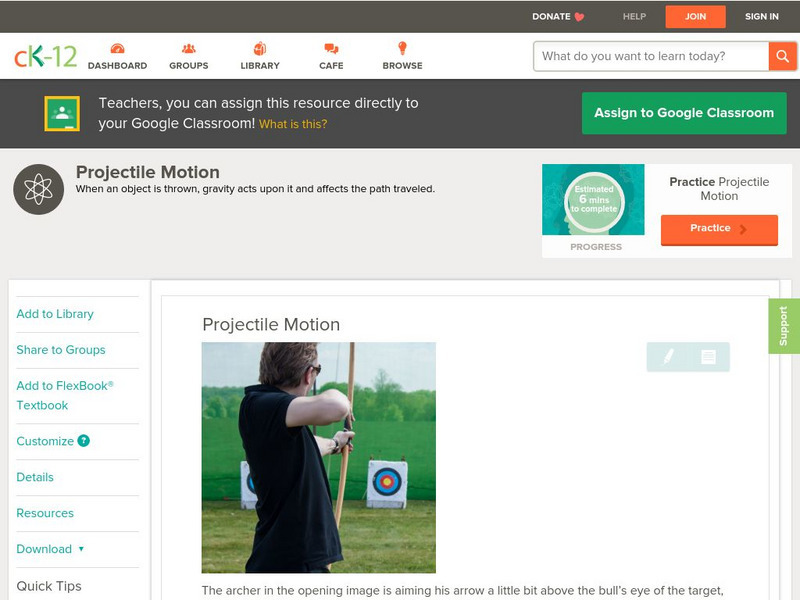
Ck 12: Physical Science: Projectile Motion
[Free Registration/Login may be required to access all resource tools.] Projectile motion and combining forces, examples of projectile motion.

Physics Classroom
The Physics Classroom: Vectors Motion and Forces in Two Dimensions
Three complete tutorials on vectors and two dimension forces and motion. Lessons include informational text, interactive activities, animations, and quick, interactive comprehension checks along the way.
Physics Classroom
The Physics Classroom: Motion/forces in Two Dimensions: Projectile's Trajectory
This illustrated tutorial discusses the horizontal and vertical components of a projectile's motion; specific attention will be given to the presence/absence of forces, accelerations, and velocity.
Science and Mathematics Initiative for Learning Enhancement (SMILE)
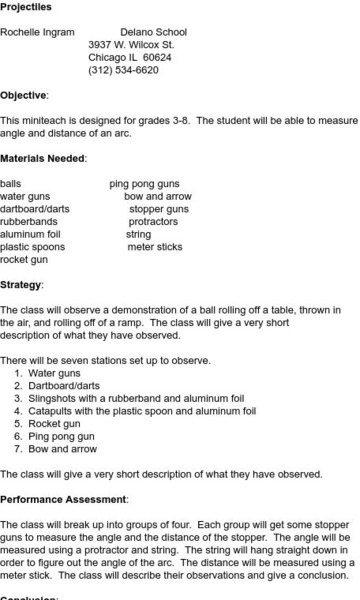
Smile: Projectiles
Lesson plan in which students will observe demonstrations and interact with various objects dealing with projectile motion. Subject matter for intermediate or middle school.
CK-12 Foundation
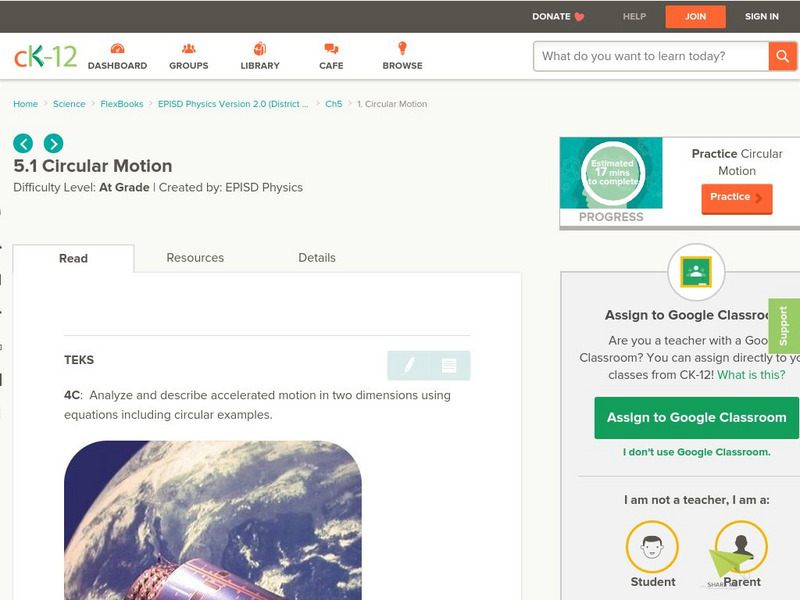
Ck 12: Circular Motion
[Free Registration/Login may be required to access all resource tools.] In the following lesson students will be asked to analyze and describe accelerated motion in two dimensions using equations including circular examples.
Physics Classroom
The Physics Classroom: Horizontally Launched Projectile Problems
In the case of projectiles, students use information about the initial velocity and position of a projectile to predict such things as how much time the projectile is in the air and how far the projectile will go. They do this to make...
Physics Classroom
The Physics Classroom: Motion and Forces in Two Dimensions: What Is a Projectile
Students apply both kinematic principles and Newton's laws of motion to understand and explain the motion of objects moving in two dimensions, more specifically, the motion of projectiles.
Physics Classroom
The Physics Classroom: Circular and Satellite Motion: Principles for Satellites
Students explore how a satellite's motion is governed by the same physics principles and described by the same mathematical equations.
Physics Classroom
The Physics Classroom: Vectors and 2 D Motion Table of Contents
Learners explore vectors, projectile motion, and forces in two-dimension. The tutorial consists of lessons and problems to check for understanding.
TeachEngineering
Teach Engineering: Engineering Out of Harry Situations
Under the "The Science Behind Harry Potter" theme, a succession of diverse complex scientific topics are presented to students through direct immersive interaction. Student interest is piqued by the incorporation of popular culture into...
NASA
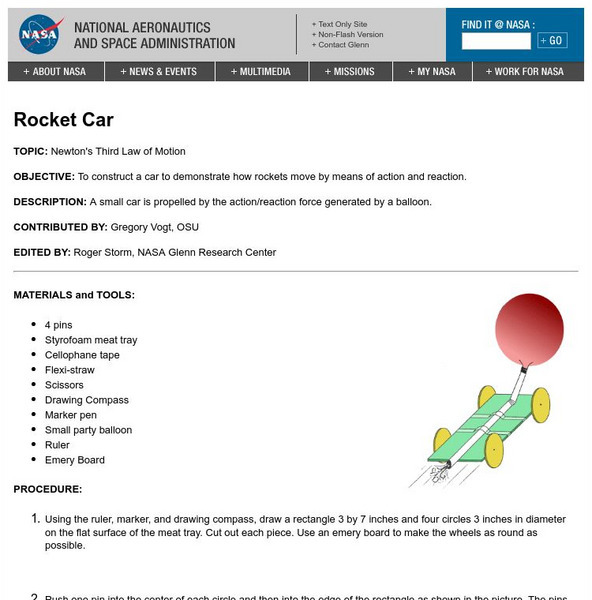
Nasa Glenn Research Center: Rocket Car (Class Activity)
Students discover Newton's Third Law of Motion by constructing a rocket car.
Physics Classroom
The Physics Classroom: Horizontal and Vertical Components of Velocity
Students learn how to describe the motion of projectiles numerically; specifically how the numerical values of the x and y components of the velocity and displacement change with time. Includes animations and interactive simulation.
Physics Classroom
The Physics Classroom: Vectors: Non Horizontally Launched Projectile Problems
In this physics tutorial on vectors, the use of kinematic equations to solve non-horizontally launched projectiles is demonstrated.
TeachEngineering
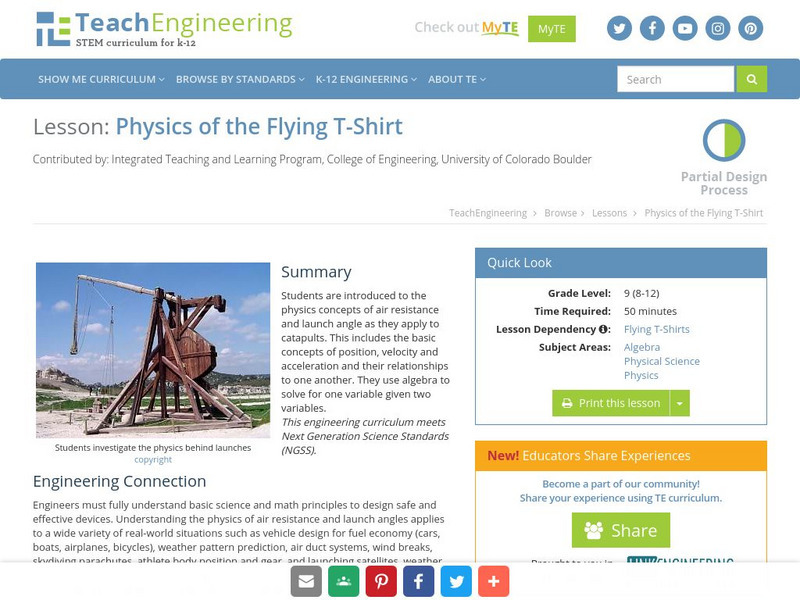
Teach Engineering: Physics of the Flying T Shirt
Students are introduced to the physics concepts of air resistance and launch angle as they apply to catapults. This includes the basic concepts of position, velocity and acceleration and their relationships to one another. They use...
TeachEngineering
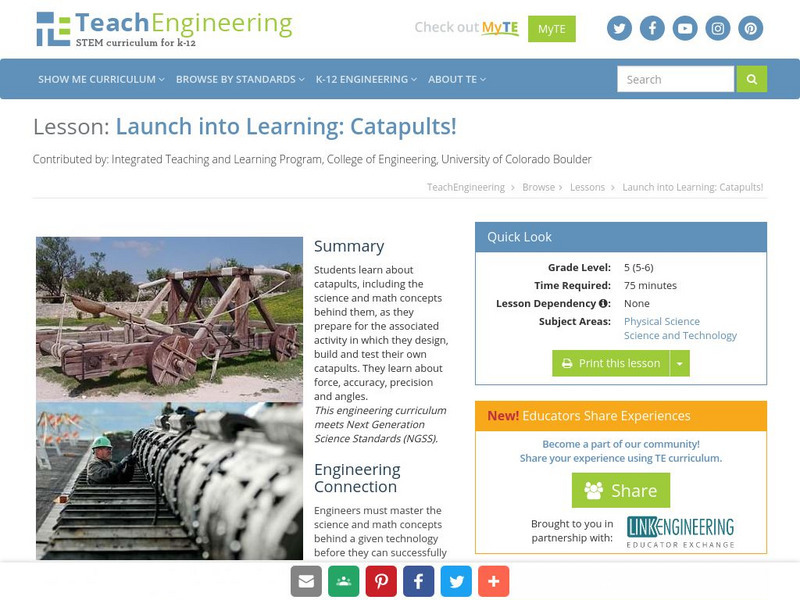
Teach Engineering: Launch Into Learning: Catapults!
Students learn about catapults, including the science and math concepts behind them, as they prepare for the associated activity in which they design, build and test their own catapults. They learn about force, accuracy, precision and...
CK-12 Foundation
Ck 12: Earth Science: Direction on the Earth
[Free Registration/Login may be required to access all resource tools.] Using latitude and longitude to find a location.