Hi, what do you want to do?






Curated OER
Troublesome Towers
Young scholars observe solids and identify parts that make up the surface area. In this geometry lesson, students calculate the surface are of solids and cones. They find polygons and solids in the real world.

Curated OER
Animal Research Project
First graders are introduced to the topic of researching by the librarian. Using a worksheet, they use various sources in the library to choose one animal from various groups. They complete a fact sheet on each animal and report their...

Curated OER
Introduction to Fractals: Infinity, Self-Similarity and Recursion
High schoolers think about several of the concepts from fractals, including recursion and self similarity. They use mathematical concepts of line segments, perimeter, area and infinity are used, and skill at pattern recognition is...

Curated OER
Crafty Fractions
Fourth graders study fractions. In this fractions lesson, 4th graders define fraction-related vocabulary words. Students use beads to study fractions. Students draw shapes to study fraction equivalency and brainstorm fractions they use...

Curated OER
Classifying Rocks
Students classify rocks into groups after they observe the rocks and identify properties that can be used to divide them into groups. They then identify other properties that could be used to classify other objects into groups.

Curated OER
Regions: Meet the Experts Presentation
Learners gather information and create a web site on prairies and plains using a variety of resources, including the internet.

Curated OER
Weather Review
In this weather worksheet, students reviews terms associated with measuring different weather phenomena plus draw examples of different types of fronts on a weather map. This worksheet has 5 true or false, 15 matching, 21 multiple...

Curated OER
Pauli's Magical Water
Students predict the shape of molecules using VSEPR theory. For this chemistry lesson, students differentiate a polar and nonpolar molecule. They discuss why water's polarity is very important.

Curated OER
Paint Plus
Using the computer and the Paint program, Students explore the different tools available in the paint program, and then create a picture showing two sets of pictures and an equation.

Curated OER
Fossil Guide
Students produce a "Fossil Guide" that covers twelve fossils and includes a drawing and written description for each fossil. The written description should include such things as size, shape, and general appearance.

Curated OER
ndirect Measurement Technique: Using Trigonometric Ratios
Ninth graders find the height of an object that would be difficult or impossible to measure directly. They construct and use a Clinometer to measure the angle of elevation (or depression). Students create a sketch of the measurement...

Curated OER
Angles and Parallel Lines
Sixth graders draw parallel and intersecting lines to observe and examine the characteristics of alternate interior angles, vertical angles, corresponding angles, and supplementary angles. Through observation, they discover the...

Curated OER
Malia
Fourth graders begin their examination of the Hawaiian Islands. Using their island bookmarks from a previous lesson, they work together to put the information into a book. They identify the physical and human characteristics of the...

Curated OER
Rock Identification Lab
Eighth graders compare and contrast the three different types of rock. In this earth science lesson, 8th graders classify rock samples according to their correct rock type. They design their own data collection table.

Curated OER
Super Scientists Code
In this science learning exercise, students use the key code on the right to unscramble each of the scientists. They also match each of the scientists found to their correct description.

Curated OER
Investigating Soil
Fourth graders swap local soil samples with another school and examine the differences. They research soil properties, identify organisms that live in soil, create and maintain a biome of soil decomposition and design a poster to present...

Curated OER
Lines, Segments, and Rays
Fifth graders use their arm, toothpicks, and marshmallows to create lines, segments, and rays. In this lines, segments, and rays lesson plan, 5th graders learn how these appear on a plane.

Curated OER
WEAVING TECHNOLOGY INTO THEMATIC UNITS T.O.O.L.S. 2000
Third graders utilize computers and other technology to explain the solar system. Ten different stations involve students through laserdisc, research, art, GeoSafari, space toys, and the computer.

Curated OER
Math Vocabulary Spelling Worksheet
In this math vocabulary worksheet, learners read the math vocabulary definitions and write in the missing letters to the vocabulary words. Students complete 15 words.

Curated OER
Math Vocabulary Decoding Activity
In this math vocabulary activity, learners use a letter key code to match match vocabulary words to their definitions. A reference web site it given for additional activities.

Curated OER
A Chemist in My Class?
First graders in kindergarten science class discuss matter. They make predictions and then identify mystery items in brown paper bags as either solid, liquid, or gas by using their senses. They discuss that a chemist is a scientist that...

Curated OER
Online Interactive Math: Upper Elementary: Mixed Skills
In this online math worksheet, students complete a 20 problem multiple choice online interactive worksheet with mixed skills including geometry, rounding, and three digit multiplication.
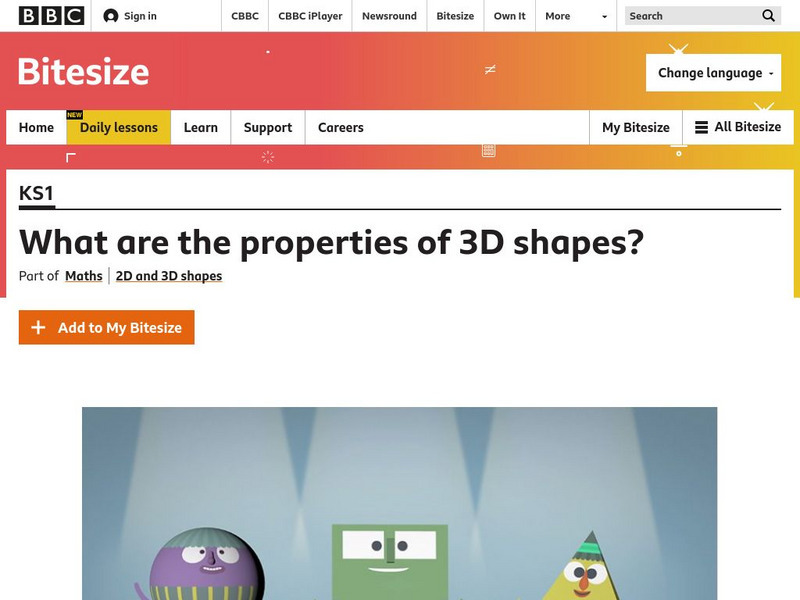
BBC
Bbc: Bitesize: Ks2: What Are the Properties of 3 D Shapes?
Watch a video and complete the activities to learn about the properties of 3D shapes.

Math Is Fun
Math Is Fun: Regular 2 D Shapes
This tutorial provides illustrations for regular 2-D shapes as well as a definition for polygons and for regular polygons.