Hi, what do you want to do?






NASA
States of Matter
Water, one of the basic needs of humans, is found in all three states of matter on Earth; no other planet—that we know of—possesses this quality. Here is a unit that allows learners to explore through experimentation what it...

Columbus City Schools
What’s Up with Matter?
Take a "conservative" approach to planning your next unit on mass and matter! What better way to answer "But where did the gas go?" than with a lab designed to promote good report writing, research skills, and detailed observation....

Steinhardt Apps
Kinetic Molecular Theory
Building off young chemists' knowledge of the states of matter, kinetic molecular theory is the focus of the unit. Eight days of lessons including multiple demonstrations, one lab experiment, directed instruction, and worksheets,...

TED Talks
Ted: Ted Ed: Describing the Invisible Properties of Gas
This video explores how scientists use principles such as gravity to describe and study the properties of gases. [3:27] Followed by a short quiz and a list of additional resources to explore.
CK-12 Foundation
Ck 12: Properties of Matter
[Free Registration/Login may be required to access all resource tools.] In this learning module, students examine differences in physical and chemical properties of solids, liquids, and gases.
CK-12 Foundation
Ck 12: Properties of Matter
[Free Registration/Login may be required to access all resource tools.] In this online tutorial, students will begin to understand a substance according to its physical properties. Learn to distinguish between extensive and intensive...
The Association of the British Pharmaceutical Industry
Abpi: Solids, Liquids, and Gases
Students learn about solids, liquids, and gases in this interactive slide show. Animated cartoon characters explain concepts having to do with properties of matter. A self-checking quiz follows the lesson.

CK-12 Foundation
Ck 12: Fifth Grade Science: Physical Science: Solids, Liquids, and Gases
[Free Registration/Login may be required to access all resource tools.] Explains how to describe matter in the solid state, about the properties of liquid matter and gases, and what the relationship between energy and states of matter is.
Georgia Department of Education
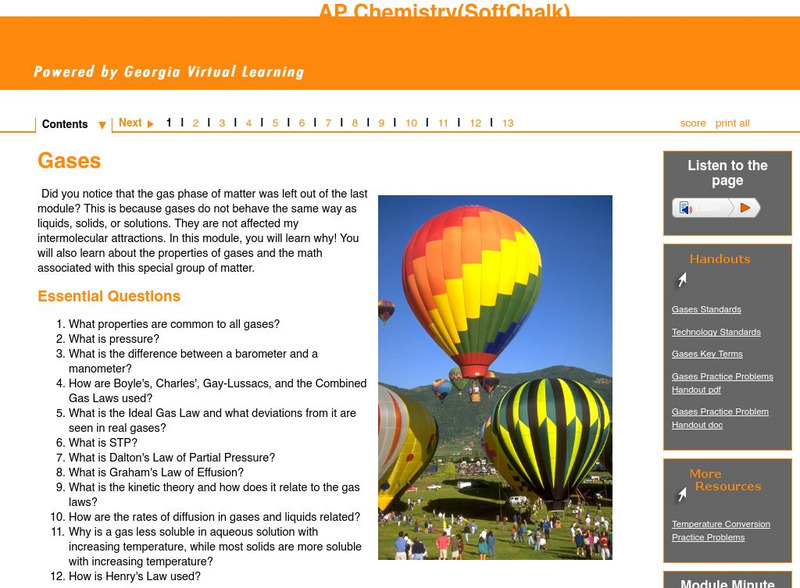
Ga Virtual Learning: Ap Chemistry: Gases
In this module, you will learn why gases are not affected by intermolecular attractions! You will also learn about the properties of gases and the math associated with this special group of matter.
CK-12 Foundation
Ck 12: Gas Properties
[Free Registration/Login may be required to access all resource tools.] The following online tutorial describes how a gas can be compressed and identifies three factors that affect gas pressure. Students will describe the effects...
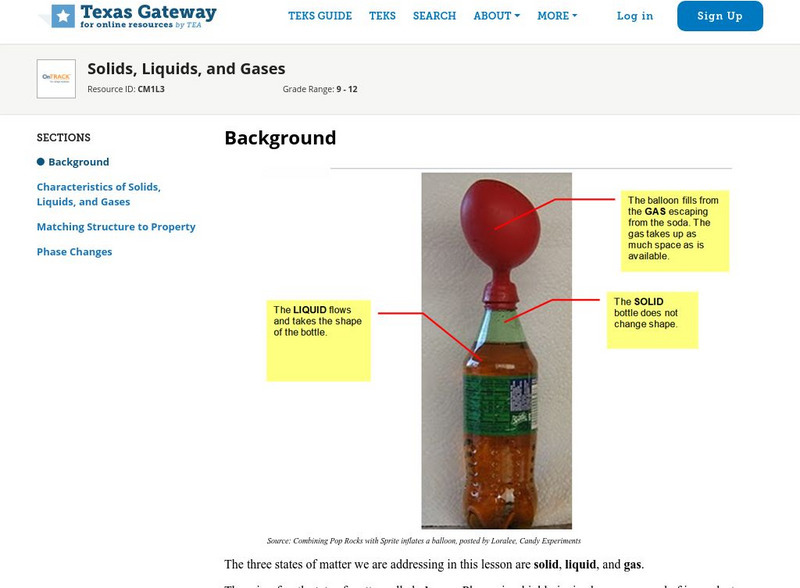
Texas Education Agency
Texas Gateway: Solids, Liquids, and Gases
Given descriptions, scenarios, or illustrations, students will distinguish between the compressibility, structure, shape, and volume of solids, liquids, and gases.
CK-12 Foundation
Ck 12: History of the Periodic Table
[Free Registration/Login may be required to access all resource tools.] In this online tutorial students will begin to explain the use of chemical and physical properties in the historical development of the Periodic Table. They will be...

E-learning for Kids
E Learning for Kids: Norway Fjords: What Are Solids, Liquids and Gases?
The differences between solids, liquids, and gases and the properties of each are presented in this lesson.
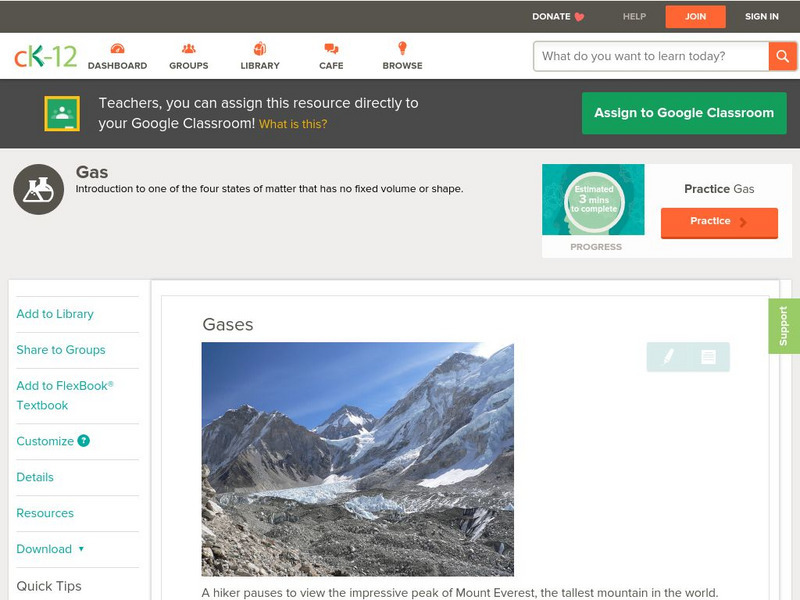
CK-12 Foundation
Ck 12: Physical Science: Gases
[Free Registration/Login may be required to access all resource tools.] Discusses properties of gases, why they exert pressure, and atmospheric pressure.
CK-12 Foundation
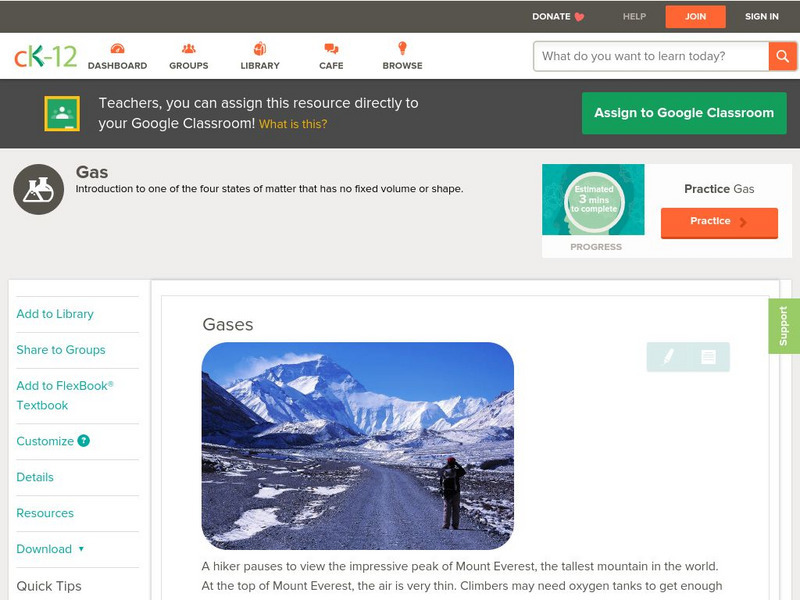
Ck 12: Chemistry: Gases
[Free Registration/Login may be required to access all resource tools.] Properties of gases, why they exert pressure and atmospheric pressure.
Texas Education Agency
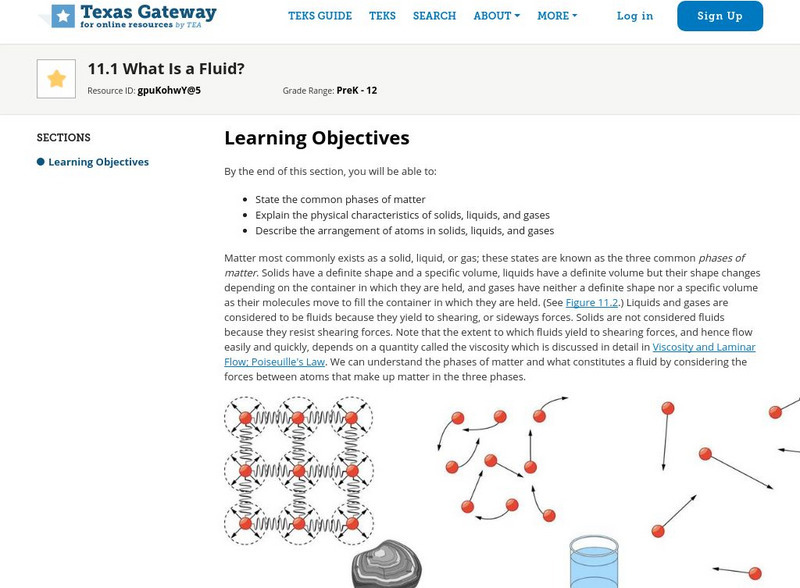
Texas Gateway: Ap Physics: Fluid Statics: What Is a Fluid?
By the end of this section, you will be able to state the common phases of matter; explain the physical characteristics of solids, liquids, and gases; and describe the arrangement of atoms in solids, liquids, and gases.
CK-12 Foundation
Ck 12: Physical Science: Noble Gases
[Free Registration/Login may be required to access all resource tools.] Group 18 elements and their properties.
CK-12 Foundation
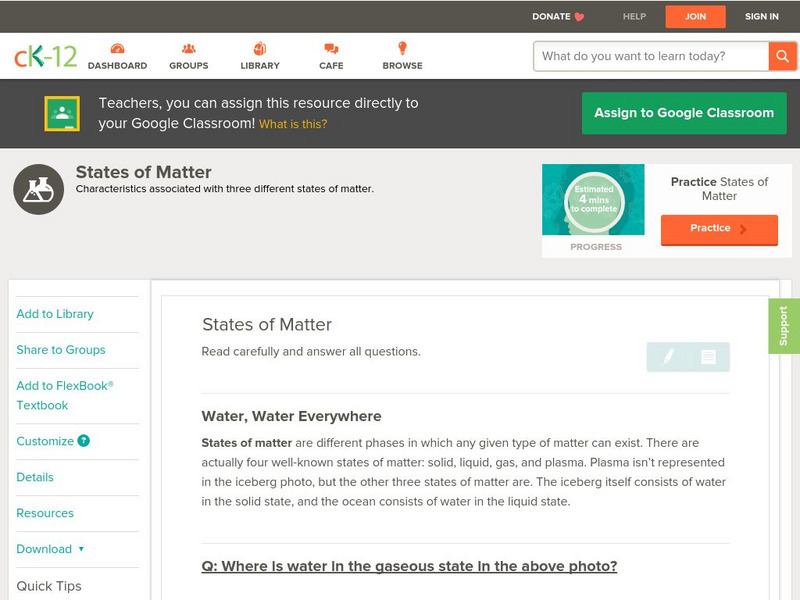
Ck 12: Chemistry: States of Matter
[Free Registration/Login may be required to access all resource tools.] Definition of state of matter and the three common states of matter and their differences.
Chem Tutor
Chem Tutor: Chemistry: States of Matter
This lesson focuses on the states of matter: solids, liquids, and gases. It also discusses the Kinetic Theory of Matter, Thermodynamics, Triple point, Phase Change Graphs and the Heating Curve of Water. It provideds adrawing of a heating...
Other
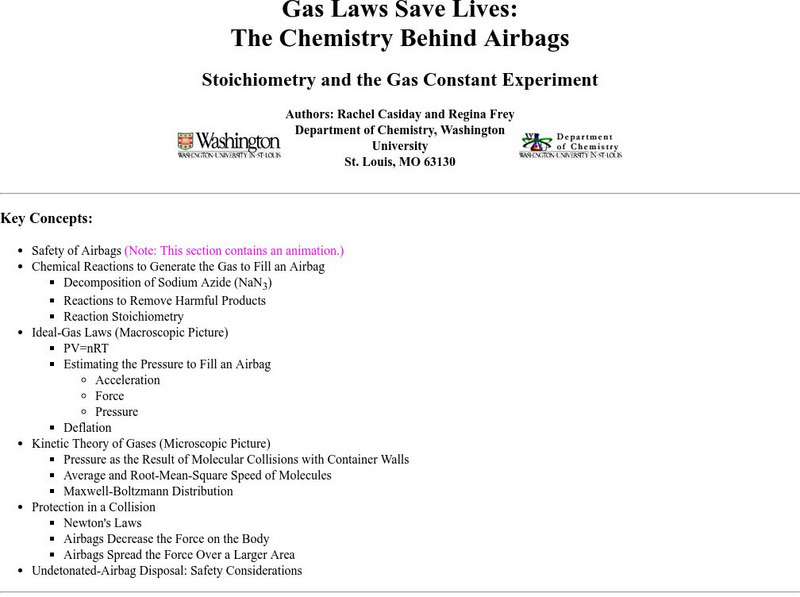
Washington University: Chemistry Behind Airbags
This site from the Chemistry Department at the Washington University provides informaiton on airbags. A lot of gas properties find their way into airbags, and this site goes into a great deal of it. Worth a look for the real world...
OpenStax
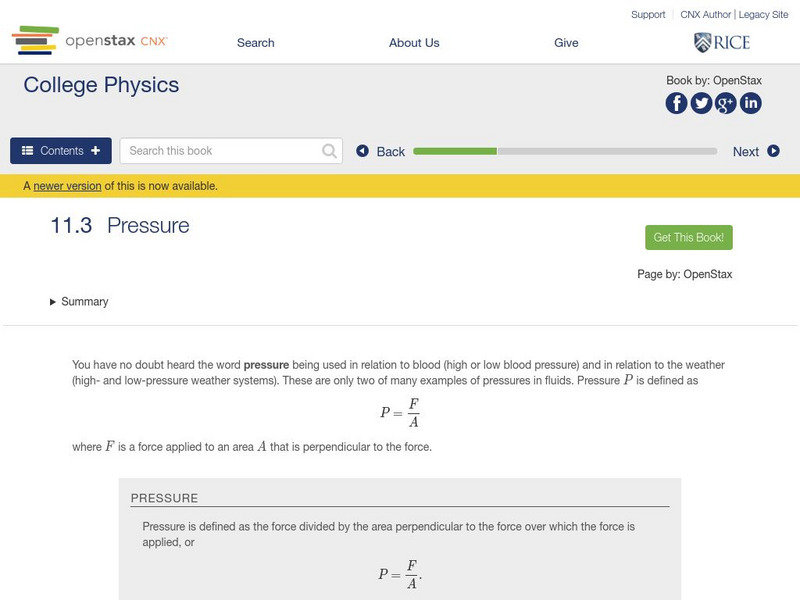
Open Stax: Pressure
From a chapter on Fluid Statics in a Physics textbook. This section of the chapter defines pressure and how it relates to force, as well as how to find the amount of force given area and pressure. Includes questions, problems and...

State University of New York
State University of New York: The Ideal Gas Law
The behavior of gases near room temperature and 1 atm pressure can be described using four main properties: amount, pressure, volume, and temperature. In this simulation the mass, pressure and temperature can be varied.
CK-12 Foundation
Ck 12: Electron Configuration and the Periodic Table
[Free Registration/Login may be required to access all resource tools.] In the following online tutorial students will sse the Periodic Table to identify and explain the properties of chemical families, including alkali metals, alkaline...
PBS
Pbs Learning Media: Global Warming: Carbon Dioxide and the Greenhouse Effect
This video segment adapted from NOVA/FRONTLINE demonstrates the physical property of carbon dioxide that causes the greenhouse effect. Includes background reading and discussion questions. [2:26]