Hi, what do you want to do?





Lawrence Berkeley National Laboratory
Berkeley Lab: Theoretical Models
Resource explores three important nuclear models: Liquid Drop Model, Nuclear Shell Model, and Collective Model.

PBS
Nova: Life's Little Essential
This extensive overview of water describes the unusual properties that make it essential for life.
Science Buddies
Science Buddies: Getting Critical Over Colloids
What is a colloid? If you have made Oobleck out of corn starch and water, then you know that a colloid is a mixture that acts like a solid and a liquid at the same time. This activity helps you determine the critical factors that...
TeachEngineering
Teach Engineering: Wet Pennies
Students conduct a simple test to determine how many drops of each of three liquids can be placed on a penny before spilling over. The three liquids are water, rubbing alcohol, and vegetable oil; because of their different surface...
Science Education Resource Center at Carleton College
Serc: Does It All Add Up?
In this chemistry classroom lab activity, students use critical thinking to investigate the molecular properties of different liquids: rubbing alcohol and water.
Other
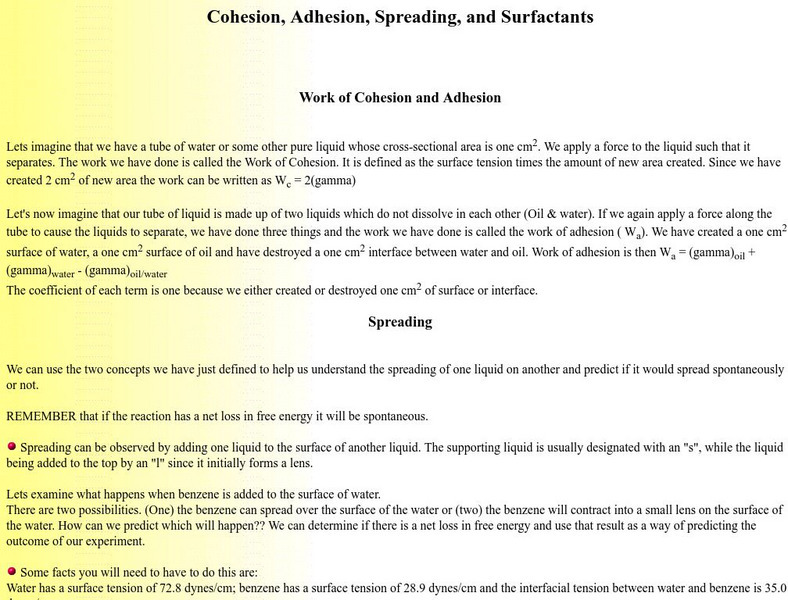
Wilkes Univ.: Cohesion, Adhesion, and Spreading
Wilkes University provides information on the liquid properties of cohesion, adhesion, spreading and surfactants.

PBS
Pbs Teachers: Scientific American: Super People: Getting the Minerals Out
Explore the composition and physiology of bones, describe how humans lose bone mass and explain how this becomes a challenge for extended space flight. Compare and contrast the decalcifying properties of several liquids.
TeachEngineering
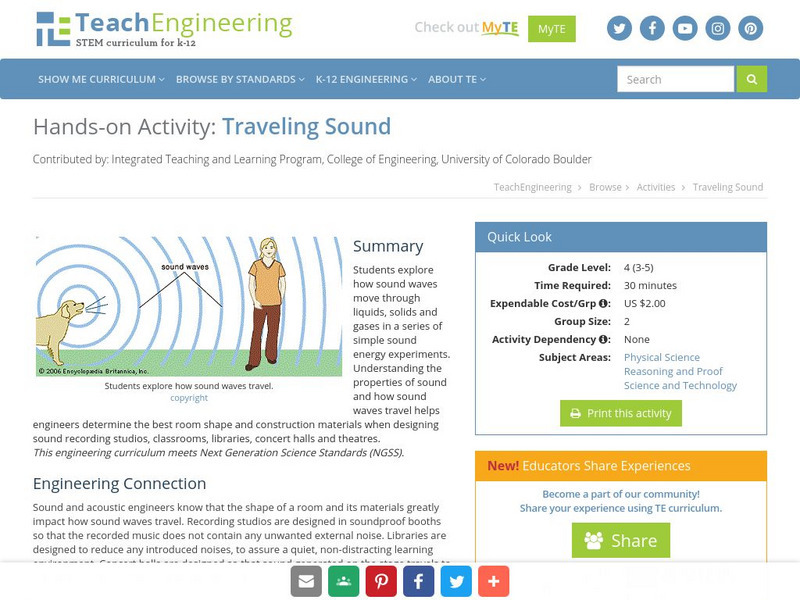
Teach Engineering: Traveling Sound
Students explore how sound waves move through liquids, solids and gases in a series of simple sound energy experiments. Understanding the properties of sound and how sound waves travel helps engineers determine the best room shape and...
Florida-Spectrum Environmental Services
Florida Spectrum: Chemical Fact Sheet: Neon
Detailed information on neon, its properties, history and uses. A good resource for this element.
Web Elements
Web Elements Periodic Table: Mercury
An excellent summary of basic information on mercury, including chemical and physical properties and uses.
Science Education Resource Center at Carleton College
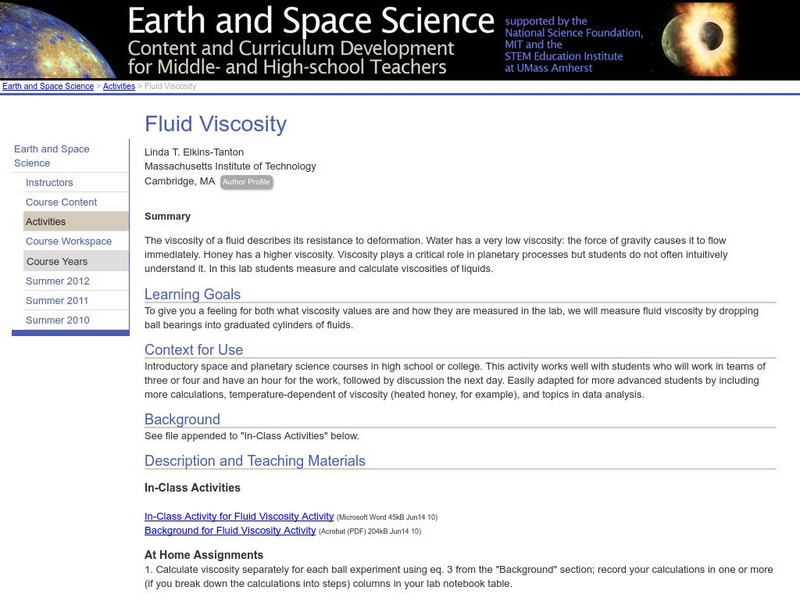
Serc: Fluid Viscosity
To give students a feeling for both what viscosity values are and how they are measured in the lab, they measure fluid viscosity by dropping ball bearings into graduated cylinders of fluids.
Web Elements
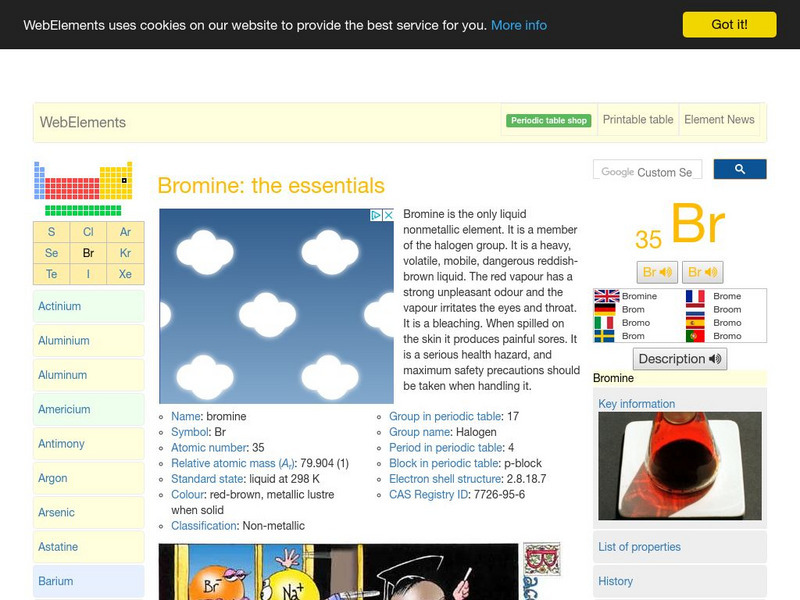
Web Elements Periodic Table: Bromine
An excellent site with a vast amount of information on bromine and its properties.
Read Works
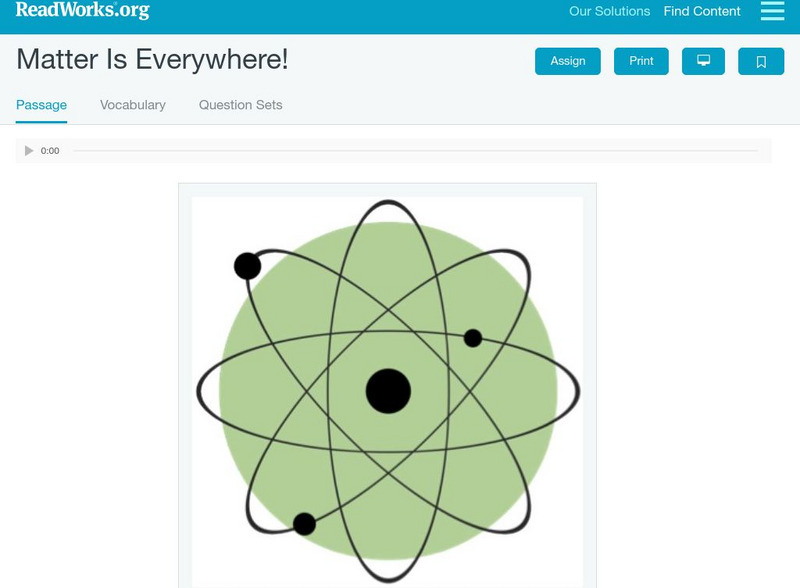
Read Works: Matter Is Everywhere!
[Free Registration/Login Required] An informational text about mass and its properties. A question sheet is available to help students build skills in reading comprehension.

University of Florida
Chem. 2041 Lecture Notes: The Forces Between Molecules
A discussion of the variety of forces which hold molecules together. The relative strengths of these forces for the various states of matter is discussed. The effect of such forces on the boiling points and other phase change...
Science Education Resource Center at Carleton College
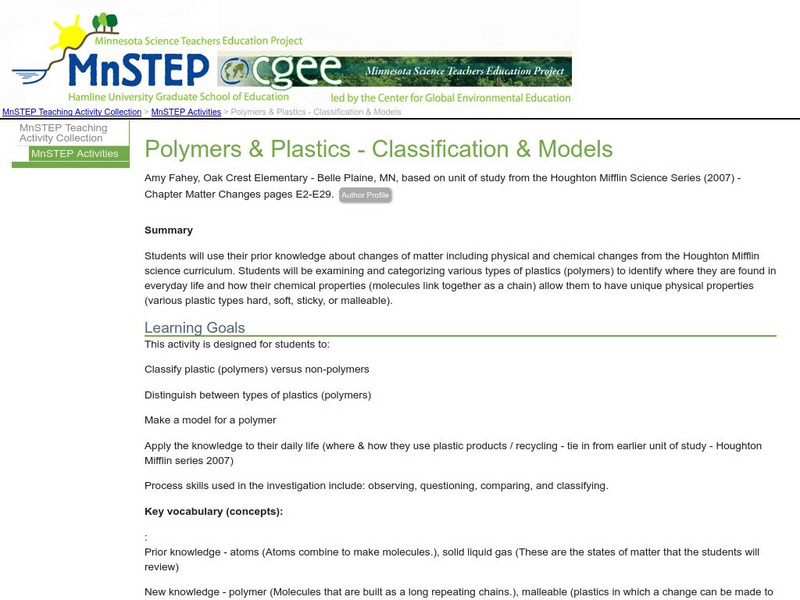
Serc: Polymers & Plastics: Classification & Models
Students will use their prior knowledge about changes of matter including physical and chemical changes to examine and categorize various types of plastics (polymers). They will identify how their chemical properties allow them to have...
Read Works
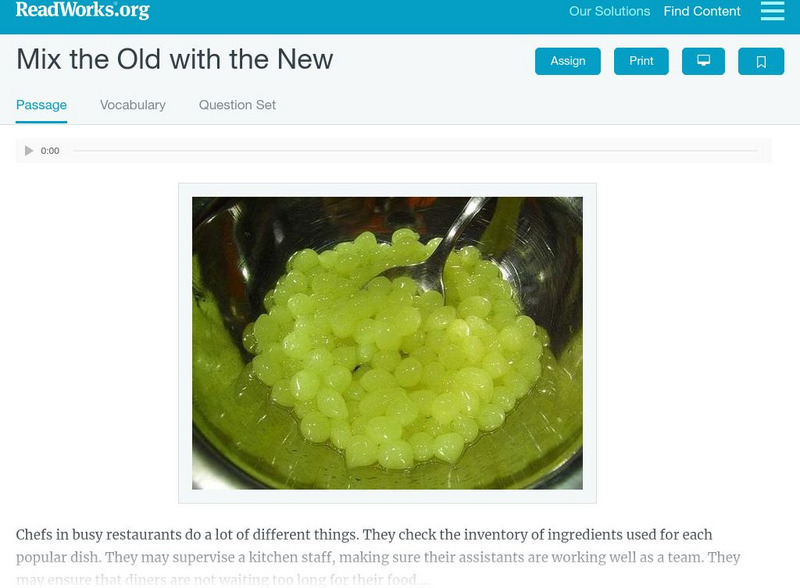
Read Works: Mix the Old With the New
[Free Registration/Login Required] An informational text about how cooking causes changes in matter. A question sheet is available to help students build skills in reading comprehension.

ClassFlow
Class Flow: Gases Around Us
[Free Registration/Login Required] Through this unit children learn that gases are materials and can be distinguished from solids and liquids by their properties. They also learn about the uses of some important gases and where gases can...

ClassFlow
Class Flow: Matter 2nd Grade
[Free Registration/Login Required] Interactive flipchart teaching the states of matter for a 2nd grade classroom containing four topics with several lessons in each one. The topics covered are: matter, solids, liquids, and gases....
Fact Monster
Fact Monster: Adhesion and Cohesion
The forces of adhesion and cohesion are compared and contrasted. Various phenomena which can be explained by such forces are identified and discussed.
TeachEngineering
Teach Engineering: Concentrate This! Sugar or Salt
Students investigate the property dependence between concentrations and boiling point. In Section 1, students first investigate the boiling point of various liquid solutions. In Section 2 they analyze data collected from the entire class...

PBS
Pbs Teachers: Bottle Fountain Experiment
Demonstrate how heating expands air molecules by constructing a bottle fountain powered by air pressure.


PBS
Pbs Teachers: Floating Paper Clips Experiment
Explore surface tension in water by making a paper clip float.