Hi, what do you want to do?






NASA
States of Matter
Water, one of the basic needs of humans, is found in all three states of matter on Earth; no other planet—that we know of—possesses this quality. Here is a unit that allows learners to explore through experimentation what it...

Core Knowledge Foundation
Rocks & Minerals
Take young geologists on an exploration of the rock cycle with this six-lesson earth science unit on rocks and minerals. Through a series of discussions, demonstrations, and hands-on investigations your class will learn...

Curated OER
Density - To Float or Not to Float? That is the Question!
Students investigate how to find the density of fluids and solids using math. Students also learn how to find the density of regular and irregular shaped objects.

Cuemath
Cuemath: 3 D Shapes
Introduces the concept of 3D shapes by learning the definition, types, properties, and three dimensions. Check-out the solved examples for better understanding and try your hand at solving a few interactive questions at the end of the page.
Texas Education Agency
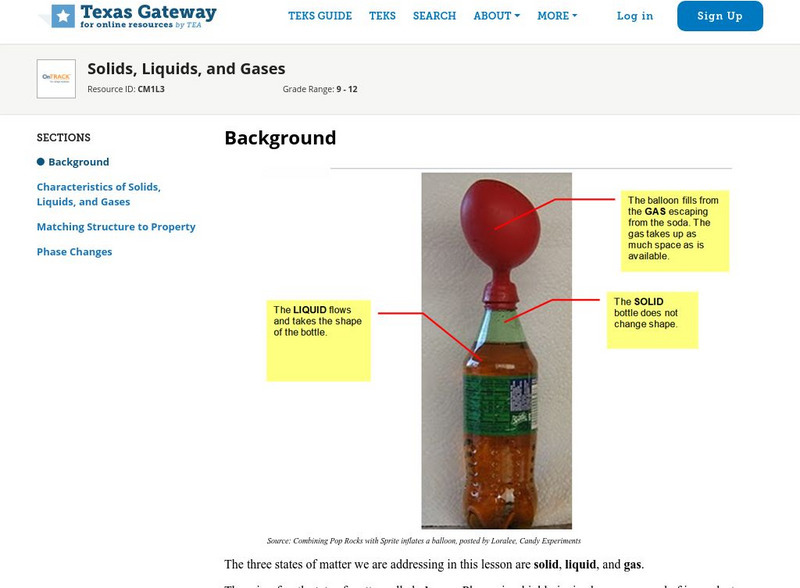
Texas Gateway: Solids, Liquids, and Gases
Given descriptions, scenarios, or illustrations, students will distinguish between the compressibility, structure, shape, and volume of solids, liquids, and gases.
Math Is Fun
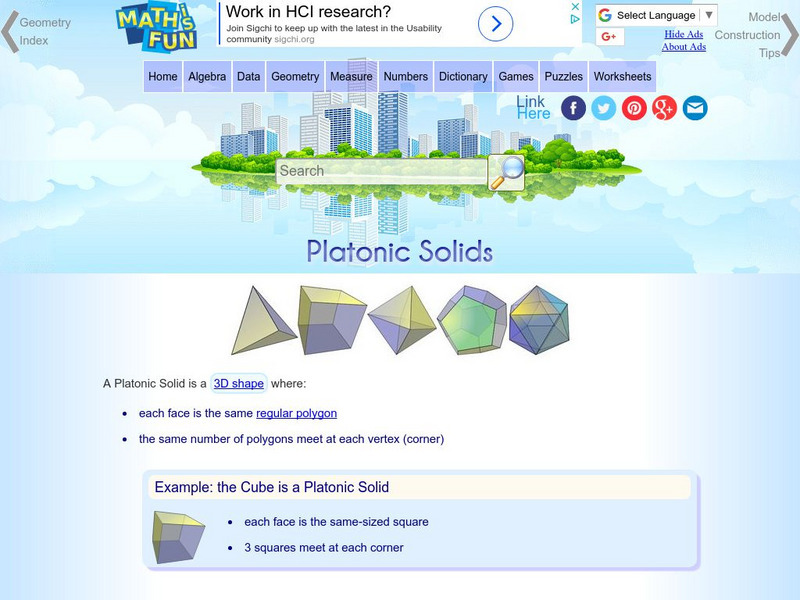
Math Is Fun: Making 3 D Solids
This tutorial features templates and instructions to make the following solids: tetrahedron, cube, octahedron, dodecahedron, and icosahedron.
Cuemath
Cuemath: Cone
Learn all about the basic properties of a cone. This lesson targets the formula, volume, parts, and shapes of a cone and has interesting solved examples and practice questions.
CK-12 Foundation
Ck 12: Fifth Grade Science: Physical Science: Separating Mixtures
[Free Registration/Login may be required to access all resource tools.] Discusses how mixtures of solids can be separated based on observable properties of their parts such as particle size, shape, color, and magnetic attraction.