Hi, what do you want to do?





Lawrence Berkeley National Laboratory
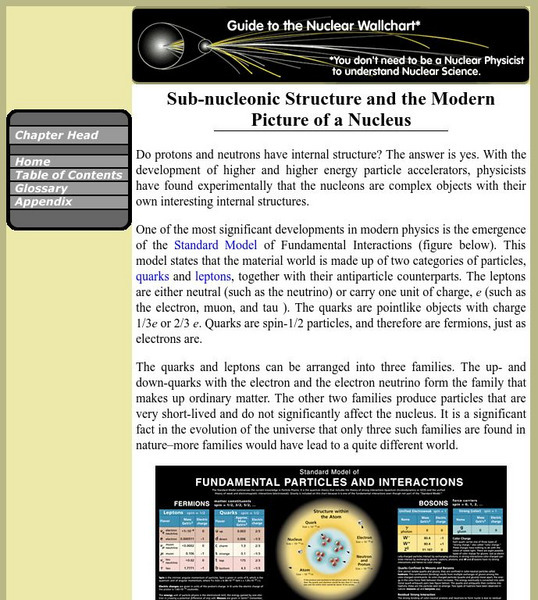
Berkeley Lab: Sub Nucleonic Structure and the Modern Picture of a Nucleus
A simple explanation of the structures theoretically found within protons and neutrons. The resource consists of pictures and links to additional resources.
CK-12 Foundation
Ck 12: Structure of the Atom
[Free Registration/Login may be required to access all resource tools.] Students learn about the important discoveries of subatomic particles, and how they led to our current understanding of the atom.

Annenberg Foundation
Annenberg Learner: Interactives: The Periodic Table
An interactive website where students learn about the basics of an atom, periodic tables organization, and the structure and properties of matter. Module includes an introduction and five lessons that are followed by a quiz and an...
Utah Education Network
Uen: Atom in a Bag
Students will use bags of beads with known quantities of electrons, neutrons and protons to identify the element that they represent.
Science Struck
Science Struck: How Does Radioactive Decay Work?
Explains the processes of radioactive decay in primary and secondary modes.
New York University
New York University: Law of Conservation of Energy
Site presents a straightforward presentation of Rutherford's work concerning the Law of Energy Conservation. Provides an adequate summary of early science on the nucleus, and includes much needed illustrations.
Lawrence Berkeley National Laboratory
Berkeley Lab: Basic Nuclear Science Information
Site provides the ABC's of nuclear science including radioactivity and gamma decay to fission and comic rays.
Utah Education Network
Uen: Atomic Model Construction
Students create models of atoms then compare the various aspects of the atoms including; relative size, charge, positions of subatomic particles, and identity of the atom based on proton, neutron, and electrons with the class.