Hi, what do you want to do?






Curated OER
Pilots, Drivers, and Captains
Students listen to the song, The Wheels on the Bus, then change the words for a boat.

Curated OER
Make Waves
Sixth graders discover, through exploration, the basic characteristics of waves. After a lecture/demo, 6th graders work in groups and participate in a series of labs where they investigate waves. Each group presents its findings to the...

Curated OER
Snakes: Illusions in Locomotion
Students learn how snakes move. In this locomotion lesson, students learn the four main methods of locomotion that snakes use. Students visually create one locomotive movement.

Curated OER
Short Vowel Review
First graders practice short vowel sounds. In this literacy lesson, the teacher demonstrates the short vowel sounds, then guides students through practicing the sounds and making words. Students complete a worksheet for independent...

Curated OER
Forces and Machines
In this forces and machines worksheet, students will review vocabulary associated with forces including friction, inertia, and work. Students will also explain how simple machines help to do work easier. This worksheet has 10 matching, 6...


Curated OER
Locate-a-quake
Student, use seismic readings of the same earthquake from three recording stations and locate the epicenter of an earthquake on a map.

Curated OER
Earthquake!
Students study causes, probability and location of earthquakes. They complete a number of activities and look at web pages to examine the characteristics of earthquakes.

Curated OER
Simple Machines make work easier.
Students examine how simple machine work can make work easier. In this machines instructional activity students complete an activity that shows them what makes up a machine, and how to measure displacement and velocity.

Alabama Learning Exchange
Alex: To Push or Pull, That Is the Question?
In group students will learn to identify pushes and pulls. Students will learn how a push or pull will affect various items. This lesson plan was created as a result of the Girls Engaged in Math and Science University, GEMS-U Project.

Utah STEM Foundation
Utah Stem Action Center: Push or Pull?
This super simple activity for kindergarten-age learners requires no materials and can be done inside or outside, or both and explores forces and motion.

University of Colorado
University of Colorado: Ph Et Interactive Simulations: Forces and Motion: Basics
See how forces affect various items that are pushed or pulled.
The Wonder of Science
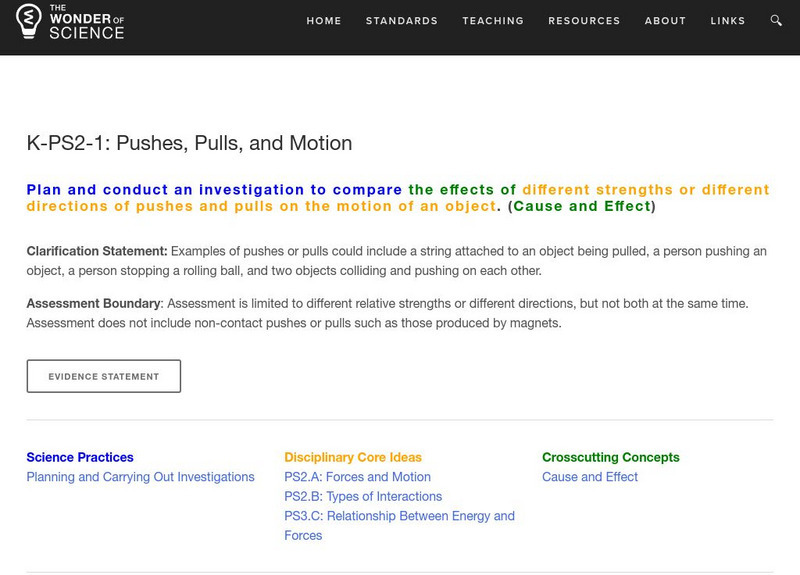
The Wonder of Science: K Ps2 1: Pushes, Pulls, and Motion
Teaching students about pushes, pulls, and motion? Use this site to plan lessons for students to conduct investigations to compare the effects on the motion of an object when pushes or pulls come from different directions or strengths.
Science Education Resource Center at Carleton College
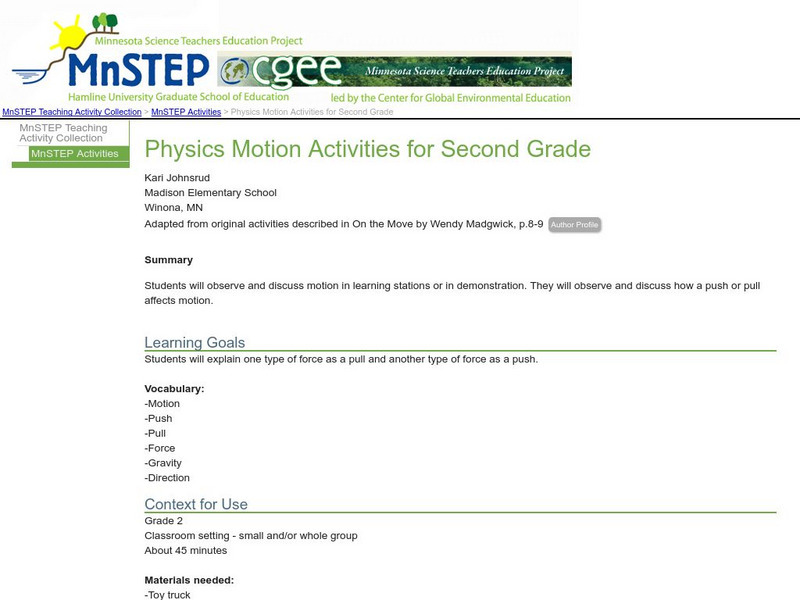
Serc: Physics Motion Activities for Second Grade
A lesson plan for stations that allow students to explore how a push or pull affects motion.
Utah Education Network
Uen: Forces & Motion With Simple Machines
Third graders will sort simple machines according to an applied force --push or a pull.
The Wonder of Science
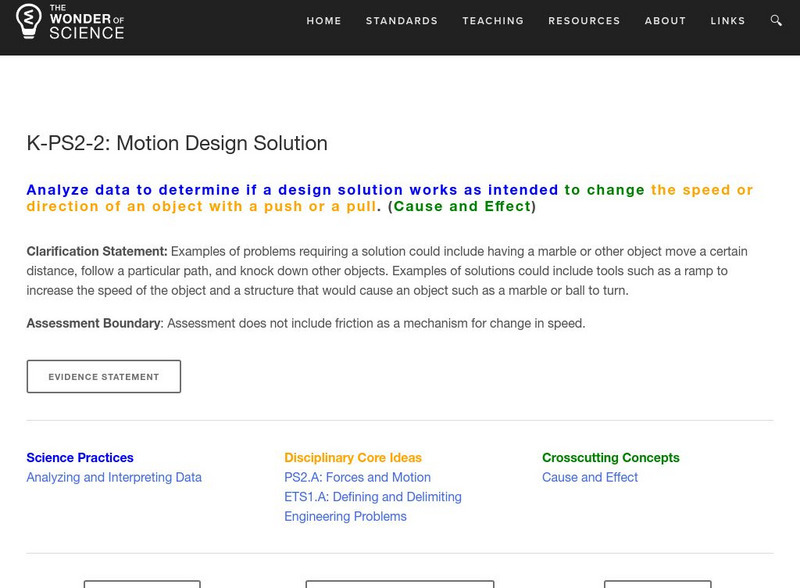
The Wonder of Science: K Ps2 2: Motion Design Solution
The NSTA vetted source includes resources to teach how to analyze data to determine if a design solution works as intended to change the speed or direction of an object with a push or a pull. Included are assessment ideas, videos,...

E-learning for Kids
E Learning for Kids: Science: Indian Ocean: What Kind of Natural Forces Do We Recognize?
Learn about forces (push or pull), gravity, and friction in this module by training dolphins.
University of Colorado
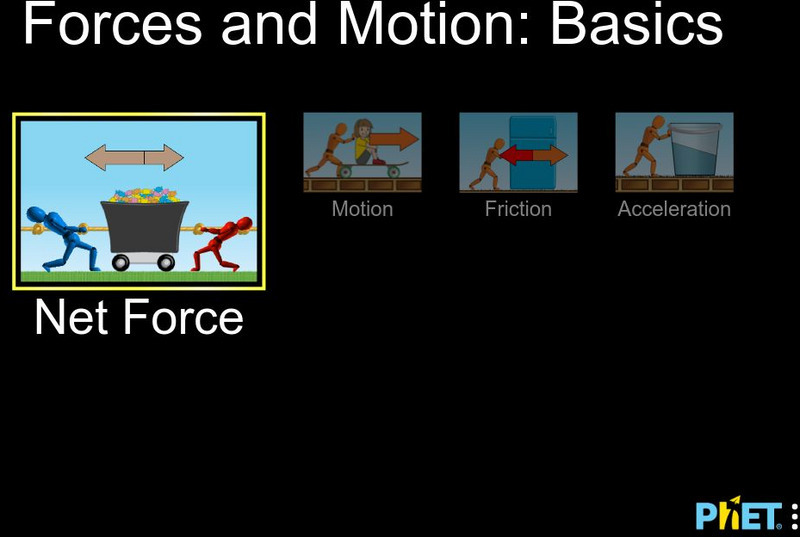
University of Colorado: Ph Et Interactive Simulations: Forces and Motion: Basics
Explore the forces at work when pulling against a cart, and pushing a refrigerator, crate, or person. Create an applied force and see how it makes objects move. Change friction and see how it affects the motion of objects.
Other
Bscs: Forces and Motion Content Background Document
In this document, we will try to answer a fundamental question of physical science, "Why do things start to move, slow down, speed up, stop moving or change direction?" In answering these core questions we can develop concepts that can...

E-learning for Kids
E Learning for Kids: Science: Egypt: What Can Forces Do?
A learning module reviewing how much force is needed to push or pull objects. Also learn about the force of gravity.
Science Education Resource Center at Carleton College
Serc: Identifying the Force Used to Put Sports Equipment Into Motion
Children discuss, observe, and play with equipment used in familiar sports, and then brainstorm a list of familiar sports and the equipment used in the sports. They discuss how the equipment is used, and predict how it is put into motion...
Better Lesson
Better Lesson: Exploring Force and Motion
Students will explore what they can do with balls, cars, marbles, and ramps and document findings in their science journals. This will engage their curiosity, allow them to make self-discoveries, and explore self-interests.
Other
Bscs: Forces Lesson 1: What Makes Something Start to Move?
Through hands-on activities, this lesson will show students that a force is a push or a pull and forces cause changes in motion. Included are a minute-by-minute lesson plan, activities, and teacher discussion points and questions.
Concord Consortium
Concord Consortium: Spring and Mass Model
An interactive tool where students can explore how a spring behaves, and how changing the elasticity, mass, push/pull force, and friction affect its motion or period. As the spring moves, its motion is shown on a distance-time graph.