Hi, what do you want to do?






EngageNY
Modeling with Quadratic Functions (part 2)
How many points are needed to define a unique parabola? Individuals work with data to answer this question. Ultimately, they determine the quadratic model when given three points. The concept is applied to data from a dropped...

EngageNY
Using the Quadratic Formula
What is the connection between the quadratic formula and the types of solutions of a quadratic equation? Guide young mathematicians through this discovery as they use the discriminant to determine the number and types of solutions,...

Mathematics Vision Project
Module 7: Structure of Expressions
The structure of an expression is a descriptive feature. Learners build a solid understanding of quadratic functions using an analysis of expressions in different forms. The seventh module in a series of nine includes 12 lessons...

Curated OER
Discovery Research of Quadratics
Students investigate the properties behind the quadratic equation. In this algebra lesson, students identify quadratic equation in the real world. They graph the parabola and identify the vertex and intercepts.

West Contra Costa Unified School District
Introduction to Inverse Functions
Ready to share the beauty of the inverse function with your classes? This algebra II lesson plan guides the discovery of an inverse function through a numerical, graphical, and an algebraic approach. Connections are made between the...

EngageNY
Overcoming a Third Obstacle to Factoring— What If There Are No Real Number Solutions?
Time for pupils to use their imagination! Learners examine the relationship between a system with no real solution and its graph. They then verify their discoveries with algebra.

CK-12 Foundation
Horizontal Translations or Phase Shifts: Horizontal Translations
Find out what causes a function to slide. Pupils move a function along the x-axis and see the resulting change in its equation. Scholars determine the effects that the translation has on the intercepts, domain, and range of the function.

5280 Math
Pythagorean Triples
From Pythagorean triples to the unit circle. Learners use the Pythagorean Theorem to find Pythagorean triples and then relate their work to the unit circle in a fun algebra project. Their discovery that x^2+y^2 is always equal to one on...

Yummy Math
Playing with my calculator on the 4th of July
This fun activity guides learners through an exploration of the effects of replacing f(x) with -f(x), f(x) + c, k f(x), and f(x + c). Using graphing calculators, students experiment with variations of the graph of y = x^2 to design a...

Curated OER
Let's Look at Those Roots!
In this root learning exercise, students determine the roots of given quadratic equations. They solve algebraically or by graphing. This one-page learning exercise contains 8 problms.

West Contra Costa Unified School District
Writing Exponential Functions Based on Data
Give your class a concrete example of exponential growth and decay using this hands-on activity. These Algebra II lessons allow for the exploration of exponential growth and decay models, as well as the discovery of the patterns of...

Curated OER
Podcasting Parabolas
Students explore parabolas. In this algebra and technology lesson, students construct the equation of a specific parabola, then take digital photos of real-life representations of these parabolas. Students create a podcast...

Curated OER
Two Investigations of Cubic Functions
Through learning about cubic functions, students graph cubic functions on their calculator. Students determine the local maximum and minimum points and the tangent line from the x-intercept to a point on the cubic function. ...

Virginia Tech
Unit Plan: Exponential and Logarithmic Functions
A six-day unit for algebra II on exponential and logarithmic functions builds upon Chapter 12 of Merrill Algebra II with Trigonometry; Applications and Connections. The text provides assistance in the depth of instruction...
Discovery Education
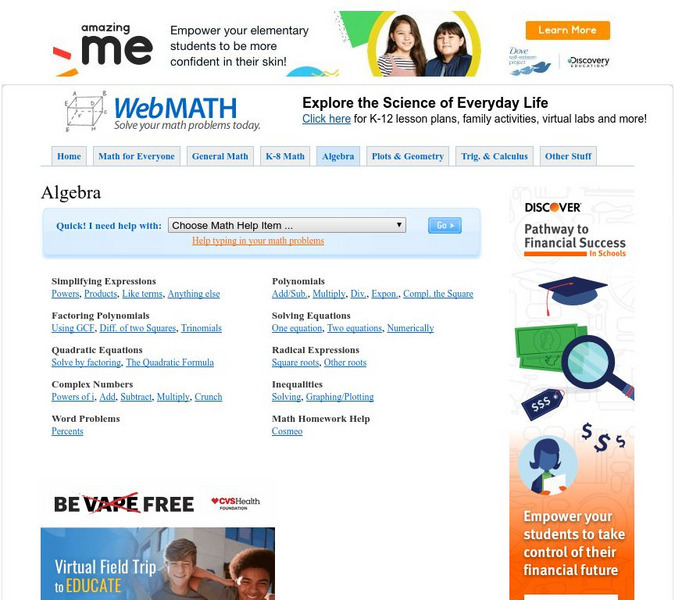
Discovery Education: Web Math: Algebra
This WebMath site provides links to tutorials and lessons in both Algebra I and II. Links to topics such as factoring, solving equations, polynomials, simplifying equations, graphing, and much more.