Hi, what do you want to do?






University of St. Andrews (UK)
University of St. Andrews: The Quantum Age Begins
This University of St. Andrews page provides an interesting discussion of the beginning of the age of quantum physics. (Quantum physics/mechanics is thought to govern the energy levels of electrons in atoms.) There is a references link...

Other
Particles, Special Relativity and Quantum Mechanics
Quantum physics, despite its inherent weirdness, is thus far the best model physicists have for explaining the universe. This site gives a great overview of the principles of quantum mechanics and gives scenarios to help the reader...

Concord Consortium
Concord Consortium: Stem Resources: Quantum Tunneling
A learning module with built-in interactive features where students can explore the fascinating topic of matter tunneling through a barrier. They will learn how electron waves can sometimes manage this, devices that use this concept, and...

Khan Academy
Khan Academy: The Quantum Mechanical Model of the Atom
Introduction to the quantum mechanical model of the atom: Thinking about electrons as probabilistic matter waves using the de Broglie wavelength, the Schrodinger equation, and the Heisenberg uncertainty principle. Electron spin and the...

TED Talks
Ted: Ted Ed: How Quantum Mechanics Explains Global Warming
You've probably heard that carbon dioxide is warming the Earth. But how exactly is it doing it? Lieven Scheire uses a rainbow, a light bulb and a bit of quantum physics to describe the science behind global warming. [5:01]

National High Magnetic Field Laboratory
Magnet Academy: Low Temperature Physics
Why do physicists want to study things at temperatures so cold atomic motion almost comes to a halt? And how do they create such frigid environments, anyway? Read on for the what, how and why of low temperature physics.
Famous Scientists
Famous Scientists: Hans Bethe
Find out about Hans Bethe, one of the founders of quantum physics.
University of Colorado
University of Colorado: Physics 2000: Elements as Atoms: The Pauli Exclusion Principle
The Pauli Exclusion Principle shows how electrons fill atomic orbitals. Includes biographical information on Wolfgang Pauli.
University of Colorado
University of Colorado: Physics 2000: The Pauli Exclusion Principle
This site from the University of Colorado at Boulder has great information on the Pauli Exclusion Principle. Pictures are provided along with links to additional information. The information provided is not in-depth and it is...
Duke University
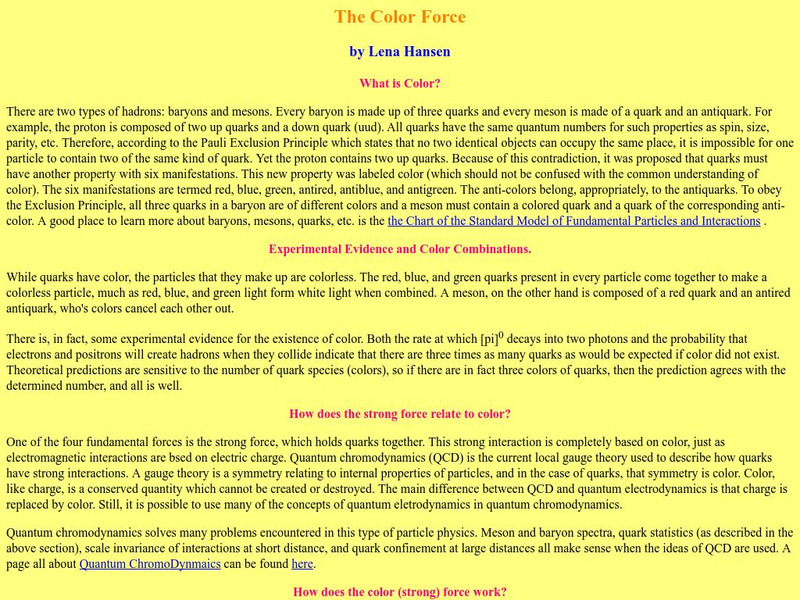
Duke University: The Color Force
What does color have to do with particle physics? This page explains the concepts of color and the color force, which are fundamental subjects in quantum chromodynamics.

PBS
Science Odyssey: Heisenberg States Uncertainty Principle
Explains the Heisenberg Uncertainty Principle, that it is impossible to know both the momentum and position of an electron, along with describing the impact that it made upon the scientific community upon its introduction in 1927.
Science Struck
Science Struck: Biography of Albert Einstein
The life and many accomplishments of Albert Einstein are detailed in this article. Includes descriptions of his scientific theories and contributions.
Science Buddies
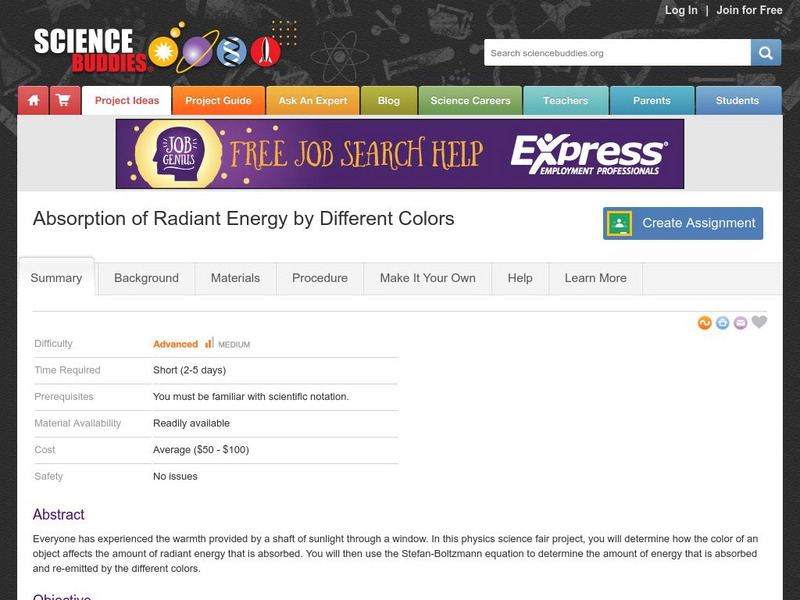
Science Buddies: Absorption of Radiant Energy by Different Colors
In this science fair project, use an infrared thermometer to measure the temperature of differently colored paper exposed to sunlight, and calculate energy emission using the Stefan-Boltzmann equation. Find discussion questions, a list...
Cosmo Learning
Cosmo Learning: Introduction to Astrophysics
A collection of audio lectures from an introduction to astrophysics course taught at the University of California, Berkeley. The course discusses the solar system, stars, quantum mechanics, gravitation, and cosmology focusing on how...
My Hero Project
My Hero: Stephen Hawking
Use this resource to learn about Stephen Hawking's famous contributions to the world of science and science theory despite his crippling battle with Lou Gehrig's disease.