Hi, what do you want to do?






Perkins School for the Blind
Conservation of Mass
How do you teach a student with visual impairments about the conservation of mass? You use tactile models that represent the theoretical concept. Baking soda and vinegar are used to add gas to a deflated balloon. Learners will feel the...

Royal Society of Chemistry
Mass Changes in Chemical Reactions—Microscale Chemistry
What better way is there to introduce conservation of mass than a few simple experiments? Young chemists conduct two chemical reactions, take the masses of reactants and products, then compare their results to determine...

Royal Society of Chemistry
A Giant Silver Mirror Experiment
Mirror, mirror, on the wall ... who's the best chemistry teacher of them all? You'll get the vote for certain after your class completes the Silver Mirror experiment! Partnered pupils use Tollen's reagent and glucose to silverplate a...

University of Colorado
University of Colorado: Ph Et Interactive Simulations: Reactants, Products and Leftovers
An interactive simulation that teaches about chemical reactions and limiting reactants by creating sandwiches to represent chemical reactions. See how many can be made using different amounts of reactants. This simulation can either be...
Chemistry Collective
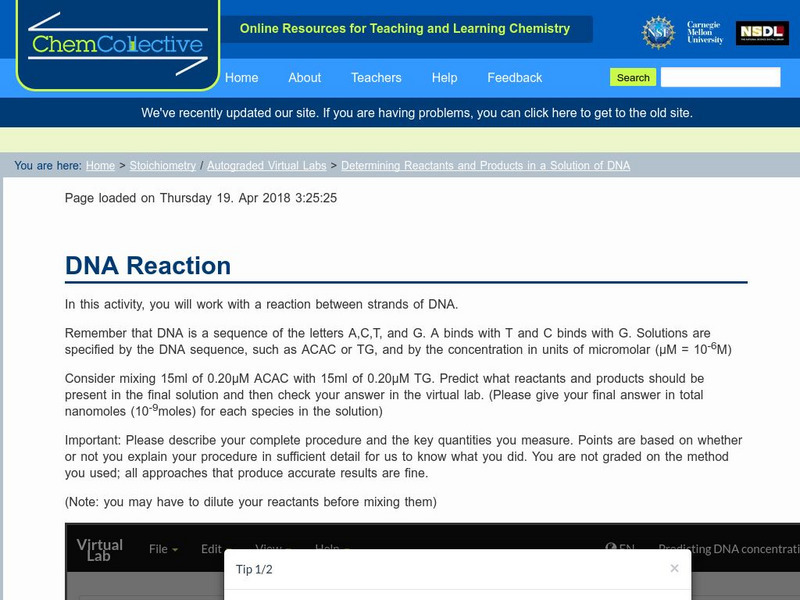
Chem Collective: Determining Reactants and Products in a Solution of Dna
In this limiting reagents problem, students are given specific concentrations of DNA solutions and are asked to predict what products and reactants will remain after a specific volumes are mixed and reaction has occurred.
Chemistry Collective
Chem Collective: Predicting Dna Concentration
In this limiting reagents problem, students are given specific concentrations of DNA solutions and are asked to predict what products and reactants will remain after a specific volumes are mixed and reaction has occurred.

CK-12 Foundation
Ck 12: Plix: Chemical Formulas and Symbols: Reactants and Products
[Free Registration/Login Required] Drag the atoms from the table to create chemical formulas. You will need a sign-in to access this media, but it will be well worth your time!

Other
Widener University: Hints for Solving Stoichiometry Prob.
Great analogy if you are uncomfortable with the concept of limiting reactants. A great starting point. Finishes with chemistry.
Chemistry Collective
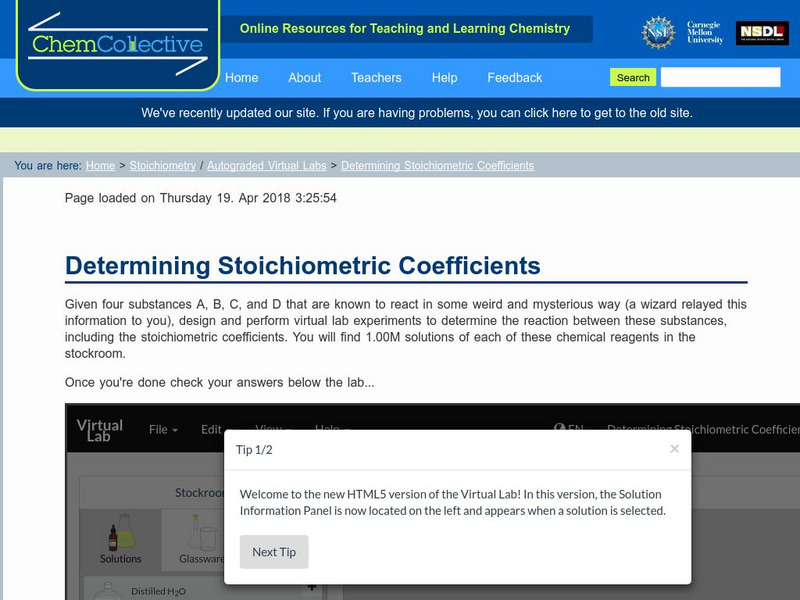
Chem Collective: Determining Stoichiometric Coefficients
Students use the virtual lab to determine how four unknown substances react with each other including their stoichiometric coefficients. In this randomized activity, each student receives a different reaction and students can check their...
Chemistry Collective
Chem Collective: Textbook Style Limiting Reagents Problem Ii
In this activity, students practice with experiments involving limiting reagents and the test their knowledge to determine the concentration of an unknown solution.
TeachEngineering
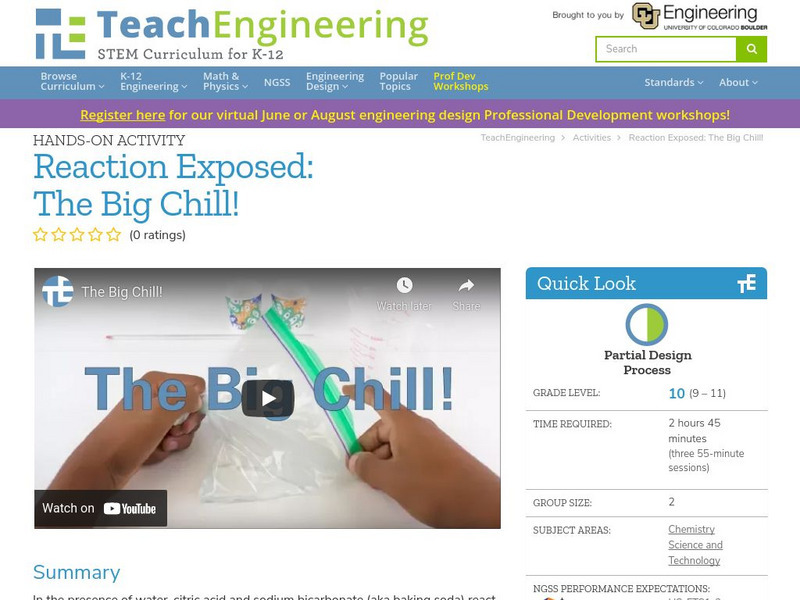
Teach Engineering: Reaction Exposed: The Big Chill!
Students investigate the endothermic reaction involving citric acid, sodium bicarbonate and water to produce carbon dioxide, water and sodium citrate. In the presence of water [H2O]; citric acid [C6H8O7] and sodium bicarbonate [NaHCO3]...
Chemistry Collective
Chem Collective: Camping Problem Ii
In this part of the MRE scenario, students determine change in the enthalpy of a reaction as the concentration of reactants are varied.
Chemistry Collective
Chem Collective: Stoichiometry and Solution Preparation Problem
In this limiting reagents problem, students mix together solutions in different ratios in an attempt to produce a final solution that contains only 1 product.
Chemistry Collective
Chem Collective: Unknown Concentration of Dna Solution Problem
In this advanced limiting reagent problem, students use the virtual lab to determine the concentration of a solution of DNA by reacting it with known amounts of a fluorescent dye which binds to the DNA.
Texas Instruments
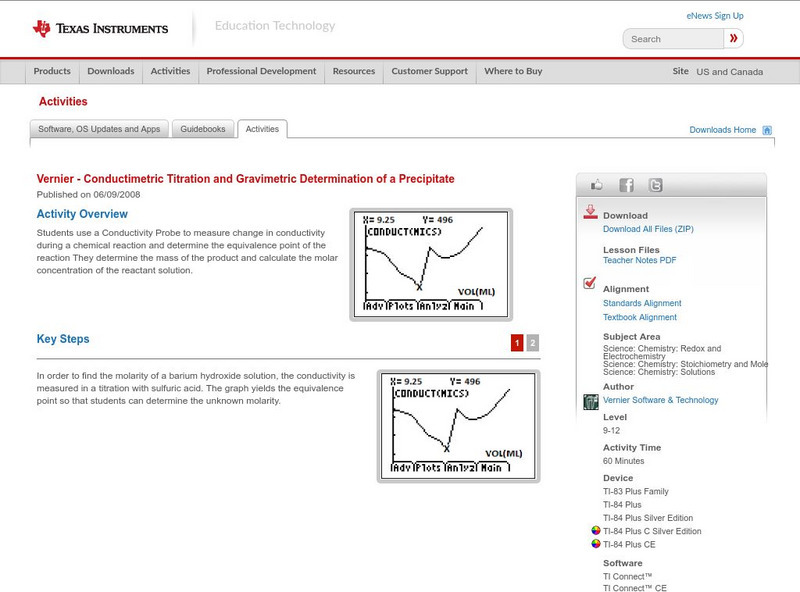
Texas Instruments: Conductimetric Titration & Gravimetric Determination
Students use a Conductivity Probe to measure change in conductivity during a chemical reaction and determine the equivalence point of the reaction They determine the mass of the product and calculate the molar concentration of the...
Purdue University
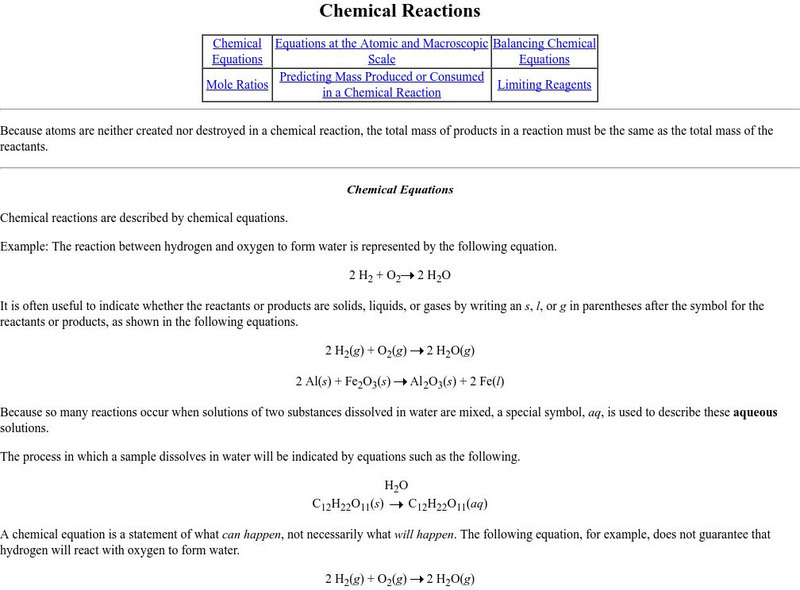
Chem Ed: Chemical Reactions
Because atoms are neither created nor destroyed in a chemical reaction, the total mass of products in a reaction must be the same as the total mass of the reactants.
TeachEngineering
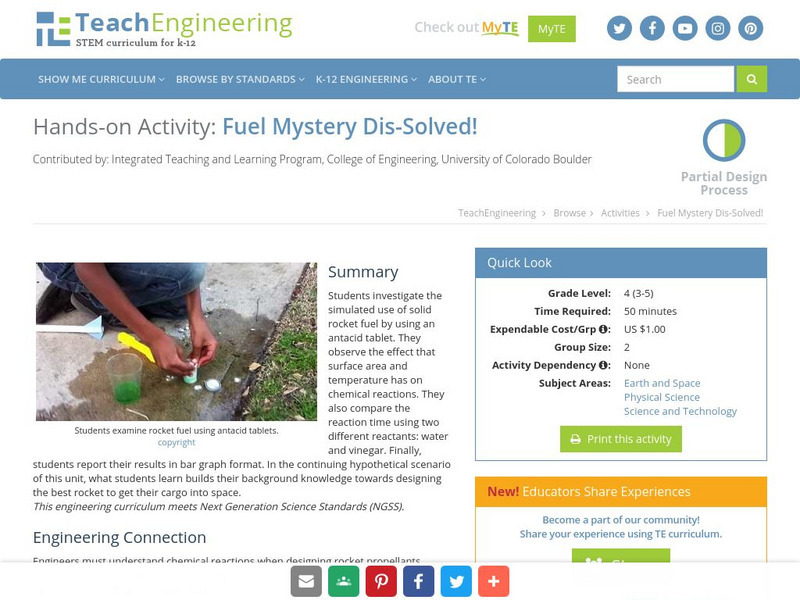
Teach Engineering: Fuel Mystery Dis Solved!
In this activity, students investigate the simulated use of solid rocket fuel by using an antacid tablet. Students observe the effect that surface area and temperature has on chemical reactions. Also, students compare the reaction time...

CK-12 Foundation
Ck 12: Plix: Balancing Chemical Equations
[Free Registration/Login Required] Before you can balance an equation, you need to count the number of each atom present in the reactants and products. Using the example that is shown here, apply the numbers and table to track how many...
Chemistry Collective
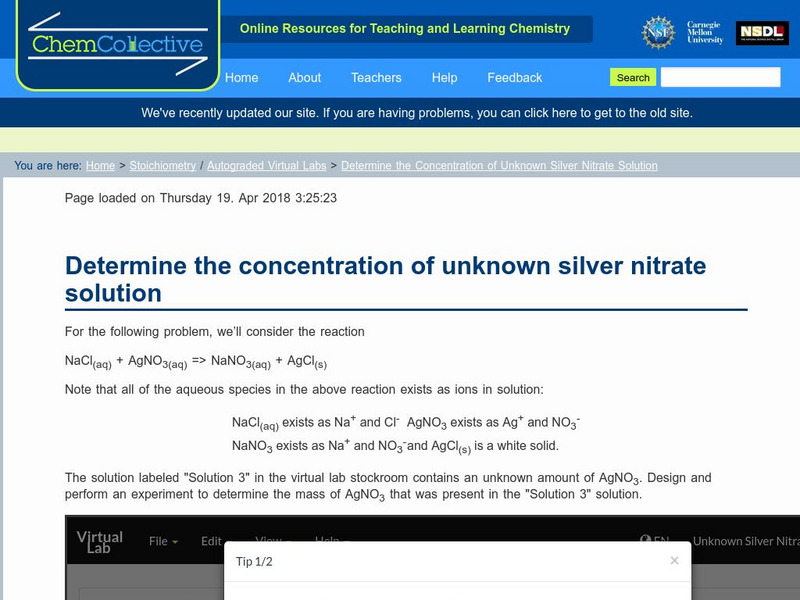
Chem Collective: Determine the Concentration of Unknown Silver Nitrate Solution
In this limiting reagents problem, students are asked to determine the amount of silver nitrate dissolved in a solution by performing a reaction with solid NaCl. In this randomized activity, each student is given a different unknown...
Chemistry Collective
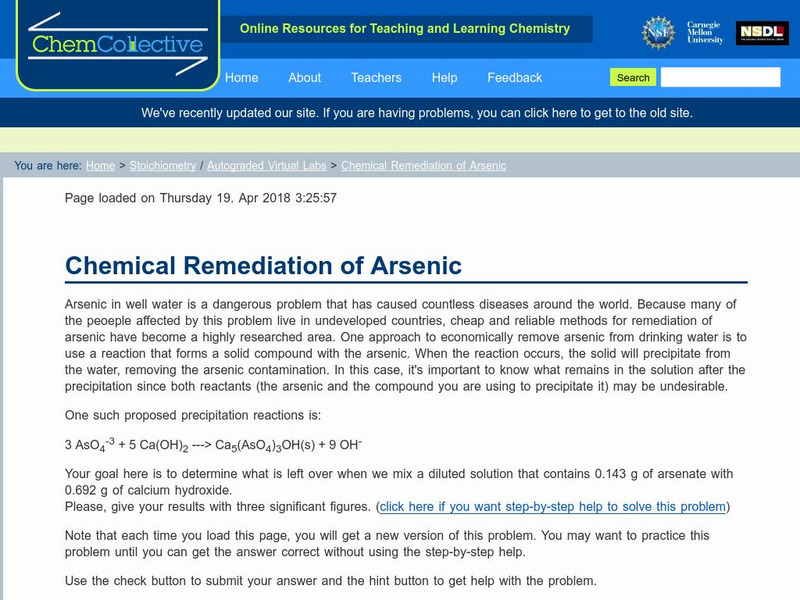
Chem Collective: Chemical Remediation of Arsenic
In this problem, students determine the limiting reagent in a reaction involving the remediation of arsenic from drinking water.
Chemistry Collective
Chem Collective: Gravimetric Determination of Arsenic
Set in the context of ground water contamination in Bangladesh, this stoichiometry and analytical chemistry activity examines the issues around identifying wells contaminated with arsenic. In this activity, students perform a gravimetric...
Center of Science and Industry
Cosi Columbus: Sidewalk Chalk
Make your own sidewalk chalk, and learn about chemical reactions. During the procedure, feel the heat as energy is released in an exothermic reaction.
Science Buddies
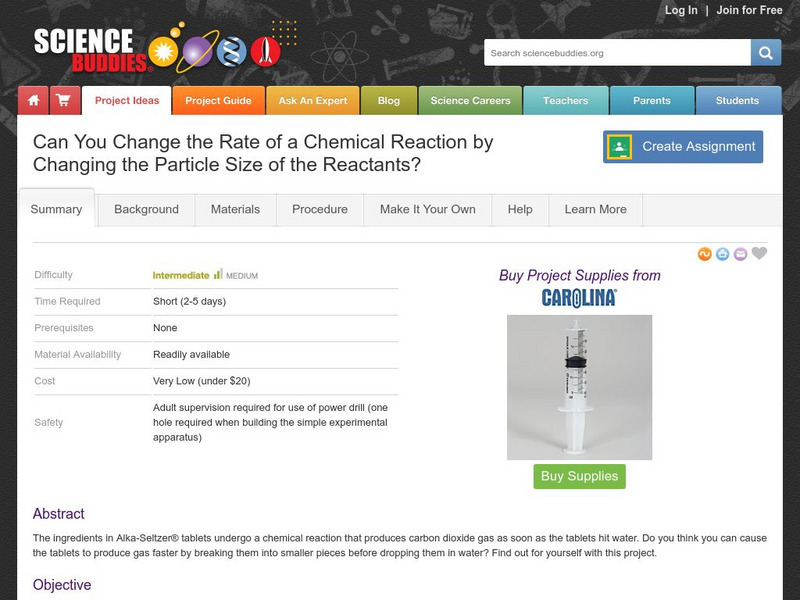
Science Buddies: Can You Change the Rate of a Chemical Reaction?
The ingredients in Alka-Seltzer tablets undergo a chemical reaction that produces carbon dioxide gas as soon as the tablets hit water. Do you think you can cause the tablets to produce gas faster by breaking them into smaller pieces...
Other popular searches
- Reactants and Products
- Limiting Reactants
- Chemistry Limiting Reactants
- Reactants of Photosynthesis
- Reactants With Vinegar
- Mass of Reactants
- Excess Reactants
- Introduction to Reactants
- Reactants of Equations