Hi, what do you want to do?






Curated OER
Salt and Water Divorce by a Physical Change
Learners discuss the definitions of physical and chemical properties and changes. They vaporize a solution of salt and water, observing the sodium chloride that is left behind.

Curated OER
Urinalysis
High schoolers participate in a lab experiment that explains why doctors take urine samples. They participate in a discussion about the urinary system and have already studied the functions of the organs involved in the urinary system...

Curated OER
Investigating the Regulation of Leukocyte Adhesion Through Extracellular Matrices
Students examine the relationship between leukocyte adhesion and migration in response to chemoattractants. They discuss sterile techniques, observe a demonstration using mock cell culture, and develop a procedure for studying the...

Curated OER
Devising a Set of Experiments to Test Water for Dissolved Substances
Students work together to test water samples for pollutants. They design data tables to collect and record their observations. They complete discussion questions to end the lesson.

Curated OER
Water Quality Monitoring
Students work together to gather water samples. They compare and contrast the water quality from different places in the community. They answer discussion questions to complete the instructional activity.

Curated OER
CULTURING PLANTS FROM EMBRYONIC PLANT TISSUE
Students use this laboratory exercise as a growth medium that contains the macronutrient and micronutrient needs of plants. They observe the effects of different hormones on tissue cultures and must use variations of the basic growth...

Curated OER
Culturing Plants from Embryonic Plant Tissue
Student groups use lima beans to represent dicots and corn to represent monocots, soak the seeds, and separate the embryos from the cotyledons. They then place the seeds in Petri dishes in agar and observe for at least one week recording...

Curated OER
Surface Tension Grabbers
Students explore why surface tension is such a very important biological concept. Determination is made on why the myriad of biota that interacts at the air-water interface are vital components of aquatic and marine ecosystems. They...

Curated OER
Calorimetry Exercises
In this calorimetry worksheet, students determine the specific heat and the heat of neutralization in the 2 problems they solve.

Curated OER
Acid and Base Worksheet
For this acids and bases worksheet, students apply the Bronsted-Lowry theory of acids and bases to write the products for the given acid-base reactions. This worksheet has 7 problems to solve.
Chemistry Collective
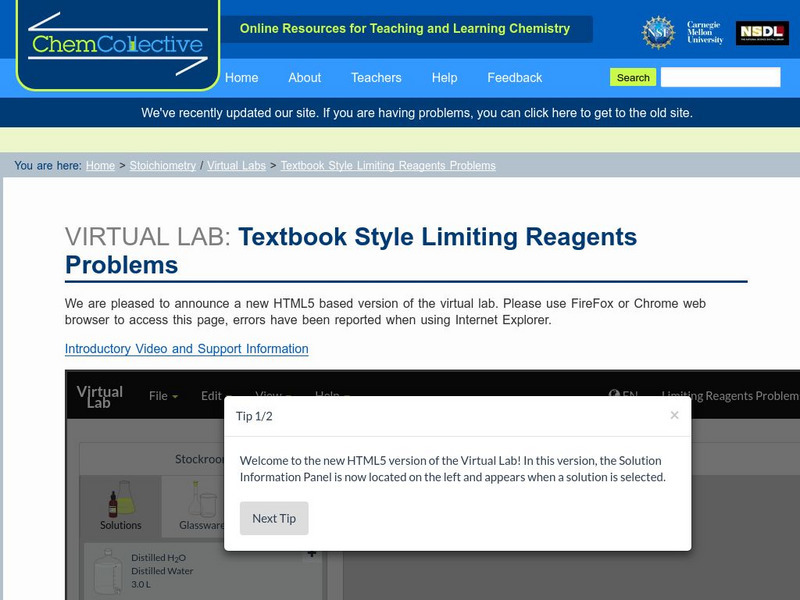
Chem Collective: Textbook Style Limiting Reagents Problems
Textbook-style practice limiting reagent exercises with that can be used as a way to "predict and check" your answers using the virtual lab.
Chemistry Collective
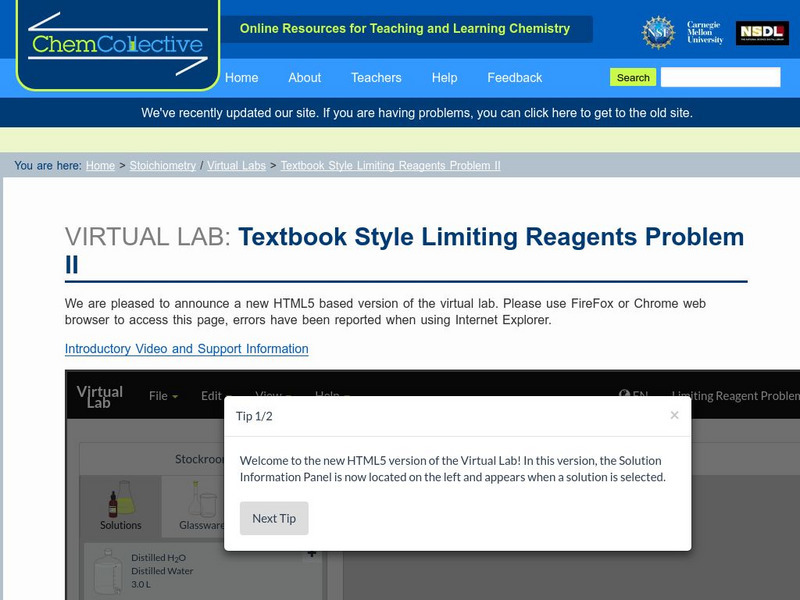
Chem Collective: Textbook Style Limiting Reagents Problem Ii
In this activity, students practice with experiments involving limiting reagents and the test their knowledge to determine the concentration of an unknown solution.

Khan Academy
Khan Academy: Limiting Reagents and Percent Yield
How to determine the limiting reagent, and using stoichiometry to calculate the theoretical and percent yield.
University of Waterloo (Canada)
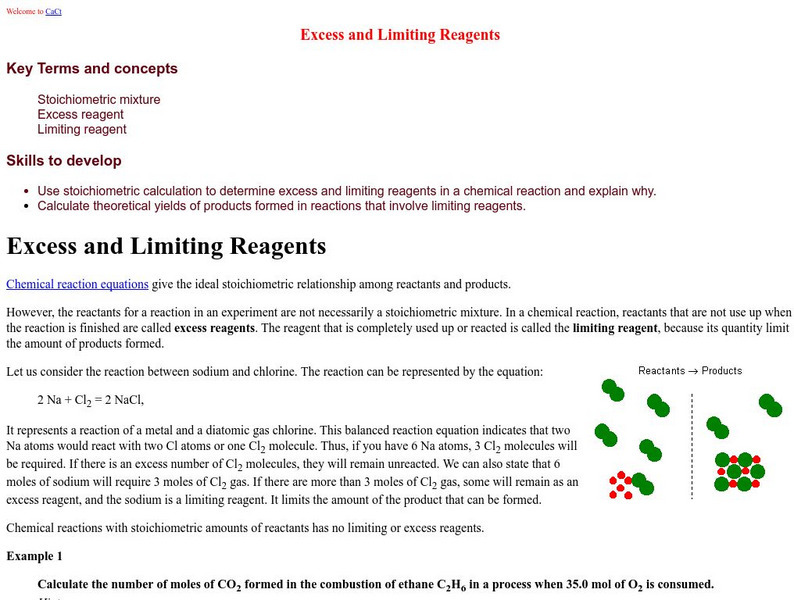
University of Waterloo: Excess and Limiting Reagents
Very good site which gives an explanation, example and skill building questions over limiting reagents.
Chemistry Collective
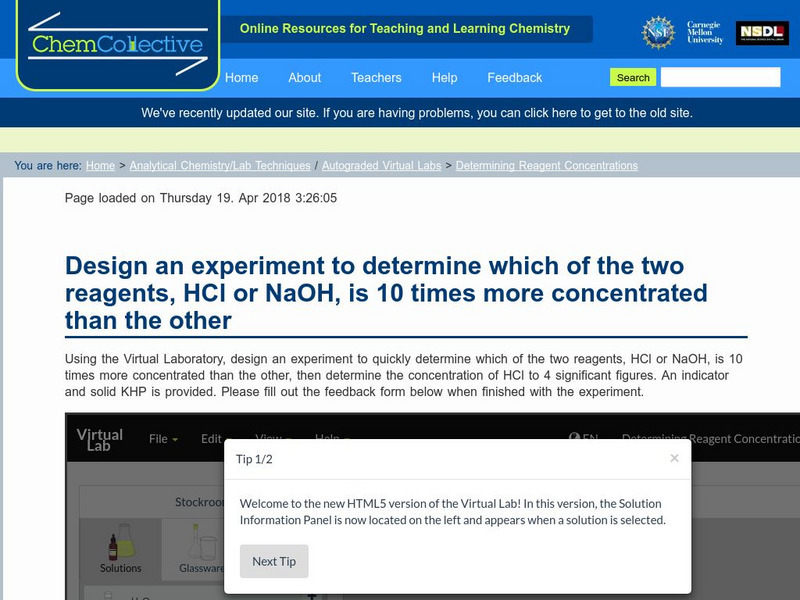
Chem Collective: Determining Reagent Concentrations
Using the Virtual Laboratory, design an experiment to quickly determine which of the two reagents, HCl or NaOH, is 10 times more concentrated than the other.
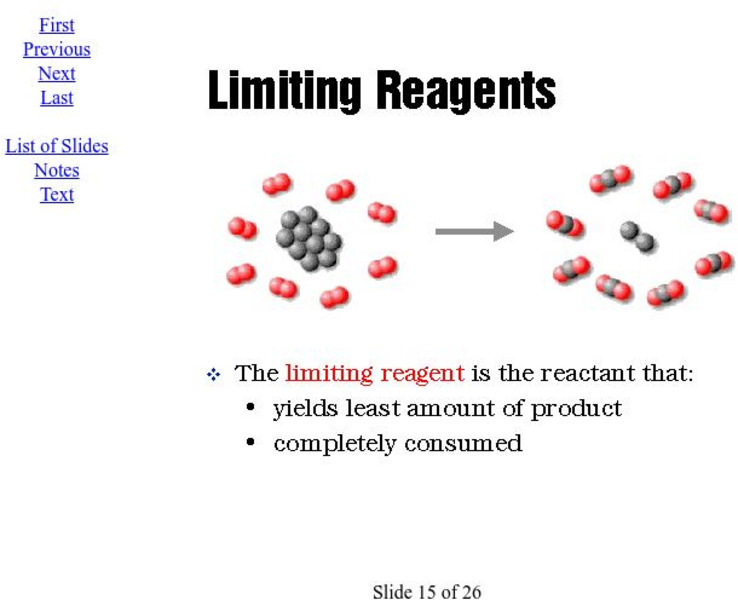
Frostburg State University
Frostburg State University: Limiting Reagents
Middle of a slide show on stoichiometry that shows a nice graphical look and example of limiting reagents.

Carnegie Mellon University
Chem Collective: Stoichiometry Bridge Course
This is a complete course in chemical stoichiometry, set in a scenario that shows how stoichiometry calculations are used in real-world situations. This course has been designed to not only help you strengthen your skills with...
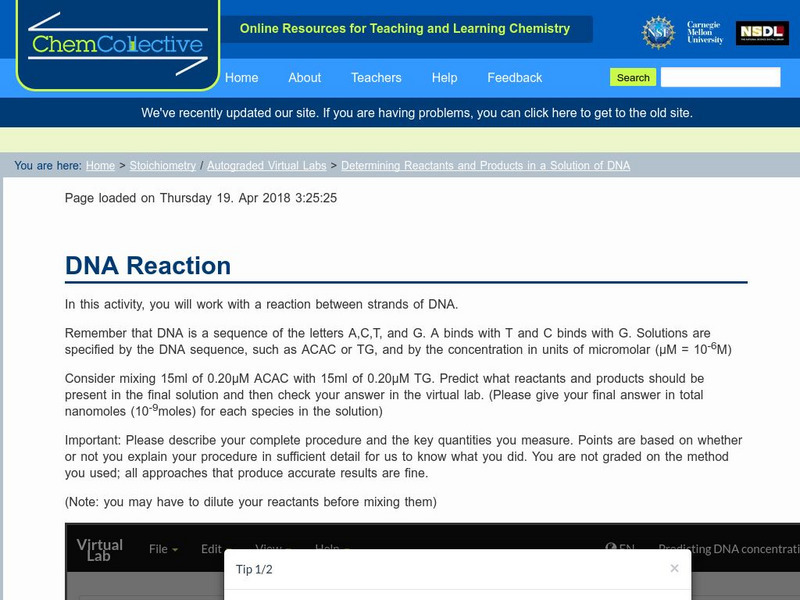
Chemistry Collective
Chem Collective: Determining Reactants and Products in a Solution of Dna
In this limiting reagents problem, students are given specific concentrations of DNA solutions and are asked to predict what products and reactants will remain after a specific volumes are mixed and reaction has occurred.
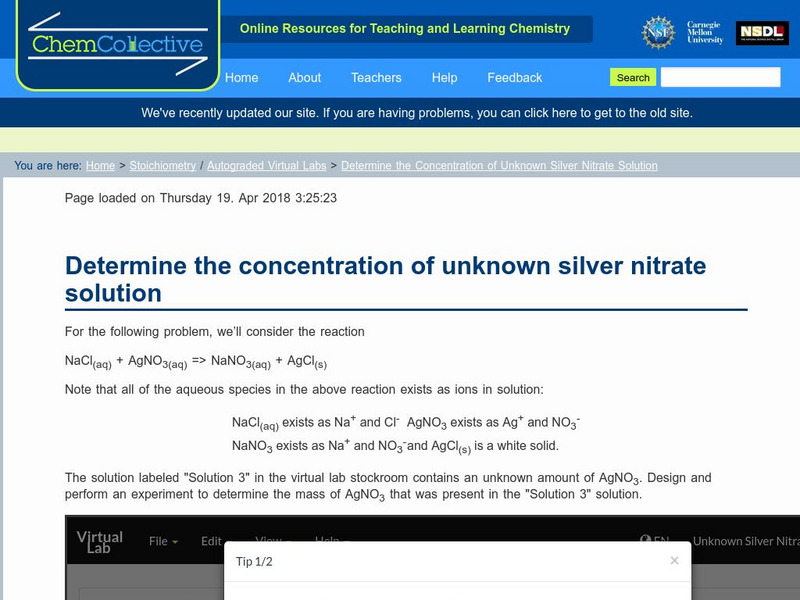
Chemistry Collective
Chem Collective: Determine the Concentration of Unknown Silver Nitrate Solution
In this limiting reagents problem, students are asked to determine the amount of silver nitrate dissolved in a solution by performing a reaction with solid NaCl. In this randomized activity, each student is given a different unknown...
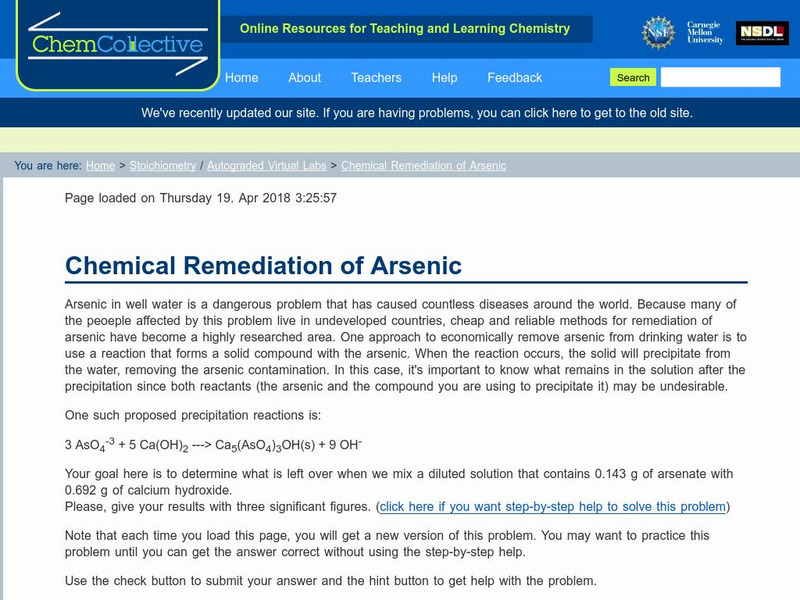
Chemistry Collective
Chem Collective: Chemical Remediation of Arsenic
In this problem, students determine the limiting reagent in a reaction involving the remediation of arsenic from drinking water.
Chemistry Collective
Chem Collective: Stoichiometry Applet
One of the first numerical problems encountered in introductory chemistry is that of "limiting reagents". This applet serves as a supplement to such calculations, providing imagery that helps students see beyond the rote mathematics.
Chemistry Collective
Chem Collective: Stoichiometry and Solution Preparation Problem
In this limiting reagents problem, students mix together solutions in different ratios in an attempt to produce a final solution that contains only 1 product.
Chemistry Collective
Chem Collective: Predicting Dna Concentration
In this limiting reagents problem, students are given specific concentrations of DNA solutions and are asked to predict what products and reactants will remain after a specific volumes are mixed and reaction has occurred.
Chemistry Collective
Chem Collective: Unknown Concentration of Dna Solution Problem
In this advanced limiting reagent problem, students use the virtual lab to determine the concentration of a solution of DNA by reacting it with known amounts of a fluorescent dye which binds to the DNA.