Hi, what do you want to do?





Science Education Resource Center at Carleton College
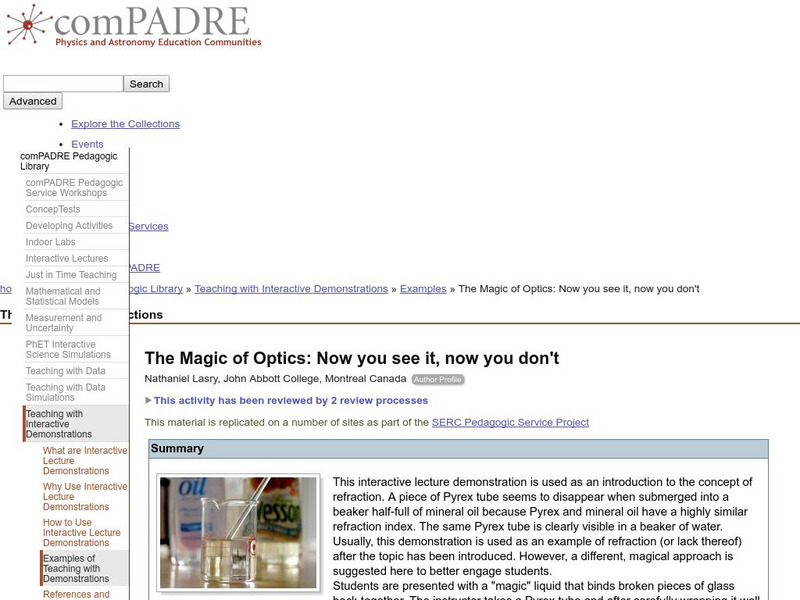
Serc: Com Padre: The Magic of Optics: Now You See It, Now You Don't
A lesson demonstrating the concept of refraction. It uses a highly engaging 'magic' trick where a smashed glass tube is seemingly put back together.

BBC
Bbc: Gcse Bitesize: Why Do Scientists Think That Light and Sound Are Waves?
Light travels as transverse waves and can travel through a vacuum. Sound travels as longitudinal waves and needs to travel through a solid, liquid or gas. Read about the properties of light and of sound, and learn the differences between...

American Museum of Natural History
American Museum of Natural History: Ology: See the Light
Reflection, refraction, and the colors that make up white light is explored through lab activities after reading a brief background about light energy.
Physics Classroom
The Physics Classroom: Refraction and the Ray Model of Light: Rainbow Formation
Understand the physics behind Roy G. Biv, and how rainbows are formed by drawing upon our understanding of refraction, internal reflection, and dispersion.
Physics Classroom
The Physics Classroom: Refraction and the Ray Model of Light: Converging Lenses
An illustrated tutorial which takes students step-by-step through the process of drawing ray diagrams.
Physics Classroom
The Physics Classroom: Refraction/ray Model of Light: Farsightedness/correction
A brief introduction to the physics side of farsightedness, and how lenses correct this vision defect.
Physics Classroom
The Physics Classroom: Refraction/ray Model of Light: Nearsightedness/correction
A brief introduction to the physics side of nearsightedness, and how lenses correct this vision defect.
Physics Classroom
The Physics Classroom: Refraction/ray Model of Light: Image Formation/detection
Students discover the four parts of the eye are the most instrumental in the task of producing images that are discernible by the brain.
Other
Siemens Science Day: Physical Science: Through the Looking Glass
Students will make their own spectroscope, learn how light is bent by a diffraction grating, and explore how various forms of light differ.
Other
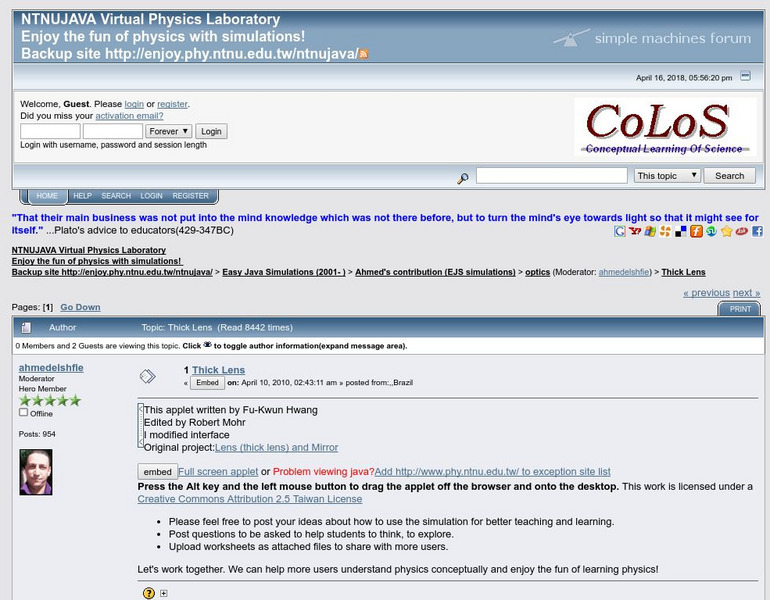
Ntnu Virtual Physics Lab: Thick Lens Java Applet
An interactive Java applet which allows the user to investigate the path of light through a lens shape object. The shape of the object, the index of refraction of the material, and the location of the incident rays can be altered.

Khan Academy
Khan Academy: Reflection and Refraction Questions
This is a 10-question exercise/quiz pertaining to reflection and refraction.
Physics Classroom
The Physics Classroom: Refraction/ray Model of Light: Image Formation Revisited
Students take an in-depth look at the physics behind image formation.
PBS
Pbs Learning Media: Diamonds: The Science Behind the Sparkle
This illustrated essay from the NOVA Web site explains why the atomic structure of a diamond slows down light and produces a sparkle more brilliant than from any other colorless substance.
TeachEngineering
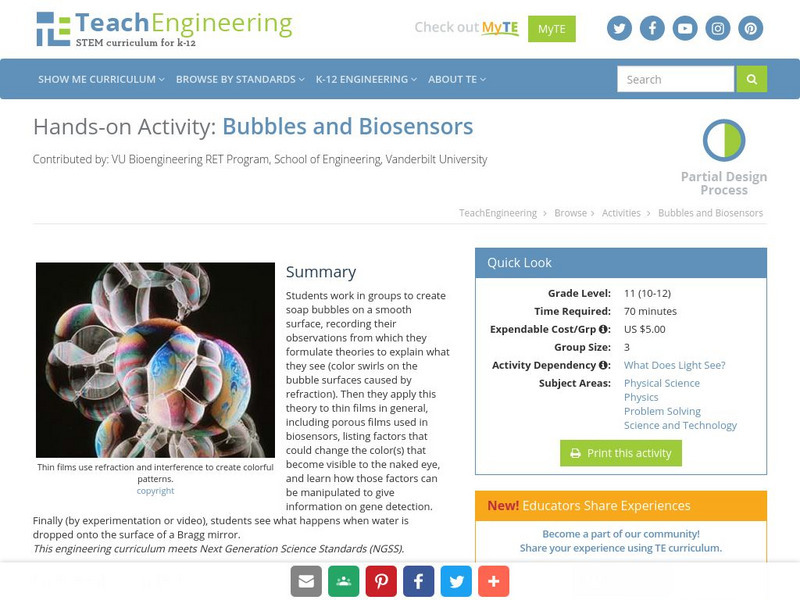
Teach Engineering: Bubbles and Biosensors
Students learn that color swirls on the bubble surfaces are caused by refraction. Then they apply this theory to thin films in general, including porous films used in biosensors, listing factors that could change the color that become...
Georgia State University
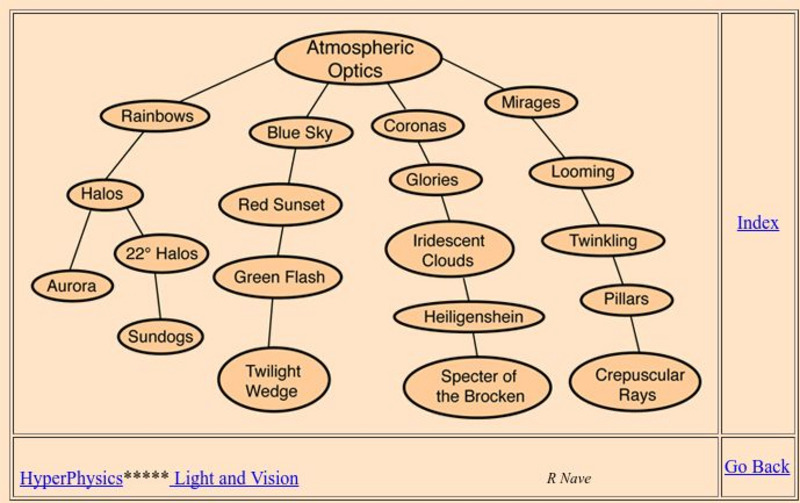
Georgia State University: Hyper Physics: Atmospheric Optics Concepts
This physics department site features an indexing page for a variety of pages pertaining to atmospheric optics. Topics include rainbows, halos, auroras, mirages, star twinkling, sunsets, green flashes, coronas, and more. Excellent...
Discovery Education
Discovery Education: 3 M Young Scientist Lab: Gelatin Optic Fibers
Strips of gelatin dessert and a laser pointer demonstrate total internal reflection.
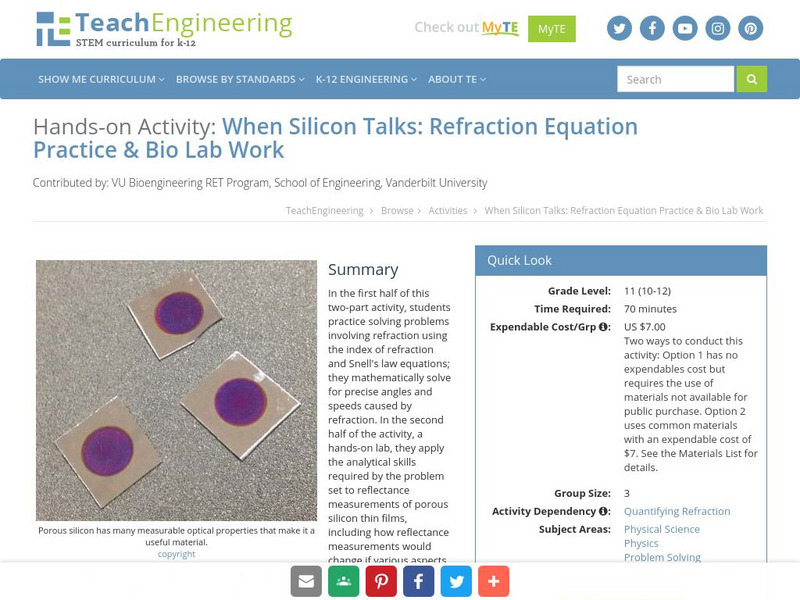
TeachEngineering
Teach Engineering: When Silicon Talks
In this activity, students tackle this aspect of engineering as they solve problems for precise angles and speeds, and predict data output when samples are altered.
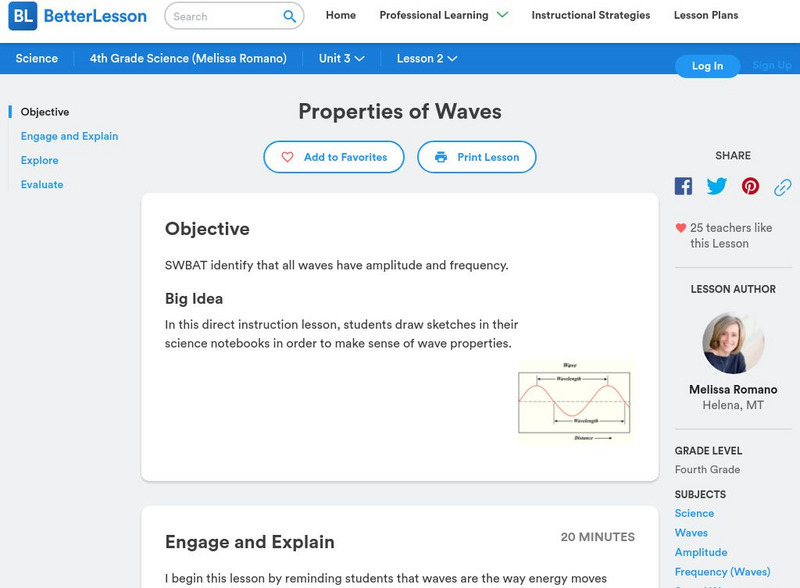
Better Lesson
Better Lesson: Properties of Waves
In this direct instruction lesson, students draw sketches in their science notebooks in order to make sense of wave properties. Resources include a slideshow presentation on the properties of waves and multiple examples of student work.
TeachEngineering
Teach Engineering: Learning Light's Properties
Students learn the basic properties of light--the concepts of light absorption, transmission, reflection and refraction, as well as the behavior of light during interference. Lecture information briefly addresses the electromagnetic...

ClassFlow
Class Flow: What Is Light?
[Free Registration/Login Required] This flipchart reviews the characteristics of light and its properties. Students are given examples of reflection, refraction, and lens types. An assessment component is included.
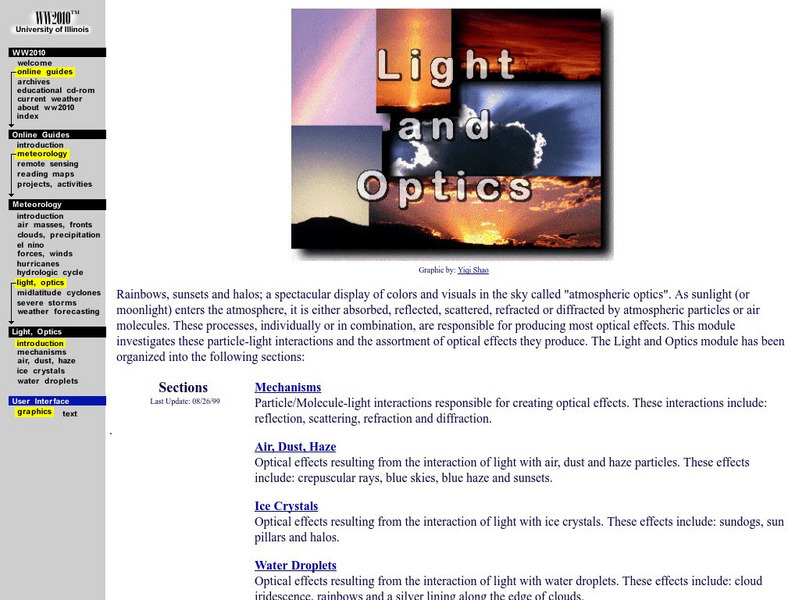
University of Illinois
University of Illinois Urbana Champaign: Light and Optics
Rainbows and sunsets are called "atmospheric optics". They can be caused by light being absorbed, reflected, scattered, refracted, or diffracted by particles in the atmosphere. Learn all about different atmospheric optics along with...
Georgia State University
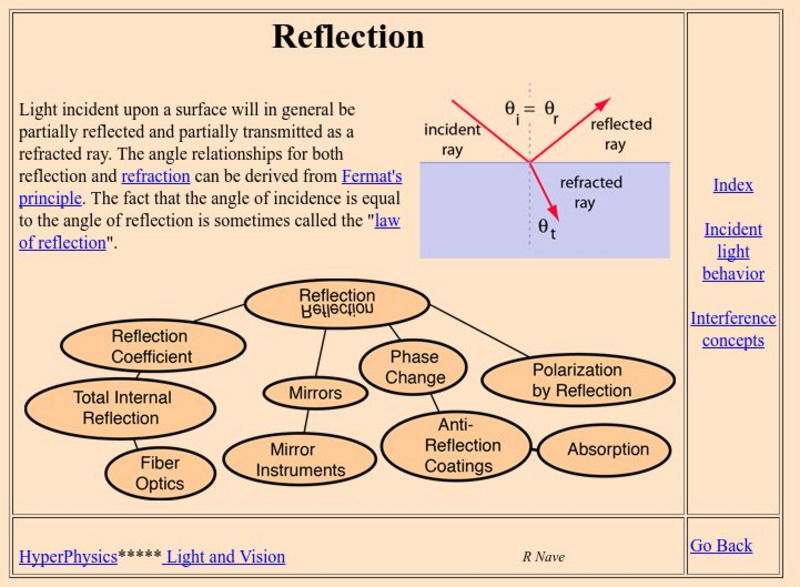
Georgia State University: Hyper Physics: Behavior of Incident Light
This site from Georgia State University is an indexing page for several other pages on the topic of reflection. Topics are treated in an understandable manner and utilize meaningful graphics.
Utah State Office of Education
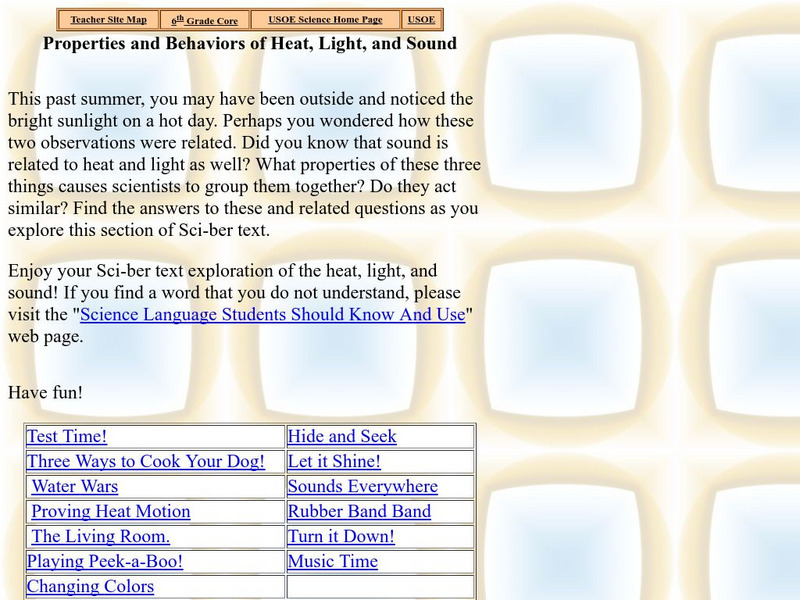
Utah Science: Properties and Behaviors of Heat, Light and Sound
How can scientists lump heat, light and sound together when investigating properties and behaviors? This learning module will address that question through a series of activities.
Physics Classroom
The Physics Classroom: Polarization
"How Do We Know Light Behaves as a Wave?" An answer is provided in this discussion of the polarization of light and the use of Polaroid filters in sunglasses. The four methods discussed on this page are: polarization by transmission,...