Hi, what do you want to do?






Laboratory for Atmospheric and Space Physics
The Planets and Scale
Scholars gain an insight into the relative size of planets and distance between inner and outer planets with the help of informational text, a data table, and a series of four questions.

International Technology Education Association
Tidy Up Those Sloppy Force Fields!
It is just magnetic. This resource presents the concept of Earth's and another planet's magnetic field and how spacecrafts detect them. Learners study a problem using magnetometers and participate in three experiments to come up with a...

Mr. Hill's Science Website
Solar System Fact Sheet
Here is a fantastic, educational handout packed with information and facts not only about the planets in our solar system, but also regarding major moons and their surface features, dwarf planets, comets, and asteroids.

CK-12 Foundation
Ck 12: Earth Science: Revolutions and Rotations of the Earth Study Guide
[Free Registration/Login may be required to access all resource tools.] Summarizes the key points about how our understanding of the Earth's movements evolved from ancient times and what we know today. Includes some questions to check...

NASA
Planetary Geodynamics Laboratory: Ocean Tides and the Earth's Rotation
An explanation of the effect that the tides have on the Earth's rotation.
NASA
Nasa: Imagine the Universe: Speed of Earth's Rotation
Presents an informative answer to the question "What is the speed of the turning of the Earth?"
Nine Planets
The Nine Planets: The Moon
Explore the mythology, structure, observational history, gravitational force, and orbit of Earth's Moon.

University of Wisconsin
University of Wisconsin: Reasons for the Seasons
A brief explanation of the Earth's rotation around the Sun and how it relates to the amount of sunlight the Earth receives, and to the seasons. Includes two questions for students to respond to.
Smithsonian Institution
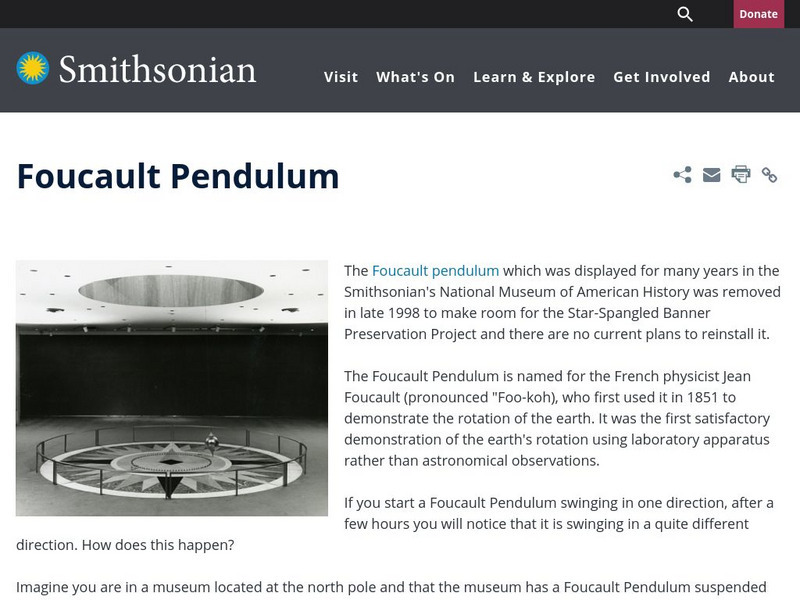
Encyclopedia Smithsonian: Foucault Pendulum
Provides a detailed description of the Foucault Pendulum and how it works. It was originally built to demonstrate the rotation of the Earth.
Wikimedia
Wikipedia: The Black Hole
This site examines the black hole as an object in astrophysics. Delve into this comprehensive resource that covers this concept from its history, to qualitative physics, the reality of black holes, mathematical physics and more.
Other
University of Windsor: Climates on a Rotating Earth
This site offers the text of a college lecture on the atmosphere, with information on the effect prevailing westerlies have on North America.
Science Struck
Science Struck: A Scientific Explanation to What Causes Day and Night
Explains how the rotation and the axial tilt of the Earth are responsible for the phenomenon of day and night. Provides information about the Sun, the solar system, and the Earth, and how the circumference of the Earth was first measured...
American Association of Physics Teachers
Com Padre Digital Library: Open Source Physics: Kepler System Model
This site from Open Source Physics offers a file with a simulation of Kepler's theory of planetary motion, tested with the Earth rotating around the sun and another planet of the user's choosing. The download requires Java.
PBS
Pbs Learning Media: Global Weather Machine
In this illustrated essay from NOVA Online, explore the cyclical process of weather creation and the effects of El Nino on the global weather system.
Other
Bad Astronomy/phil Plait: Tides and Why Our Days Are Getting Longer
Why does the Moon always shows the same face to the Earth? Why is the Moon's rotation period the same as the length of time it takes to orbit the Earth? Why are there two tides a day? These questions and more are answered here.