Hi, what do you want to do?





Massachusetts Institute of Technology
Mit: Open Course Ware: Orbits of Planets and Satellites
Students explore orbits of planets and satellites. Some topics examined in the activities are planetary motion, angular momentum of orbits, and Kepler's laws. The resource consists of video clips, lecture notes, practice problems, and...

Science Buddies
Science Buddies: Stargazing for Satellites
Did you know you can see many satellites with the naked eye? Try this activity and find out for yourself!
Physics Classroom
The Physics Classroom: Circular and Satellite Motion: Principles for Satellites
Students explore how a satellite's motion is governed by the same physics principles and described by the same mathematical equations.
Physics Classroom
The Physics Classroom: Circular and Satellite Motion: Energy in Satellites
Through interactive practice problems and illustrated examples, students explore energy relationships for satellites.
NASA
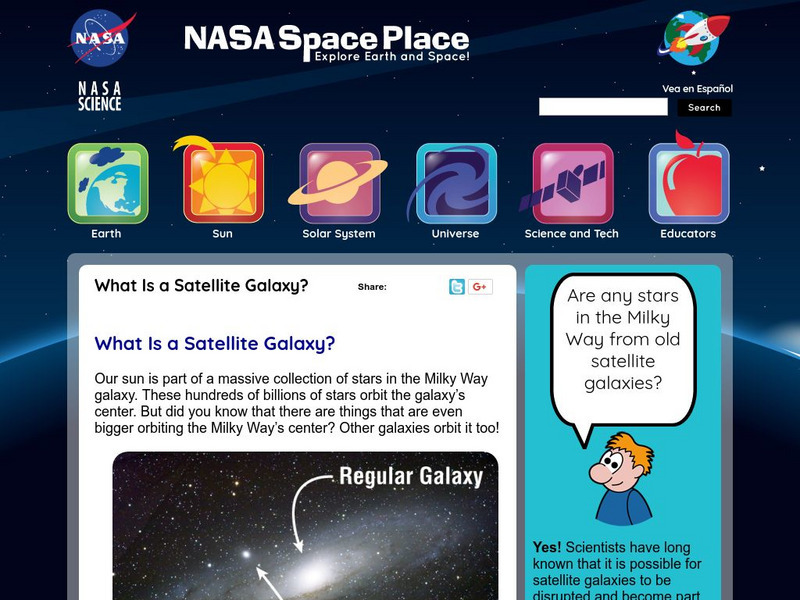
Nasa: Space Place: What Is a Satellite Galaxy?
Find out about the behavior and characteristics of the many satellite galaxies that orbit other galaxies.
CK-12 Foundation
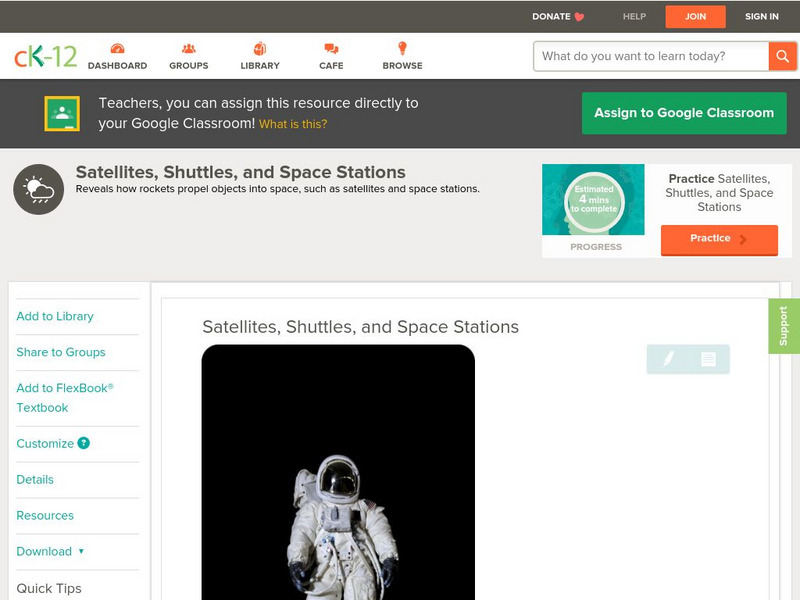
Ck 12: Earth Science: Satellites, Shuttles, and Space Stations
[Free Registration/Login may be required to access all resource tools.] Astronauts and space study.
European Space Agency
European Space Agency: Esa Kids: Our Universe: Satellites
A basic introduction to artificial, or man-made, satellites. Links to information about the planets and other objects in our solar system are included.

National High Magnetic Field Laboratory
Magnet Academy: Oersted Satellite, 1999
Named in honor of Danish physicist Hans Christian Oersted, Denmark's first satellite has been observing and mapping the magnetic field of the Earth.
CK-12 Foundation
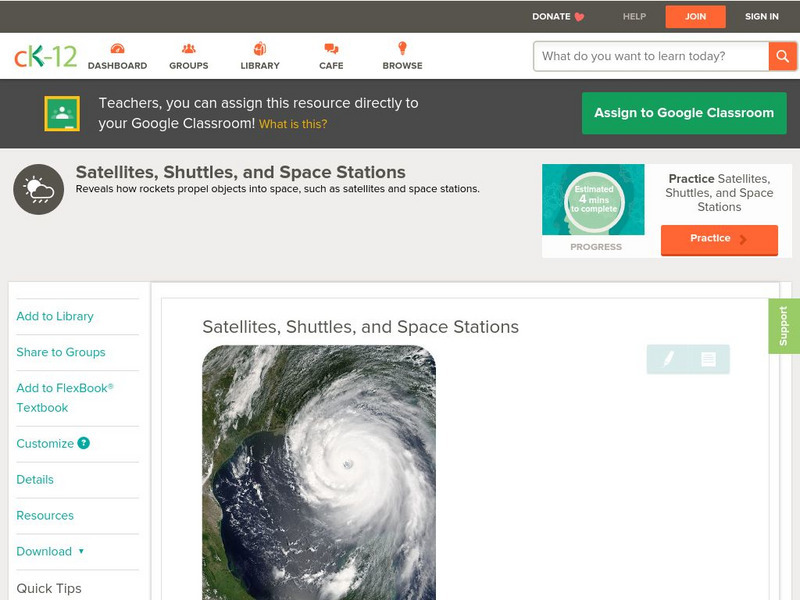
Ck 12: Earth Science: Satellites, Shuttles, and Space Stations
[Free Registration/Login may be required to access all resource tools.] Astronauts and space study.
Illustrative Mathematics
Illustrative Mathematics: G C Orbiting Satellite
A satellite is orbiting the Earth at a given height and learners are asked to find the distance it travels to complete 70 percent of an orbit. This task provides a context for connecting an angle in radians to the arc length intercepted...
The Tech Interactive
Tech Museum: The Satellite Site!
An engaging look at satellites! What they are, what they do, and how they orbit. One interactive activity is building three different types of satellites.
TeachEngineering
Teach Engineering: Where Am I: Navigation and Satellites
How do we know where we are? In this lesson, students explore the concept of triangulation that is used in navigation satellites and global positioning systems designed by engineers. Also, students learn how these technologies can help...
Science Education Resource Center at Carleton College
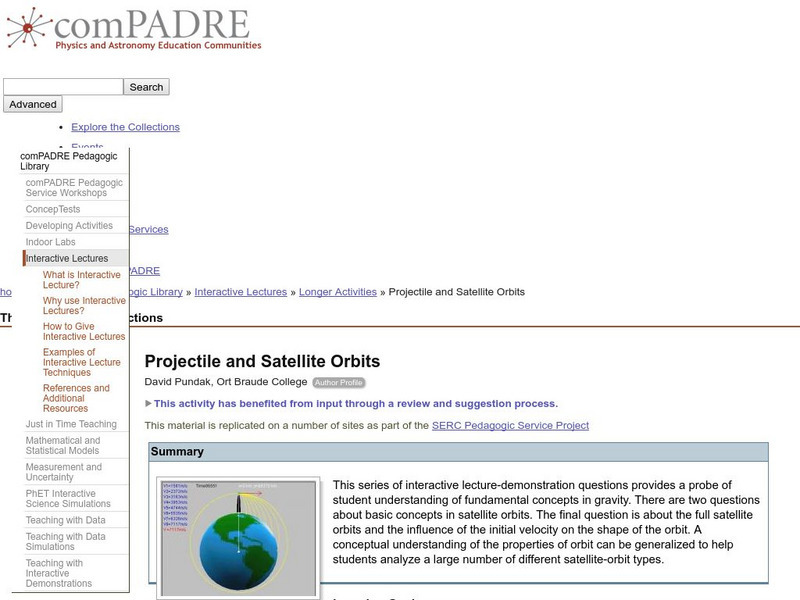
Serc: Projectile and Satellite Orbits
This activity introduces gravity and Kepler's Laws and helps to develop an understanding of gravitational force, satellite orbits, and their dependence on the initial velocity.
TeachEngineering
Teach Engineering: Keep in Touch: Communications and Satellites
How do we communicate with each other? How do we communicate with people who are close by? How do we communicate with people who are far away? For this lesson, students will explore the role of communications and how satellites help...
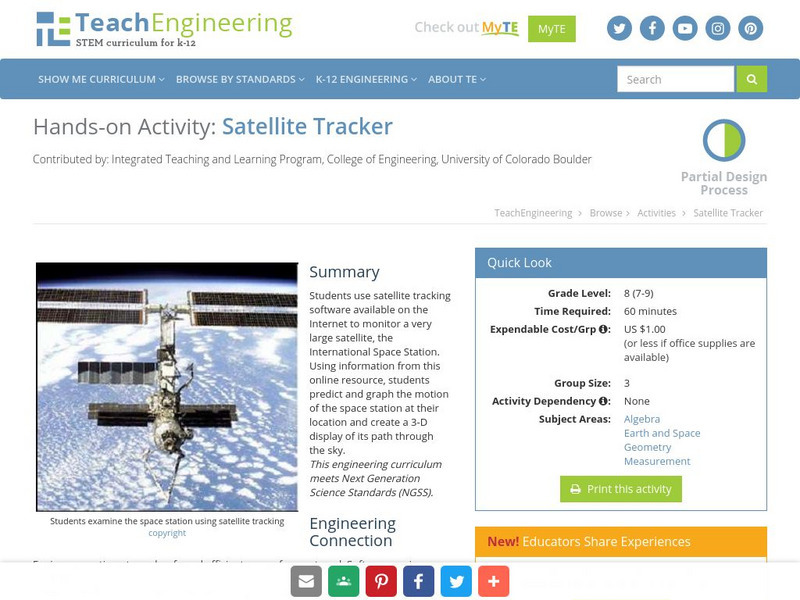
TeachEngineering
Teach Engineering: Satellite Tracker
Students use satellite tracking software available on the Internet to monitor a very large satellite, the International Space Station. Using information from this online resource, students predict and graph the motion of the space...

University of St. Andrews (UK)
University of St. Andrews: Orbits and Gravitation
A page describing the physics, mathematics, and historical figures associated with planetary motion, satellite motion, and universal gravitation.

NASA
Nasa: Kepler and His Laws
This site from NASA provides biographical details about the lives of Tycho Brahe and Johannes Kepler. Discusses Kepler's successes at developing laws of planeatry motion. States the three laws and discusses each one individually....
Other
Solar and Astrophysics Lab: Trace Analysis Guide
This site provides a detailed overview of the TRACE (Transition Region and Coronal Explorer) satellite mission, data received, details about the instrumentation, and how to interpret the data.
NASA
Nasa: The Solar and Heliospheric Observatory (Soho)
NASA provides a detailed overview of the Solar and Heliospheric Observatory (SOHO), currently orbiting the sun and gathering information on the sun's structure, composition and dynamics. Site includes images, movies, data, solar lessons,...

John F. Kennedy Presidential Library & Museum
John F. Kennedy Presidential Library and Museum: Space Program
In 1957 the Soviet Union launched the satellite Sputnik and had an astronaut orbit the moon a few years later. The U.S. was shocked and vowed to not be left behind. Examine how JFK rallied the country and Congress to get behind the race...
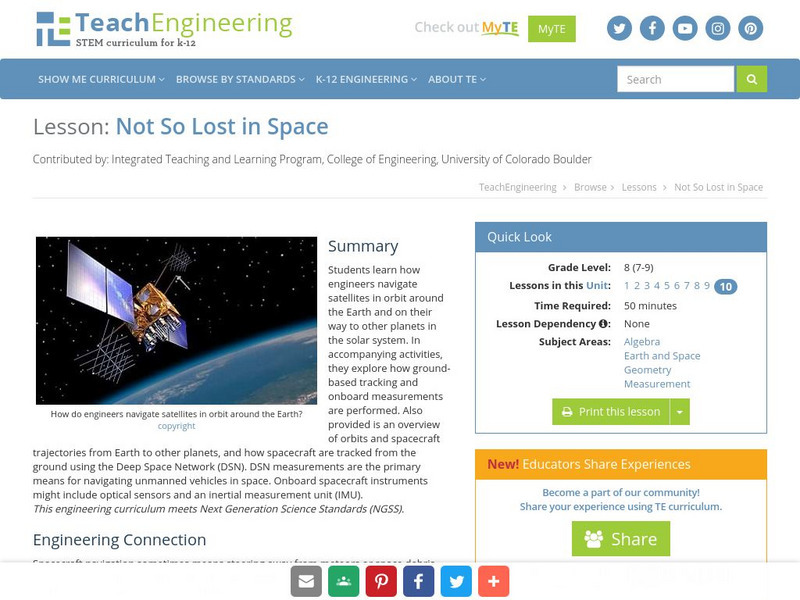
TeachEngineering
Teach Engineering: Not So Lost in Space
Middle schoolers learn how engineers navigate satellites in orbit around the Earth and on their way to other planets in the solar system. In accompanying activities, they explore how ground-based tracking and onboard measurements are...
Physics Classroom
The Physics Classroom: Circular and Satellite Motion: Weightlessness in Orbit
Through illustrated examples and practice problems, this interactive physics tutorial helps students clear up their possible misconceptions about weightlessness.
Physics Classroom
The Physics Classroom: Circular and Satellite Motion: The Inverse Square Law
Through illustrated examples and interactive practice, students explore Newton's ability to relate the cause for heavenly motion (the orbit of the moon about the earth) to the cause for Earthly motion (the falling of an apple to the...
Physics Classroom
The Physics Classroom: Circular and Satellite Motion: Speed and Velocity
In this interactive module, describe and explain the motion of objects that either move in circles or can be approximated to be moving in circles. Kinematic concepts and motion principles will be applied to the motion of objects in...