Hi, what do you want to do?






CK-12 Foundation
Ck 12 Exploration Series: Simulations: Physics: Newton's Cannon
[Free Registration/Login Required] Learn about orbits and how an object can stay in orbit under the influence of gravity. By adjusting launch velocities users will understand how to successfully put a virtual satellite into orbit without...
Nine Planets
The Nine Planets: The Moon
Explore the mythology, structure, observational history, gravitational force, and orbit of Earth's Moon.
Digital Public Library of America
Dpla: Race to the Moon
In 1955, the US and the USSR each announced plans to launch a satellite into orbit. Thus began the race to the moon. Throughout the 1960s and 1970s, the American space program and its new classes of astronauts achieved breakthroughs in...
NOAA
Noaa: Life Saving Satellites [Pdf]
Discover how satellites that orbit the Earth can save lives. Then use images obtained by satellites to construct a three-dimensional paper model of the Earth.
Georgia State University
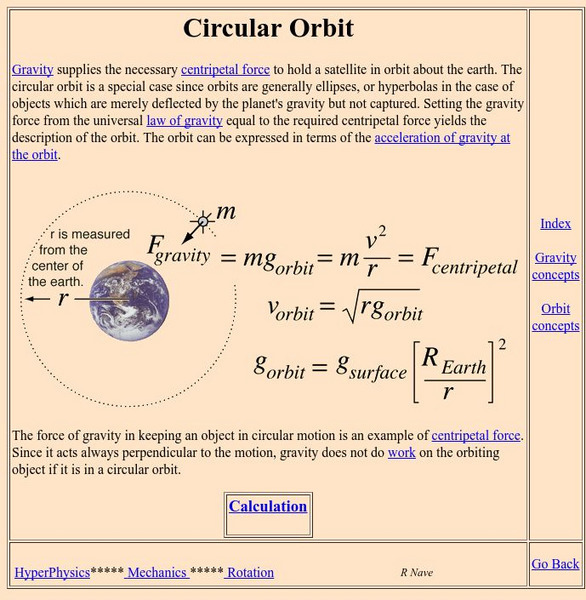
Georgia State University: Hyper Physics: Circular Orbit
The necessity of gravitation to a circular orbit is discussed and equations for the orbital speed are derived from the law of universal gravitation. Binary systems in which two objects orbit about a center of mass are explained and...
Illustrative Mathematics
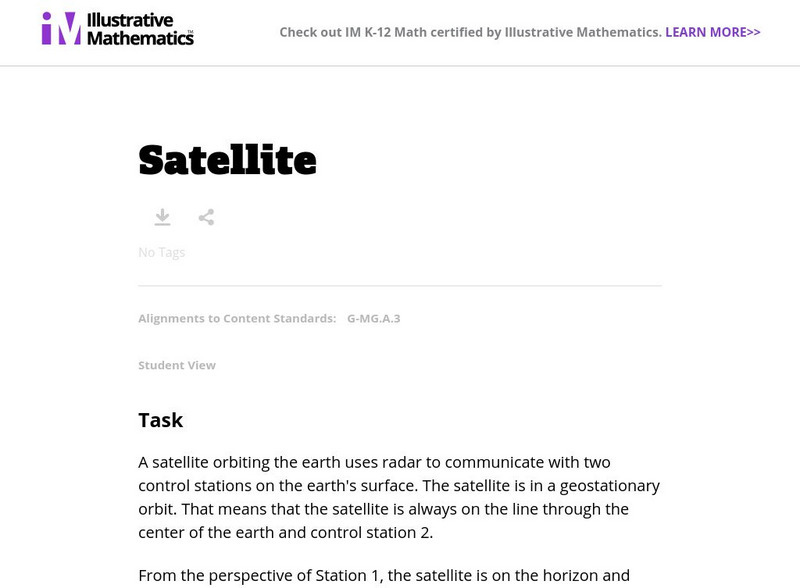
Illustrative Mathematics: G Mg Satellite
This task models a satellite orbiting the Earth in communication with two control stations located miles apart on Earth's surface. Students determine distances between various locations and, given a rate of travel, they determine the...
CK-12 Foundation
Ck 12 Exploration Series: Simulations: Physics: Clarke's Dream
[Free Registration/Login Required] Learn about geosynchronous orbits and their use in satellite communication.
Science Buddies
Science Buddies: Catching Stardust
How do astronomers collect stardust? They design and build satellites that are launched into space to collect particles on specially designed panels. Satellites can be sent to orbit around an object of interest: a planet, moon, or comet....
Boston University
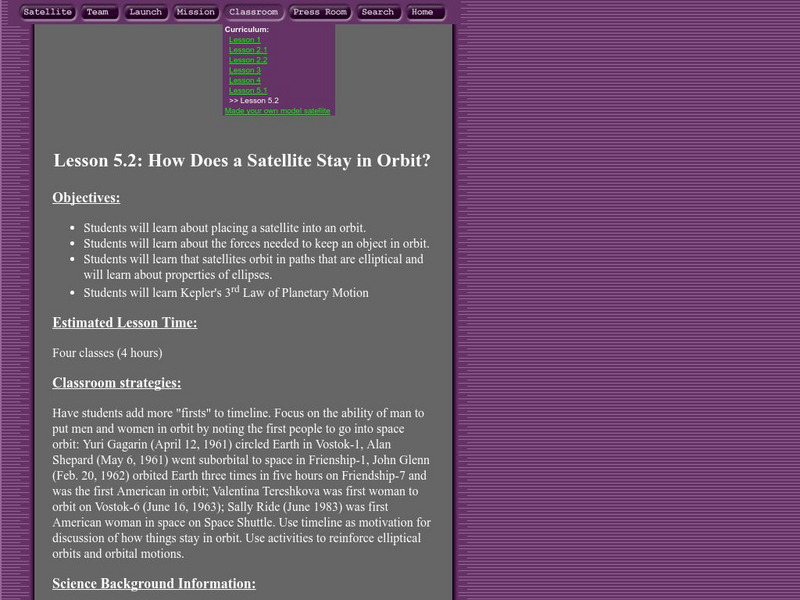
Bu: How Does a Satellite Stay in Orbit
This site contains a lesson on the ellipse. The lesson has students draw an ellipse with pencil and string, and discussions on orbits and theoretical orbiting situations.
NASA
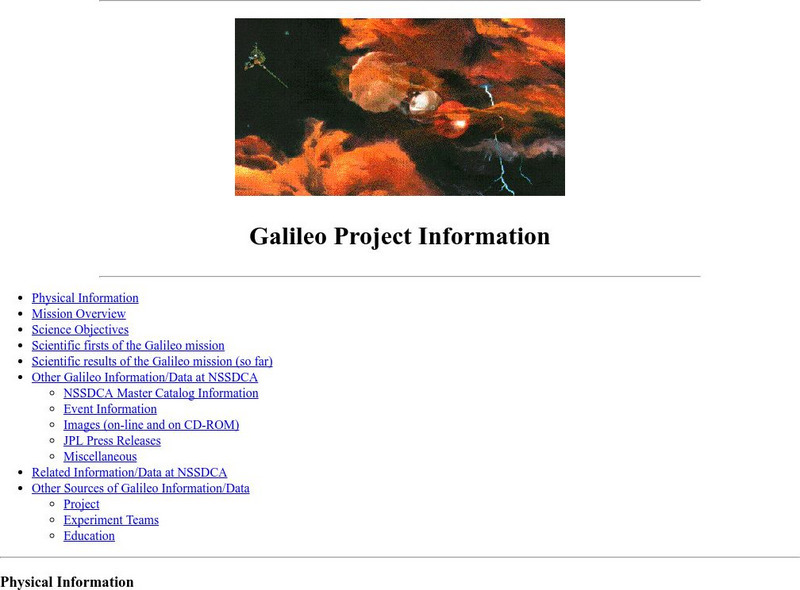
Nasa Space Science Data Archive: Galileo Project Information
This is the homepage of all of the archived information about and from the Galileo Mission. Included is data from the flybys of Venus, Earth, Moon, and Asteroids Gaspra and Ida, as well as the current data from Jupiter and its moons. See...
Government of Canada
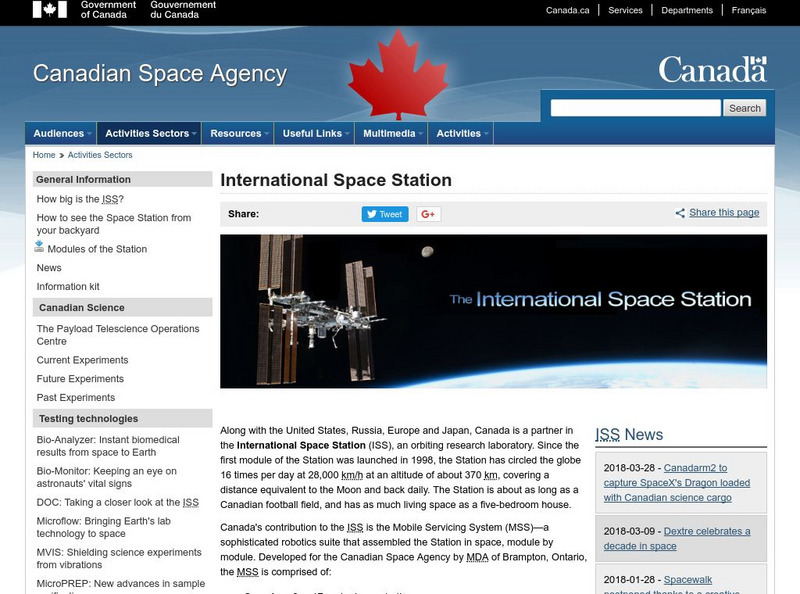
Canadian Space Agency: International Space Station
The Canadian Space Agency presents Canada?s partnership in the International Space Station that is orbiting the globe. Canada's contribution is explained and facts about the mission are explained with graphs and pictures. This site...
Other
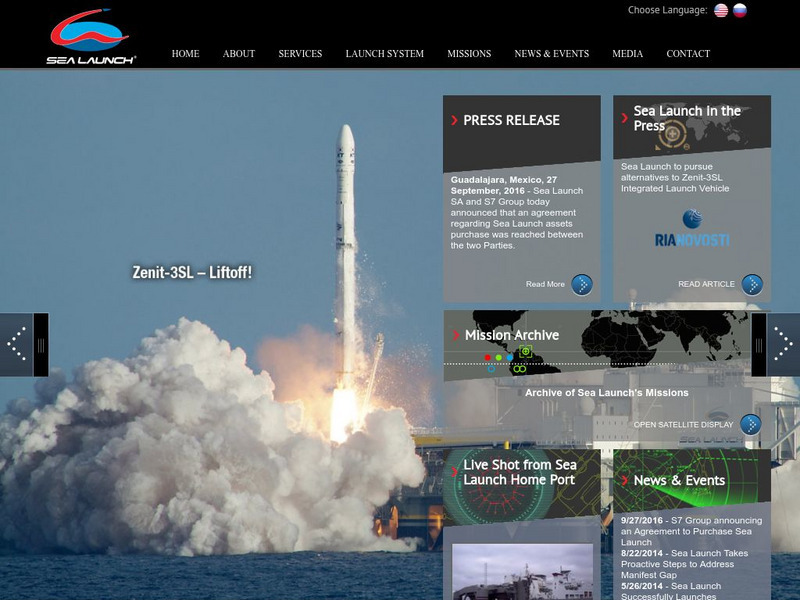
Sea Launch
This corporation launches rockets for businesses interested in a cost effective, reliable solution for sending satellites into orbit. Information, images, and detailed specifications can all be found here.
CK-12 Foundation
Ck 12: Physics: Gravitation Study Guide
This study guide on gravitation covers some key vocabulary, Kepler's Laws of Planetary Motion, and orbiting bodies or satellites. Includes important equations. It is available for download with free registration.
Science Struck
Science Struck: Facts About the Atmosphere Layers
Provides information about the five layers of Earth's atmosphere. Also discusses the satellites that orbit the Earth in the atmosphere.
NASA
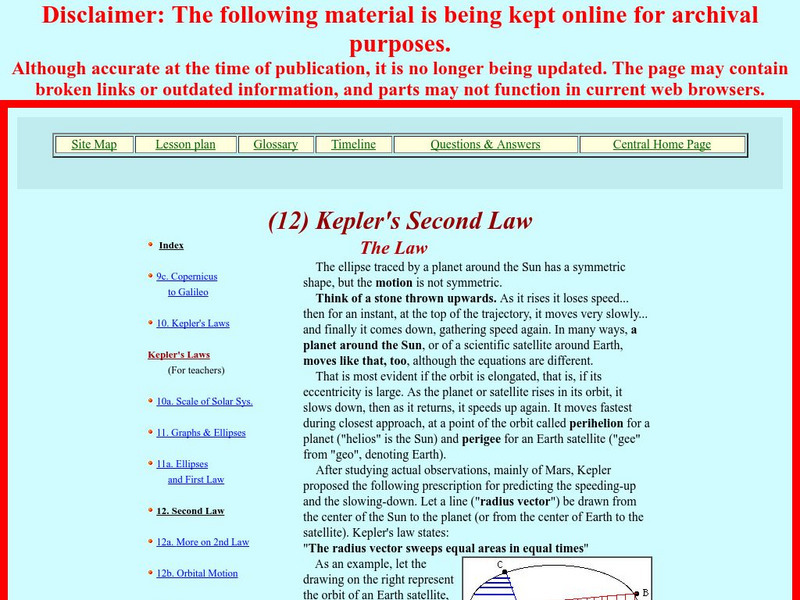
Nasa: Kepler's Second Law
This site from NASA states Kepler's second law of planetary motion and depicts its meaning with an informative diagram. Relates the law to conservation of energy principles and discusses the eccentricity of a satellite's (or a planet's)...
NASA
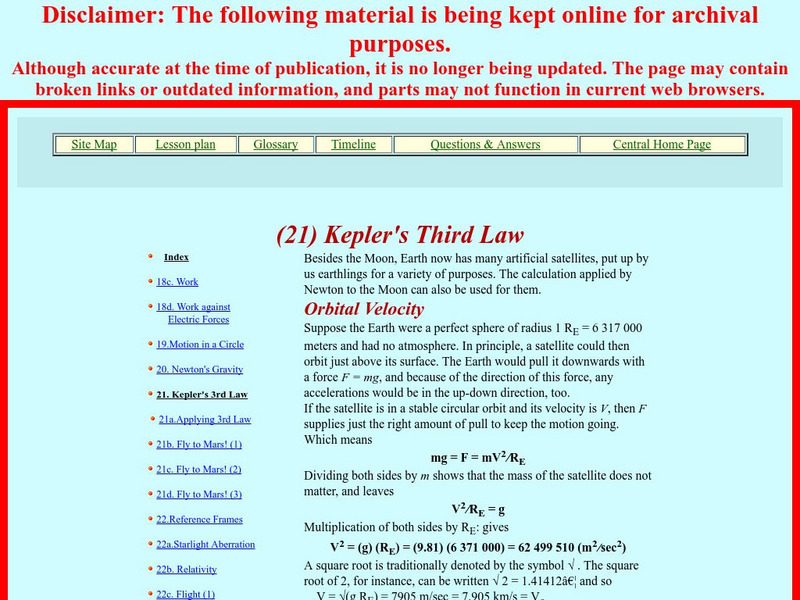
Nasa: Kepler's Third Law
This site from NASA states Kepler's third law of motion and extends it to develop an equation for the velocity of an orbiting planet.
NASA
Nasa: The Space Place: Sorting Out Trees in the Forest
This site from the National Aeronautics and Space Administration provides fun information on the subject. "people can do their jobs even better if they have very accurate images of the ground. Oddly enough, the best way to see lots of...
Science Education Resource Center at Carleton College
Serc: Flight to Mars: How Long? Along What Path?
Demonstrate how, with the use of orbital mechanics, a space mission to Mars can be planned. Using no more than algebra, Kepler's laws and the formula for the energy of an object in a Kepler orbit, the exercise derives the time for an...
Extreme Science
Extreme Science: The Moon
Read about the birth of Earth's moon, its composition, orbit, visible phases, and other interesting facts. Link to a virtual moon phase interactive which shows the current lunar phase and the phase on any date in the past or future.
Physics Classroom
The Physics Classroom: Kepler's Three Laws
The three laws of planetary motion as described by Kepler are stated and elaborated upon. Useful graphics and an easy-to-understand language are used to explain the nature of planetary motion. Both conceptual and mathematical. Includes a...
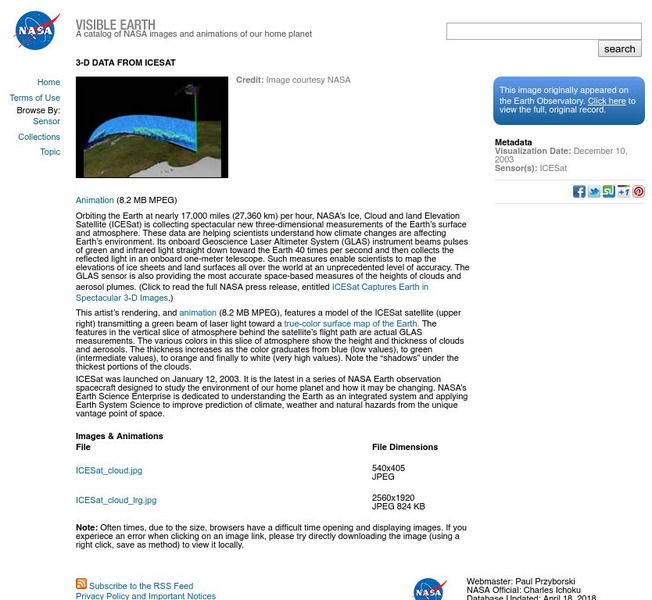
NASA
Nasa: Visible Earth: 3 D Data From Ice Sat
3-D Data from ICESat: Orbiting the Earth at nearly 17,000 miles per hour, NASA's Ice, Cloud and land Elevation Satellite (ICESat) is collecting spectacular new three-dimensional measurements of the Earth's surface and atmosphere.
PBS
Pbs News Hour Extra: Satellites Orbit the Sun to Better Predict Solar Storms
For the first time, NASA scientists have generated a full image of the sun, front and back, using twin orbiting satellites. The new view of Earth's star will allow for the study of solar weather events like coronal mass ejections that...
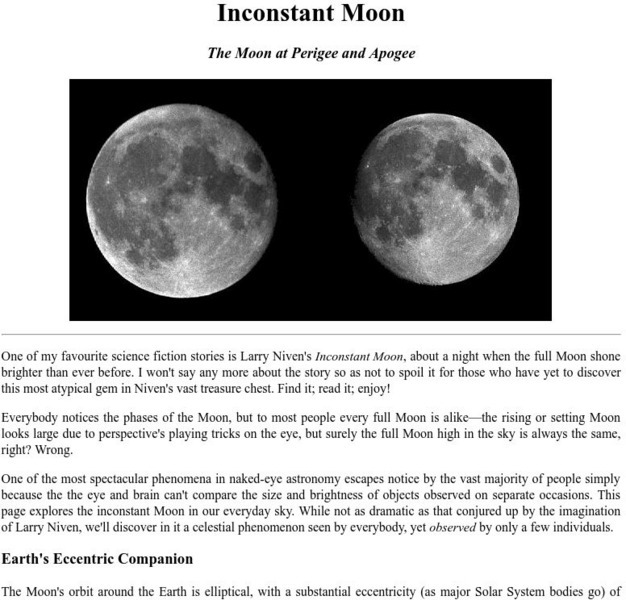
Fourmilab Switzerland
John Walker: Inconstant Moon: Moon at Perigee and Apogee
Most people think of every full moon as appearing the same, but careful observation allows us to see that sometimes the Moon appears larger than at others. This is caused by the elliptical orbit of our natural satellite.
Science Buddies
Science Buddies: Tracking Geomagnetic Storms in the Ionosphere
The Sun is the ultimate source of the energy that powers weather systems on Earth. Geomagnetic storms are sun-powered storms in the upper atmosphere, arising from energized particles that are periodically ejected by the Sun. Among other...