Hi, what do you want to do?






Visual Learning Systems
Atoms and Molecules
This video uses colorful imagery and animations to illustrate how matter is made of tiny particles. The nature of atoms and molecules is explored through instructive imagery. The video correlates to the Next Generation Science Standard...
Curated Video
Atoms and Molecules - what is the difference??
Atoms are the basic building blocks of all matter and they are very very small. They are made up of protons, neutrons and electrons and they are the smallest unit of matter that still retains the basic properties of an element.
...
...
Bozeman Science
Elements and Molecules
In this video Paul Andersen explains how elements and molecules are made of atoms. In a pure sample of a pure substance the average mass remains the same. If more than one atom is found in a molecule the ration of average masses...
Curated Video
Atoms and Elements: Defining Terms
Atoms and Elements: Defining Terms distinguishes the differences between an atom, an element, a molecule, and a compound.
Curated Video
How to Determine the Number of protons, neutrons and electrons in an ION
In this video, we'll be talking about how to determine the number of protons, neutrons, and electrons in an ion. We'll be using the periodic table to help us out, so don't miss it!
<
br/>
If you're looking to learn about atomic...
<
br/>
If you're looking to learn about atomic...
Bozeman Science
Synthesis and Decomposition Reactions
Atoms or molecules combine to form a new compound in a synthesis reaction. Examples include the addition of oxygen to magnesium metal to create magnesium oxide and the addition of carbon dioxide to water to crete carbonic acid. A...
Bozeman Science
PS1A - Structure and Properties of Matter
In the first physical science video for the Next Generation Science Standards Paul Andersen explains the structure and properties of matter. He starts by explaining how all matter is made of about 100 smaller particles called matter. ...
Bozeman Science
Emission and Absorption Spectra
In this video Paul Andersen explains how the photons emitted from or absorbed by an atom or nuclei is directly related to electrons moving between energy level. Absorption and emission are a direct result of the conservation of energy....
TED-Ed
TED-ED: What is the shape of a molecule? - George Zaidan and Charles Morton
A molecule is nearly all empty space, apart from the extremely dense nuclei of its atoms and the clouds of electrons that bond them together. When that molecule forms, it arranges itself to maximize attraction of opposite charges and...
Bozeman Science
London Dispersion Forces
In this video Paul Andersen describes the positive force intermolecular forces found between all atoms and molecules. As electrons are distributed unevenly it creates instantaneous dipoles which hold molecules together. This force even...
Crash Course
The Creation of Chemistry - The Fundamental Laws: Crash Course Chemistry
Today's Crash Course Chemistry takes a historical perspective on the creation of the science, which didn't really exist until a super-smart, super-wealthy Frenchman put the puzzle pieces together - Hank tells the story of how we...
Clarendon Learning
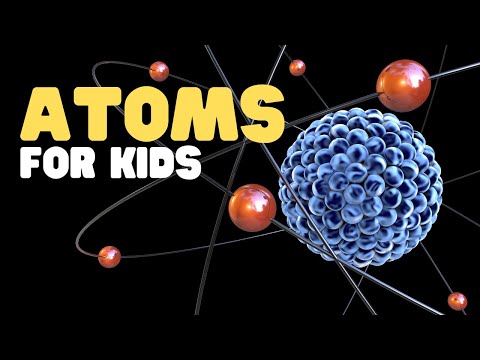
Atoms for Kids | What is an Atom? | Learn about atoms and molecules with activities and worksheets
Atoms for kids is an introduction video that helps students learn all about atoms. We answer questions like "What is an Atom?", "What is an Atom made of?", and "What do Atoms do?". We explore protons, electrons and neutrons and give a...
FuseSchool
In Depth: Atomic Mass Units
Learn the basics about Atomic Mass Units. The atomic mass is used to find the average mass of elements and molecules and to solve stoichiometry problems. Find out more in this video!
FuseSchool
CHEMISTRY - Matter - In Depth Atomic Mass Units
Learn the basics about Atomic Mass Units. The atomic mass is used to find the average mass of elements and molecules and to solve stoichiometry problems. Find out more in this video!
Curated Video
Introduction to Moles and Conversion of Grams to Moles
This video is on moles and how to convert between grams and moles. The speaker explains what a mole is, its significance in measuring chemical amounts, and the use of Avogadro's constant in determining the number of atoms or molecules in...
Science360
Chemiscope to catch chemistry in the act
What the microscope did to unlock the secrets of biology, the ""chemiscope"" is intended to do, to revolutionize chemistry. The ultimate goal is to observe chemistry in the act, to see the making and breaking of bonds in real-space and...
FuseSchool
What Shapes Do Simple Molecules Make
Learn the basics about the shapes of simple molecules, when learning about properties of matter. In reality the shapes of simple molecules are 3-D molecules and should be visualised as such. Imagine now the central carbon atom surrounded...
FuseSchool
Density Of Different States
Density Of Different States | Matter | Physics | FuseSchool Why is it easy to lift up a big inflated beach ball but much harder to lift a small heavy pebble? It is largely to do with density, the small pebble is more dense and the Big...
NASA
The Secrets behind Earth's Multi-colored Glow
What does our planet look like from space? Most are familiar with the beloved images of the blue marble or pale blue dot -- Earth from 18,000 and 3.7 billion miles away, respectively. But closer to home, within the...
Curated Video
Introduction to Alkenes and Cracking of Alkanes
This video provides an overview of alkenes, a type of hydrocarbon that contains a double carbon-carbon bond in their molecules. The video covers the structure and formulas of several alkenes, including ethene, propane, butene, and...
Curated Video
Introduction to Representing Elements and Compounds in Chemistry
This video is a lesson on how to represent elements and compounds in terms of the atoms they can take. The video covers the definition of an element, the periodic table, chemical symbols, and formulas. It also explains how compounds are...
Bozeman Science
Conservation of Atoms
In this video Paul Andersen explains how atoms are conserved in a chemical reaction. This can be seen in a chemical equation where the subscripts represent the atoms in the molecule and the coefficients represent the molecules. The...
Bozeman Science
Thinking in Structure and Function: Level 5 - Molecular-Level Structures
In this video Paul Andersen shows conceptual thinking in a mini-lesson on molecular-level structures.
TERMS
Molecular-level structures - locations of atoms in
a molecule
Function - an activity or purp
ose for a...
TERMS
Molecular-level structures - locations of atoms in
a molecule
Function - an activity or purp
ose for a...
Bozeman Science
Bond Length and Bond Energy
In this video Paul Andersen explains how the bond length and bond energy are calculated using an energy distance graph. The strength of the bond is determined by the charges in the constituent atoms. As the charge increases the bond...