Hi, what do you want to do?






Curated OER
Animal Alphabet
Second graders identify animals with each letter of the alphabet. In groups, they create a PowerPoint presentation which shows the information they have collected about each one. Using all of this information, they create an animal...

Curated OER
Volcanoes of the Deep
Students discuss how organisms relate to one another. They work together to research a specific organism and how it relates to other organisms. They present their findings to the class.

Curated OER
Classic Trash
Students investigate how trash is classified and the options to deal with it. In this trash and recycling lesson, students perform an activity to classify trash into organic, renewable/ recyclable, now renewable/recyclable and...

Curated OER
Kids for Conservation: Animal Unit
Students discuss animal needs and characteristics. In this animal mini-unit, students complete three activities studying different animals, their needs, how they have evolved, and how to protect them.

Curated OER
Buzzing is BEE-lieving
Students investigate insects. In this insect lesson, students explore various insect models and identify the characteristics of each. Students observe insects outside and tally how many insects they observe.

Curated OER
For Creative Minds: What Makes an Animal a Mammal?
Students read about categories of mammals and their features. Students then construct a marine animal, using given print outs in the instructional activity. Students then create adaptations for their mammal, using a web site reference...

Curated OER
Differences
Learners observe and compare a variety of living things and pictures of living things to note their similarities and differences.

Curated OER
Project Based Learning
What is Project-Based learning? Find out with a great informaitonal article that includeds multiple web and lesson links. Positive aspects of investigative and project based learning are some highlights you'll read about.

Curated OER
Wildlife Habitat
Pupils explain what a habitat is and describe its four elements. They see how an area's habitat suitability varies with different species of wildlife. They name factors that affect habitat suitability.

Curated OER
The Bald Eagle
Learners research selected Internet links to provide information about the characteristics and behavior of the bald eagle.

Curated OER
It's A Jungle Out There!
Young scholars report on an animal according to its appearance, habitat, and characteristics.

Curated OER
Working-with-Animals Careers
First graders list and discuss careers that involve working with animals and draw pictures of careers that interest them. They compare and contrast domestic and wild animals.

Curated OER
Plant Party
Students identify plant parts. For this plants lesson, students bring in a vegetable. Each student classifies which part of the plant their vegetable comes from (flower, root, ect.) Students identify the parts of their vegetable and...

Curated OER
Food webs and Energy Flows
Students become familiar with food chains. In this food chains lesson, students understand that as consumers eat other consumers energy is passed. Students understand the vocabulary associated with food chains.

Curated OER
The Music in Us
Students explore the origins of human music. Students watch a video and participate in a variety of activities. They examine evidence, conduct research on he various animals, and create a concept map.

Curated OER
Animal ABC Book
Students in class choose a letter of the alphabet and uses the Enchanted studying web site to pick which animal they copy and paint for their letter. Students copy animal printout and paint or color it.
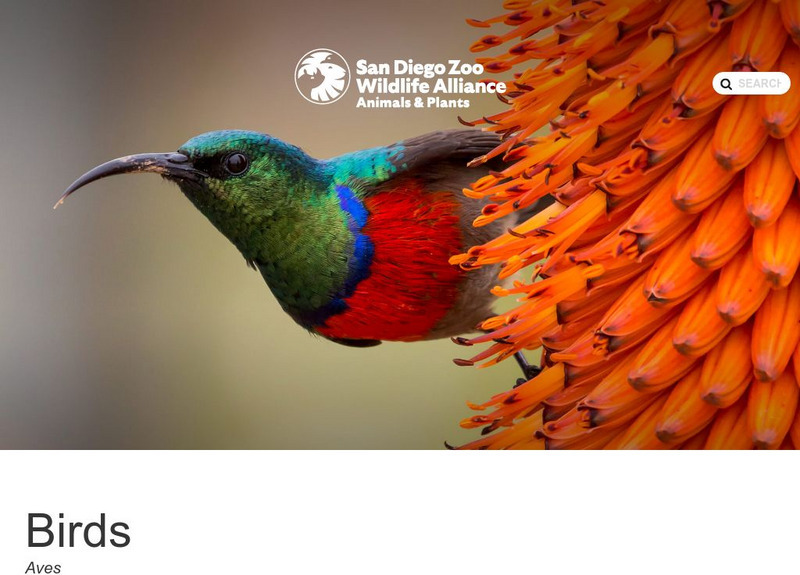
San Diego Zoo Global
San Diego Zoo: Birds
This resource provides detailed information about birds, as well as several pictures.

CK-12 Foundation
Ck 12: Third Grade Science: Life Sci: Animal Characteristics and Classification
[Free Registration/Login may be required to access all resource tools.] Presents an overview of the major animals groups (mammals, birds, reptiles, amphibians, fish, arthropods, vertebrates, invertebrates, those having live births and...

E-learning for Kids
E Learning for Kids: Science: Caribbean Sea: How Can We Classify Animals?
Welcome to Hideaway Island where five pirates need to find crews for their ships. Join in and learn about animals with backbones.
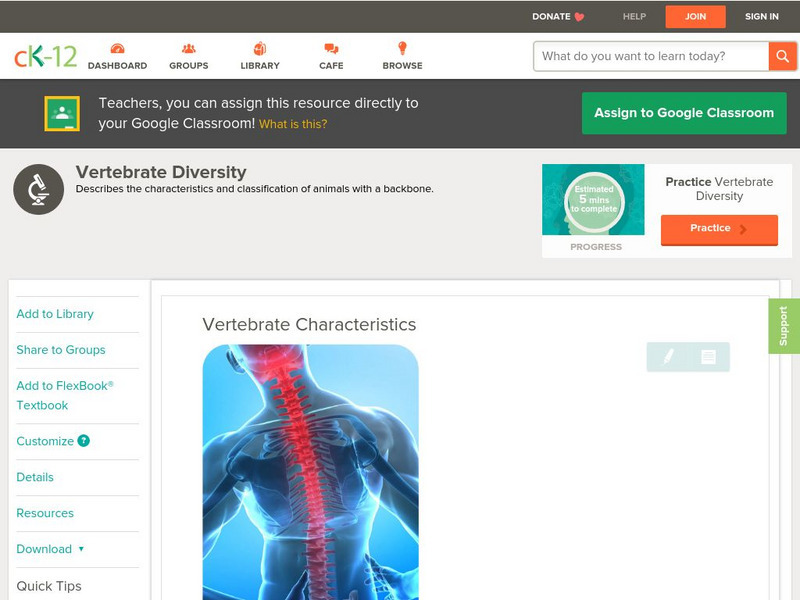
CK-12 Foundation
Ck 12: Life Science: Vertebrate Characteristics
[Free Registration/Login may be required to access all resource tools.] Vertebrates are animals with backbones. These include fish, amphibians, reptiles, birds, and mammals. Learn more about vertebrate characteristics in this learning...

CK-12 Foundation
Ck 12: Life Science: Chordates
[Free Registration/Login may be required to access all resource tools.] Did you know that fish, amphibians, reptiles, birds, and mammals are all related? They are all chordates. Chordates are a group of animals that includes vertebrates,...
Soft Schools
Soft Schools: Animal Quizzes
Links to science quizzes about animals and birds. Topics include animal classification, butterfly, beetle and frog life cycles, spiders, bats, birds of prey, owls, birds of the jungle, rainforest, cold climates and migration.
Other
Science4 Us: Animals
In online and offline activities, students broaden their understanding of animals by learning to identify and classify animals into six categories: mammals, birds, fish, amphibians, reptiles, and invertebrates.
CommonLit
Common Lit: "Strength in Numbers" by Bird Brain Science
A learning module that begins with "Strength in Numbers," accompanied by guided reading questions, assessment questions, and discussion questions. The text can be printed as a PDF or assigned online through free teacher and student...