Hi, what do you want to do?






American Museum of Natural History
What is the Greenhouse Effect?
Without the greenhouse effect, Earth would not be inhabitable. A thorough online resource describes the greenhouse effect and how it occurs. The source highlights the different types of gases that work together to absorb the sun's...

American Museum of Natural History
Planetary Mysteries
Get to know our little part of the vast universe. Learners read about the common and not-so-common facts about each of the planets in the solar system. The interactive lesson includes a large amount of information as well as a quiz to...

American Museum of Natural History
Climate Change
It actually is possible to have too much of a good thing when it comes to climate change. A slide show lesson describes how burning fossil fuels contributes to climate change. Individuals read about the scientific process and the...

American Museum of Natural History
What is Astronomy?
Go study the universe. Pupils learn seven aspects about astronomy and astronomers. They begin to learn about constellations; distance and motion between objects; gravity; the electromagnetic spectrum; dark matter and energy; and teams of...

Curated OER
Climate Change
Rising sea levels, strong storms, melting ice ... who or what is to blame? Scholars browse the website in preparation for a class discussion or debate about whether human activity is causing climate change. They gain a balanced...

Other
The Amazing World of Science With Mr. Green: Introduction to the Atmosphere
This teacher website provides a comprehensive lesson unit on the structure of Earth's atmosphere and how it sustains and impacts life on Earth and its ecosystems. Includes labeled diagrams, student worksheets, a slideshow, flashcards,...
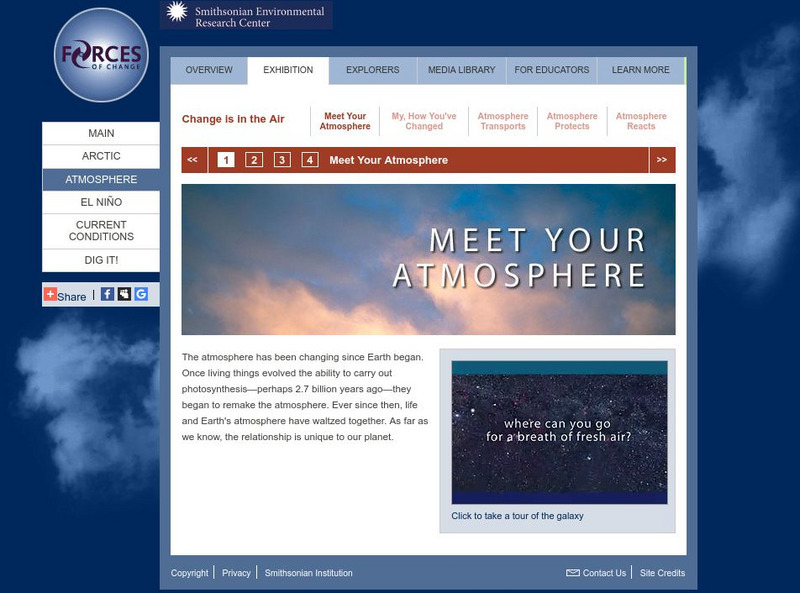
Smithsonian Institution
Smithsonian Environmental Research Center: Forces of Change:meet Your Atmosphere
This superb site has detailed information about the composition of the atmosphere, how it is always changing, how it protects life on earth, and the destructive impact human activity has on it. There is an atmosphere design lab, as well...
University Corporation for Atmospheric Research
Ucar: Introduction to the Atmosphere
A detailed overview of the Earth's atmosphere, with explanations about atmospheric properties, the structure of the atmosphere, its four layers, atmospheric processes, energy heat transfer, conduction and convection, and radiation. All...

Ducksters
Ducksters: Science for Kids: Earth's Atmosphere
Kids learn about the science of the Earth's Atmosphere. Carbon dioxide, Oxygen, Nitrogen and more make up clouds and weather.
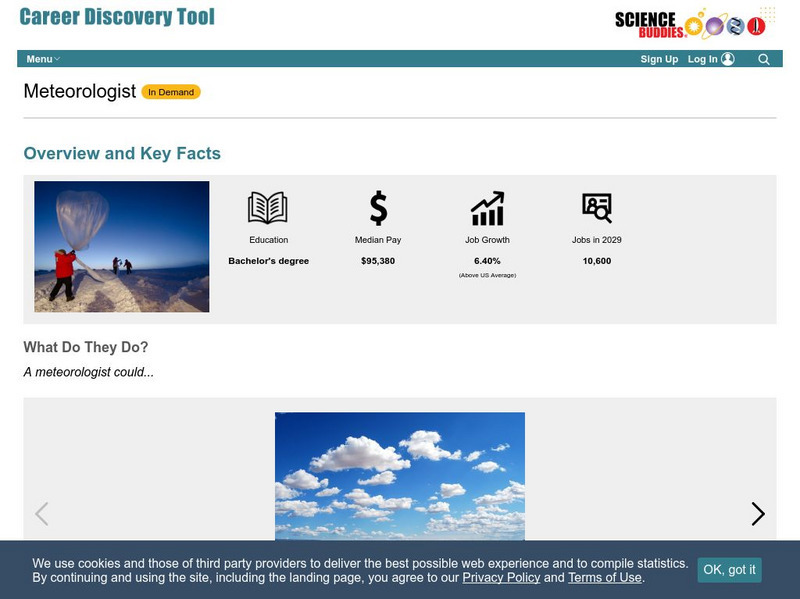
Science Buddies
Science Buddies: Career Profile: Meteorologist
As Bob Dylan once sang, you don't need a weatherman to know which way the wind blows, but you do need one to tell you why it's blowing. Science Buddies provides a career profile for a meteorologist and what the career entails. Find out...
American Geosciences Institute
American Geosciences Institute: Earth Science Week
This site includes learning resources and activities for Earth Science Week 2016. The goal of the week is to "engage young people and others in exploring geoheritage throughout the Earth systems, including the geosphere, hydrosphere,...
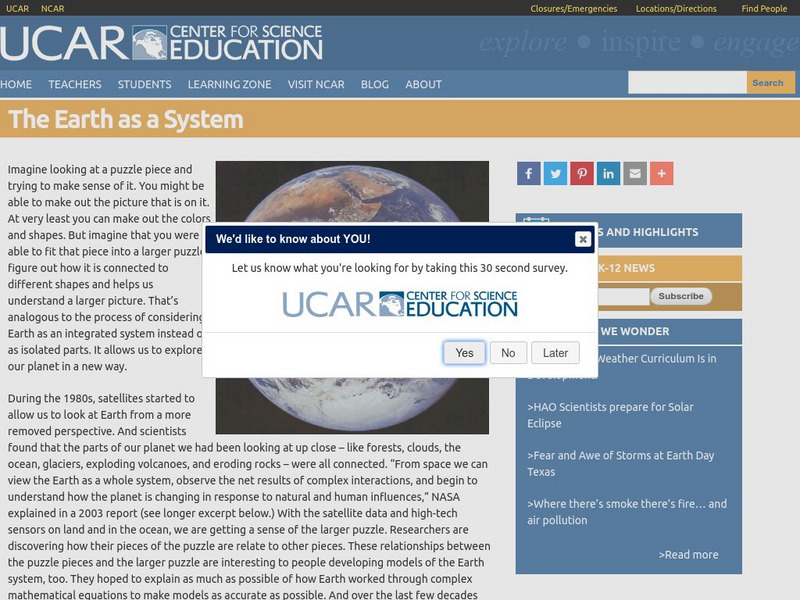
University Corporation for Atmospheric Research
Ucar: The Earth as a System
An overview of content about Earth and its atmosphere. The module was developed for middle school science teachers to provide background information for teaching the curriculum.
NASA
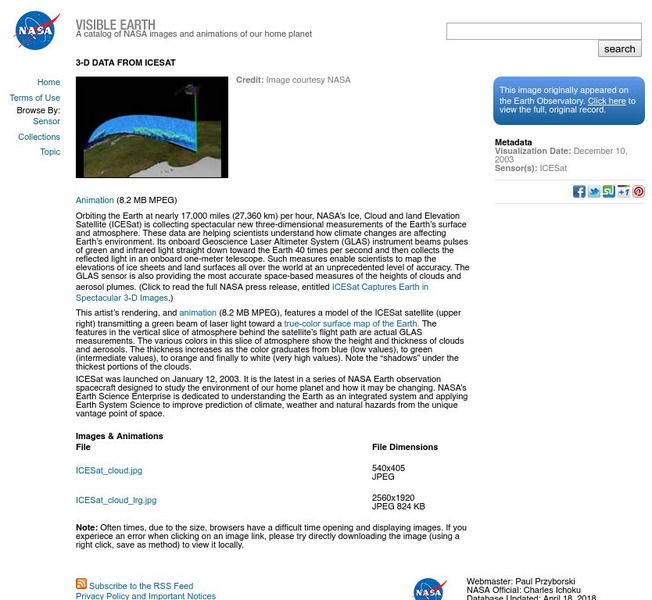
Nasa: Visible Earth: 3 D Data From Ice Sat
3-D Data from ICESat: Orbiting the Earth at nearly 17,000 miles per hour, NASA's Ice, Cloud and land Elevation Satellite (ICESat) is collecting spectacular new three-dimensional measurements of the Earth's surface and atmosphere.
NASA
Nasa: Image Science Center: Ask the Space Scientist Earth
Site from NASA contains a collection of 91 questions pertaining to the Earth's atmosphere, magnetic field, ionosphere, rotation and origin of life.
University Corporation for Atmospheric Research
Ucar: Atmospheric Science Explorers: Global Climate Change
A detailed overview of global climate change, with explanations of Earth's climate change, the carbon cycle, ecosystems, and greenhouse gases, and how the movements of matter and energy impact on climate. All information is reinforced...
US Geological Survey
U.s. Geological Survey: The Usgs and Science Education
"Explore things on, in, around and about the earth," with this web site dedicated to K-12 education from the United States Geological Survey. Homework help, science topics and fun learning games for students in Kindergarten through High...

BBC
Bbc: Schools: Chemistry (Single Science)
Chemistry is the study of the composition, behavior and properties of matter, and of the elements of the Earth and its atmosphere. This site provides links to chemistry exams over courses in BBC: AQA, Edexcel, Eduqas, OCR 21st Century,...
Morning Earth
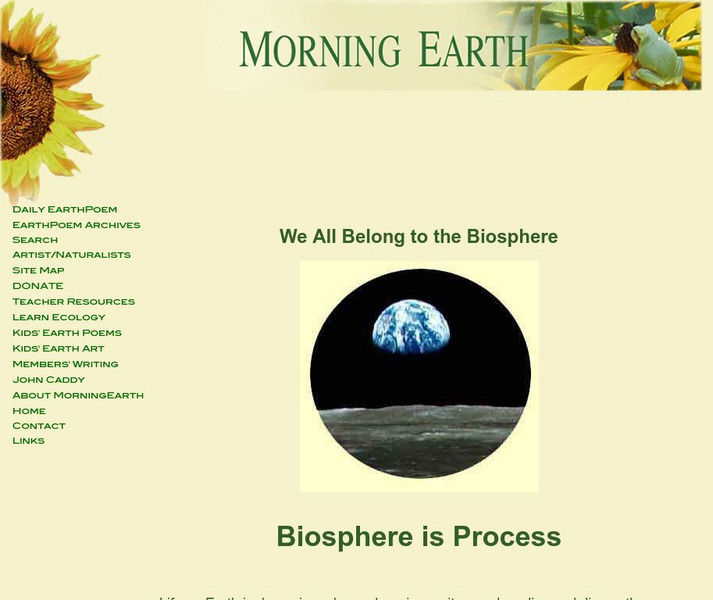
How Life Works: Biosphere Is Process: Atmosphere and Ocean Currents
Learners examine the Earth science topic of oceanography. The tutorial consists of definitions and pictures on atmosphere and ocean currents.
Globe
The Globe Program: Learning to Benefit the Environment
The GLOBE program is a worldwide network of students and scientists working together to monitor Earth's atmosphere and water. There are lots of resources here, and you can email a student involved in the program to learn more about GLOBE.
NASA
Nasa: Heliophysics: New Science of the Sun Solar System Connection
This site from NASA lists common and uncommon misconceptions about Sun-Earth Science. Site also provides links to activities and lesson plans as well as background reading.
NOAA
Noaa: Education Resources
Links to earth science sites, including safety tips, fun activities, general earth science information, and daily weather reports and more.

Ducksters
Ducksters: Science for Kids: Oxygen Cycle
Kids learn about the oxygen cycle and how this nutrient travels through the ecosystem to sustain life on Earth.
Other
Conservation Corps Newfoundland and Labrador: Climate Change Club
Join the fun at the Climate Change Club where you can find out ways to take action at home, in school, and in your community. Keep up with the latest news in climate science, and link to fact sheets and other fun sites that care about...

Ducksters
Ducksters: Earth Science for Kids: Weather: Wind
Kids learn about wind including how it is formed, how it is measured, local and global winds including prevailing, westerlies, trade, and polar easterlies.