Hi, what do you want to do?





Science Buddies
Science Buddies: Wave Blockers
What do the radio, TV, radio controlled cars, and cell phones all have in common? They all use invisible waves to transmit information. Find out which materials block radio waves, and which materials allow radio waves to pass through in...
Science Buddies
Science Buddies: Mag Nificent Breakfast Cereal
You will devise a way of testing foods for supplemental iron additives in this experiment provided by Science Buddies. Then you will use your design to test different breakfast cereals to see how much iron they contain. The goal is to...
Science Buddies
Science Buddies: When Science Is Sweet: Growing Rock Candy Crystals
Though rock candy seems to be a simple enough treat, it is also pretty interesting to make. Crystallized sugar that can be grown from a sugar-water solution is just how rock candy is made. In this experiment, you will learn to make your...

Science Buddies
Science Buddies: Baseball Bat Debate: What's Better, Wood or Aluminum?
Science and math abound in baseball. In this project, you can produce some interesting baseball statistics of your own and perhaps settle a long-standing debate. You'll set up experiments at your local playing field to find out which...
Science Buddies
Science Buddies: Cabbage Chemistry
This experiment is for all the kids out there who love boiled cabbage. Even if you don't like cabbage, perhaps you will like this amazing color-changing liquid you can make with cabbage. You'll learn which solutions around your house can...
Science Buddies
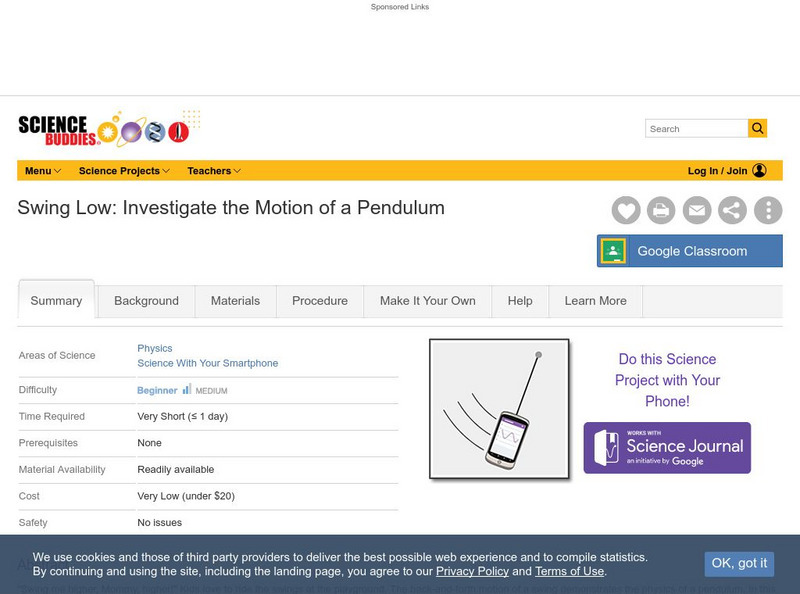
Science Buddies: Swing Low: Investigate the Motion of a Pendulum
Kids love to ride the swings at the playground. The back-and-forth motion of a swing demonstrates the physics of a pendulum. In this experiment, you will investigate the factors that affect the speed and duration of a pendulum's swing.
Science Buddies
Science Buddies: Nitrogen Fixing Bacteria and Nitrogen Fertilizers
Plants need nitrogen to build proteins and nucleic acids to grow healthy stems and leaves. Though the Earth's atmosphere is made up of 79% nitrogen, the form of nitrogen found in the atmosphere cannot be used by plants. In this...
Science Buddies
Science Buddies: It's Crowded in Here! A Study of Plant Population Density
Like humans, plants can be negatively affected by overcrowding. Unlike humans, plants cannot get up and move to a new environment or explore how to utilize new resources. This experiment will explore the effects of crowding (population...
Science Buddies
Science Buddies: Plants Are on the Move! A Study of Gravitropism
As we humans zip from place to place, we often forget to stop and smell the roses. Compared to our fast-paced lifestyle, plants seem rooted to the spot. Don't be deceived by appearances however, plants are on the move. This experiment...
Science Buddies
Science Buddies: Estimation and Population Size
Have you ever wanted to take a short cut? How about when doing your math homework? In this experiment you can learn how estimation can save you time doing math calculations. But beware, some estimations are better than others. Can you...
Science Buddies
Science Buddies: Who Has the Biggest Genome?
Humans are complex creatures, but do we have the biggest genome? All living things, from humans to worms to bacteria have genomes. In this experiment you will compare the genome sizes of different organisms to find out who has the...
Science Buddies
Science Buddies: Measuring Up
Measurements are very important for scientists. It is especially important that the measurements be accurate. Think about how important accuracy is when you want to know if you are taller than a friend of yours, every inch counts. In...
Science Buddies
Science Buddies: How Many Seeds Do Different Types of Fruit Produce?
Do you like your strawberry jelly with or without the seeds? Are you glad to have a seed-free watermelon, or do you enjoy spitting the seeds into the garden? You might not like to find seeds in your fruit, but fruit is nature's way of...
Science Buddies
Science Buddies: Pick a Card, Any Card
No matter what your favorite card game is, we all wish we could use psychic powers to draw the card we want on our turn. You may not have psychic powers, but you might have the power of probability on your side. Do this experiment and...
Science Buddies
Science Buddies: Finding Phyla
Animals come in all shapes and sizes, each a small part of the amazing diversity of life. These differences can also help us to classify animals into different groups. Which group do you belong to? Do this experiment to investigate the...
Science Buddies
Science Buddies: Play Doh Math
One piece of Play-Doh can make many different shapes. Even though you can change the shape by squishing or stretching the Play-Doh, it is still the same size unless you add or take away some of the dough. Try this experiment to test how...
Science Buddies
Science Buddies: M&m Geometry
Geometry is the study of how to use math to describe and investigate different points, lines and shapes. The way that a shape is described in geometry is with a formula, which is simply a mathematical way to calculate different...
Science Buddies
Science Buddies: How Does a Hovercraft Work?
Riding on a hovercraft is like gliding on a cushion of air. Make your own mini hovercraft in this experiment to test how hovercrafts work.
Science Buddies
Science Buddies: Rubbing Up Against Static Electricity
A tried and true balloon activity is to rub a balloon on your head to make your hair stand up. Learn how the rubbing builds up static electricity using this experiment to see if the number of rubs makes a difference.
Science Buddies
Science Buddies: How Do Different Materials React to Static Electricity?
Polyester clothing was generally accepted as a popular trend in fashion at one point in history. Now everybody wears cotton, which doesn't get static cling nearly as much. Why are some materials more susceptible to static cling than...
Science Buddies
Science Buddies: Digital Photo Contrast
What do you do if you take a photo and it turns out too dark or too bright? You can use your computer to fix it for you. In this experiment you will investigate how changing the contrast of a digital photo will change the colors and...

Science Buddies
Science Buddies: Soil Compaction
Have you ever had to dig a hole in really hard dirt? It is a lot of work. In this experiment you can make an instrument to test the soil and find out how compacted it is, before you dig.
Science Buddies
Science Buddies: Soil Color and Moisture
When you step in mud it can be very messy. How can you tell if soil is wet or dry before you step in it? In this experiment, you can see if color can help you figure it out.

Science Buddies
Science Buddies: Porosity and Particle Size
Often, when we think of something that is solid we think about rocks. But in reality, rocks have tiny holes of air inside them. This is called porosity. In this experiment you can find out what it means to be "solid as a rock."