Hi, what do you want to do?






Science Buddies
Science Buddies: Macro for Micro?
If the prefix "macro" means large and "micro" means small, then why will the macro setting of a digital camera help take a better picture of a small object? Do this experiment and get the big picture.
Science Buddies
Science Buddies: Go and Stop? Ant Traffic Signals
Have you ever stopped to watch a trail of ants moving back and forth between a food source and their nest? Have you ever wondered how they establish their trail? You've probably read that ants use chemical signals to communicate with one...

Science Buddies
Science Buddies: Mixing Light to Make Colors
You know how to make new colors by mixing paint or crayons. For example, you get green by mixing yellow and blue, or orange by mixing red and yellow. With paint, blue, yellow, and red are primary colors, which you can use to make other...

Science Buddies
Science Buddies: Yogurt Cultures
Find out in this experiment how good bacteria can turn milk into a treat by investigating the optimal starter cultures for making yogurt from whole milk.
Science Buddies
Science Buddies: Can the Color of Your House Reduce Your Energy Bill?
Did you know that the color of your house could save money? Do this experiment to see which colors regulate temperature best in different environments. Learn how painting the house can save money on the energy bill.
Science Buddies
Science Buddies: Yeasty Beasties
While looking at a package of dry yeast it is hard to believe it is alive. But add the right ingredients and presto, the mixture becomes a bubbly, oozing, mess of life. What are the right ingredients? Do this experiment and figure it out...

Science Buddies
Science Buddies: How Well Do Disinfectants Work?
Germs are everywhere. We try and clean our home with disinfectants, but do we really get rid of all the germs? Find out with this "hands-on" experiment.
Science Buddies
Science Buddies: Does Temperature Affect the Rate of Butterfly Development?
This is an interesting experiment for an Investigator who is 1) curious about insect metamorphosis and 2) patient. You'll need to set up different controlled environments for the chrysalides, and then check on them regularly as you wait...
Science Buddies
Science Buddies: Boys and Girls All Around the Town
In this experiment you will find out if boys and girls go to the same places, or if some places tend to have more of one gender over the other.

Science Buddies
Science Buddies: Do the Eyes Have It?
Some people have a photographic memory and can memorize anything they see almost instantly. Other people can remember almost anything they hear. Try this experiment to see which type of memory you have.
Science Buddies
Science Buddies: Eeeeew! Maggot Mass Temperature
If you're looking for an experiment that will gross out just about everyone, you probably can't do much better than this. This project investigates an important question in the field of forensic entomology. Just make sure to get...
Science Buddies
Science Buddies: How the Strength of a Magnet Varies With Temperature
Physicists sometimes study matter under extreme conditions. For example, think of the emptiness of interstellar space vs. the unimaginable crush of pressure at the center of a neutron star, or an object dipped in liquid nitrogen vs. the...
Science Buddies
Science Buddies: Teachers Rule!
Most students like their teachers. However, they may not always say so. Peer pressure may keep a student from expressing how they really feel. In this experiment you will find out if more students like their teacher in younger grades...

Science Buddies
Science Buddies: Distance and Constant Acceleration
This project is an experiment in classical physics. You'll be following in Galileo's footsteps, and investigating Newton's laws of motion, using a metronome as your timing device. This resource will help you get a firm understanding of...
Science Buddies
Science Buddies: Distance and Speed of Rolling Objects
This project is an experiment in classical physics. You'll be following in Galileo's footsteps, and investigating Newton's laws of motion, but you'll be taking advantage of modern video recording technology to make your measurements. The...
Science Buddies
Science Buddies: How Do the Seasons Change in Each Hemisphere?
On a rainy day, do you ever wonder what the weather is like on the other side of the planet? Different regions around the globe can have very different seasonal weather patterns. In this experiment, you can test if these seasonal...

Science Buddies
Science Buddies: How Does a Wind Meter Work?
On a windy day it is hard to keep your hat on. The power of the wind can even be strong enough to power large wind turbines to make electricity. In this experiment, find out how you can make your own instrument to measure the speed and...
Science Buddies
Science Buddies: How Many Numbers Can You Remember?
Most people don't even remember phone numbers anymore, and instead program them into their phones. There is a limit to the number of numbers, or digits, that most people can remember. Try this experiment to test your digit span, the...
Science Buddies
Science Buddies: Buoyancy of Floating Cylinders
This project presents an interesting puzzle. A disk of wood will float face-up, that is, with its circular cross-section parallel to the surface of the water. A long log of wood, however, floats with the circular cross-section...
Science Buddies
Science Buddies: What a Drag!
What makes some objects more streamlined than others? Find out which ordinary objects around your house are made to move smoothly through the water in this easy experiment. Which objects will produce the most drag when pulled through the...
Science Buddies
Science Buddies: Gears Go Round!
Music boxes, bicycles, and clocks all have one thing in common: GEARS. You might say that gears make the world turn, since they are in so many mechanical instruments. How do they work and how do you know which gears to use? Find out in...
Science Buddies
Science Buddies: Rubber Bands for Energy
If you've ever been shot with a rubber band then you know it has energy in it, enough energy to smack you in the arm and cause a sting. How can the energy of a rubber band be put to work? In this experiment you will find out how the...
Science Buddies
Science Buddies: Which Simple Machines Do I Use the Most?
When you think of a machine, you probably think of computers or robots. Try this experiment to see how simple machines are used everyday around your house.
Science Buddies
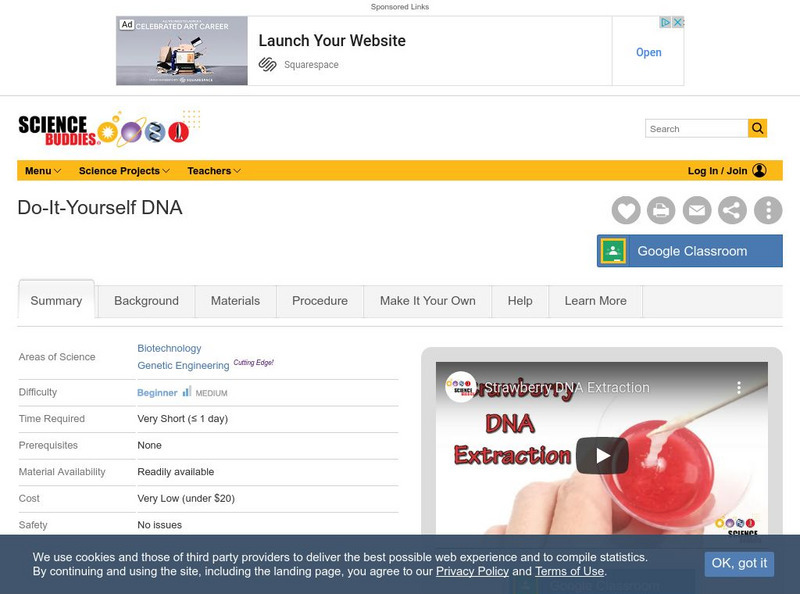
Science Buddies: Do It Yourself Dna
All living things have DNA inside their cells. In this experiment you can make your own DNA extraction kit from household chemicals and use it to extract DNA from strawberries.