Hi, what do you want to do?






Science Buddies
Science Buddies: Measuring the Moon
Sometimes a full moon can be so bright, you can walk around in the dark without a flashlight. How much brighter is a full moon than the other phases of the moon? How is the brightness of the moon measured?
Science Buddies
Science Buddies: How Many Seeds Do Different Types of Fruit Produce?
Do you like your strawberry jelly with or without the seeds? Are you glad to have a seed-free watermelon, or do you enjoy spitting the seeds into the garden? You might not like to find seeds in your fruit, but fruit is nature's way of...
Science Buddies
Science Buddies: Finding Phyla
Animals come in all shapes and sizes, each a small part of the amazing diversity of life. These differences can also help us to classify animals into different groups. Which group do you belong to? Do this experiment to investigate the...
Science Buddies
Science Buddies: How Does a Hovercraft Work?
Riding on a hovercraft is like gliding on a cushion of air. Make your own mini hovercraft in this experiment to test how hovercrafts work.
Science Buddies
Science Buddies: Rubbing Up Against Static Electricity
A tried and true balloon activity is to rub a balloon on your head to make your hair stand up. Learn how the rubbing builds up static electricity using this experiment to see if the number of rubs makes a difference.
Science Buddies
Science Buddies: How Do Different Materials React to Static Electricity?
Polyester clothing was generally accepted as a popular trend in fashion at one point in history. Now everybody wears cotton, which doesn't get static cling nearly as much. Why are some materials more susceptible to static cling than...

Science Buddies
Science Buddies: Soil Compaction
Have you ever had to dig a hole in really hard dirt? It is a lot of work. In this experiment you can make an instrument to test the soil and find out how compacted it is, before you dig.
Science Buddies
Science Buddies: Soil Color and Moisture
When you step in mud it can be very messy. How can you tell if soil is wet or dry before you step in it? In this experiment, you can see if color can help you figure it out.

Science Buddies
Science Buddies: Porosity and Particle Size
Often, when we think of something that is solid we think about rocks. But in reality, rocks have tiny holes of air inside them. This is called porosity. In this experiment you can find out what it means to be "solid as a rock."
Science Buddies
Science Buddies: Go and Stop? Ant Traffic Signals
Have you ever stopped to watch a trail of ants moving back and forth between a food source and their nest? Have you ever wondered how they establish their trail? You've probably read that ants use chemical signals to communicate with one...
Science Buddies
Science Buddies: Can the Color of Your House Reduce Your Energy Bill?
Did you know that the color of your house could save money? Do this experiment to see which colors regulate temperature best in different environments. Learn how painting the house can save money on the energy bill.
Science Buddies
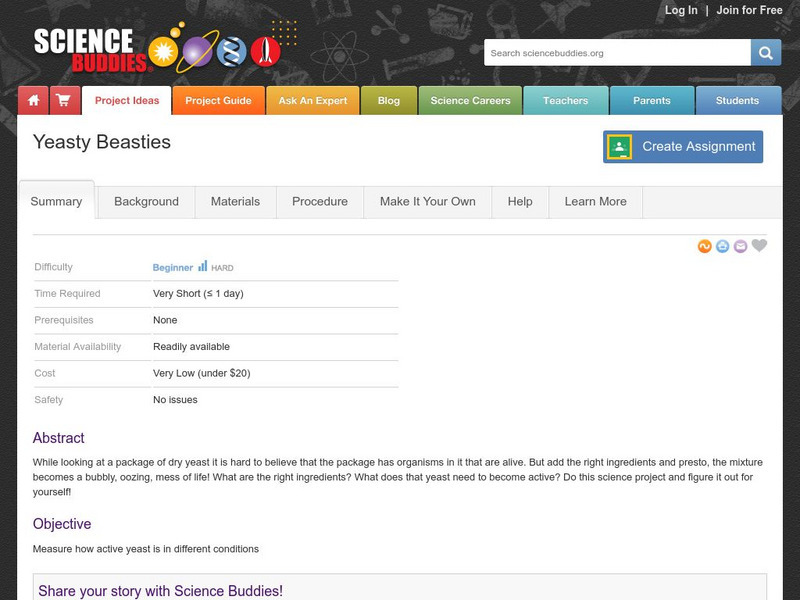
Science Buddies: Yeasty Beasties
While looking at a package of dry yeast it is hard to believe it is alive. But add the right ingredients and presto, the mixture becomes a bubbly, oozing, mess of life. What are the right ingredients? Do this experiment and figure it out...
Science Buddies
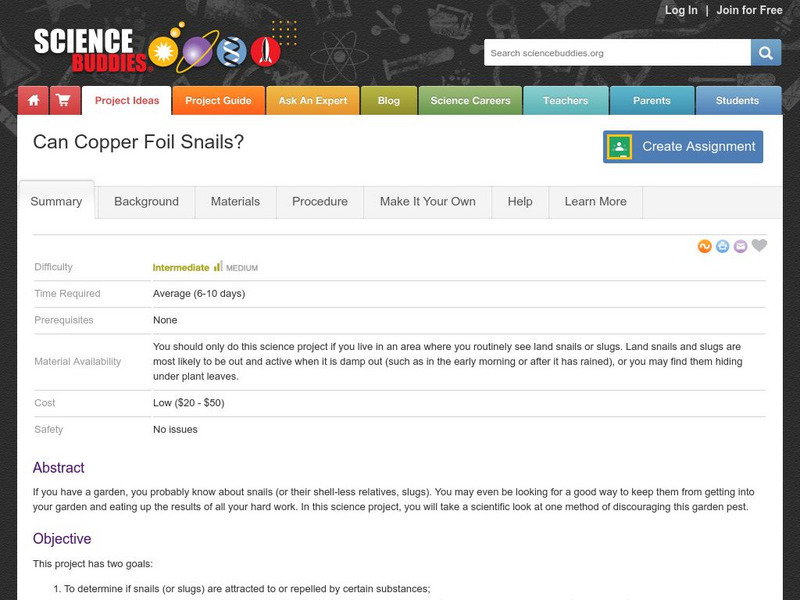
Science Buddies: Can Copper Foil Snails?
If you have a garden, you probably know about snails (or their shell-less relatives, slugs). You may even be looking for a good way to keep them from getting into your garden and eating up the results of all your hard work. Here's a...
Science Buddies
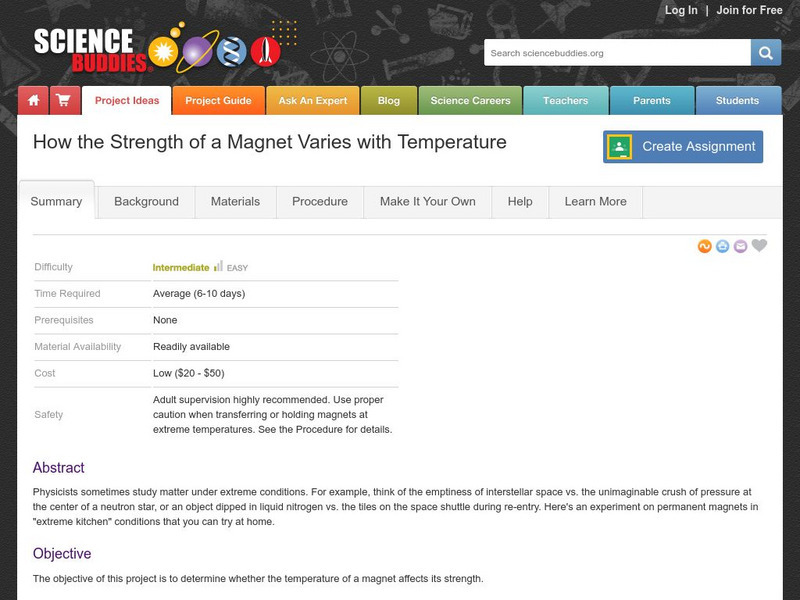
Science Buddies: How the Strength of a Magnet Varies With Temperature
Physicists sometimes study matter under extreme conditions. For example, think of the emptiness of interstellar space vs. the unimaginable crush of pressure at the center of a neutron star, or an object dipped in liquid nitrogen vs. the...
Science Buddies
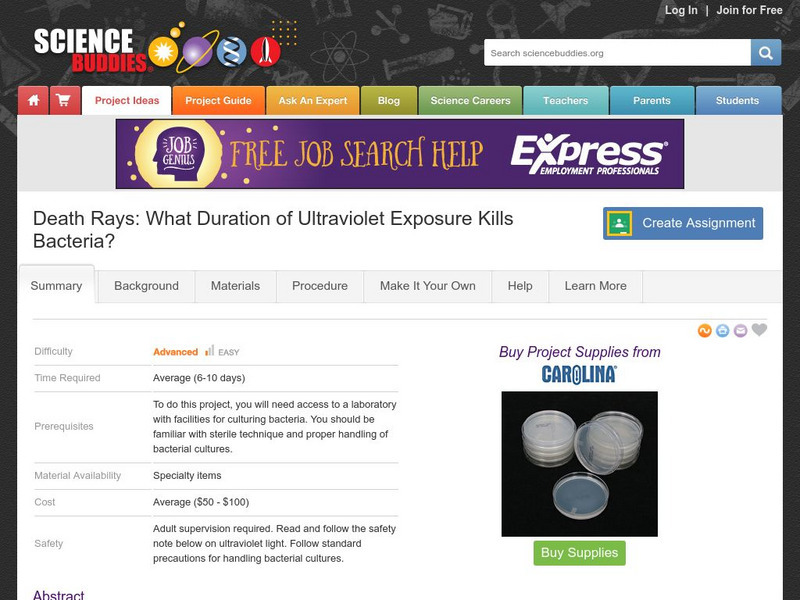
Science Buddies: What Duration of Ultraviolet Exposure Kills Bacteria?
Ultraviolet light can damage DNA molecules. If a cell's DNA repair mechanisms can't keep up with the damage, mutations are the result. As harmful mutations accumulate, the cell eventually dies. How much ultraviolet light is too much for...

Science Buddies
Science Buddies: How Does a Wind Meter Work?
On a windy day it is hard to keep your hat on. The power of the wind can even be strong enough to power large wind turbines to make electricity. In this experiment, find out how you can make your own instrument to measure the speed and...
Science Buddies
Science Buddies: What a Drag!
What makes some objects more streamlined than others? Find out which ordinary objects around your house are made to move smoothly through the water in this easy experiment. Which objects will produce the most drag when pulled through the...
Science Buddies
Science Buddies: Molecular Scissors
Ever used a pair of molecular scissors? Restriction enzymes are molecular scissors that cut DNA into pieces. Find out which enzymes will cut, and where by making a restriction map. Then you can figure out what will happen if you change...
Science Buddies
Science Buddies: Make Your Own Psychrometer
From the name, you might guess that a psychrometer is an instrument designed to measure your thoughts. Actually, it is an instrument that can help you forecast the weather. Read more to find out how it works.
Science Buddies
Science Buddies: Gears Go Round!
Music boxes, bicycles, and clocks all have one thing in common: GEARS. You might say that gears make the world turn, since they are in so many mechanical instruments. How do they work and how do you know which gears to use? Find out in...
Science Buddies
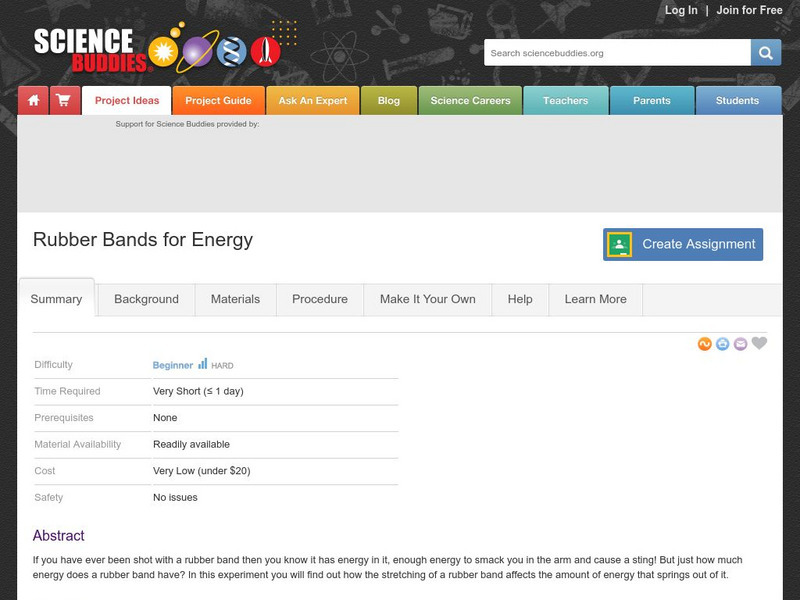
Science Buddies: Rubber Bands for Energy
If you've ever been shot with a rubber band then you know it has energy in it, enough energy to smack you in the arm and cause a sting. How can the energy of a rubber band be put to work? In this experiment you will find out how the...

Science Buddies
Science Buddies: Which Simple Machines Do I Use the Most?
When you think of a machine, you probably think of computers or robots. Try this experiment to see how simple machines are used everyday around your house.
Science Buddies
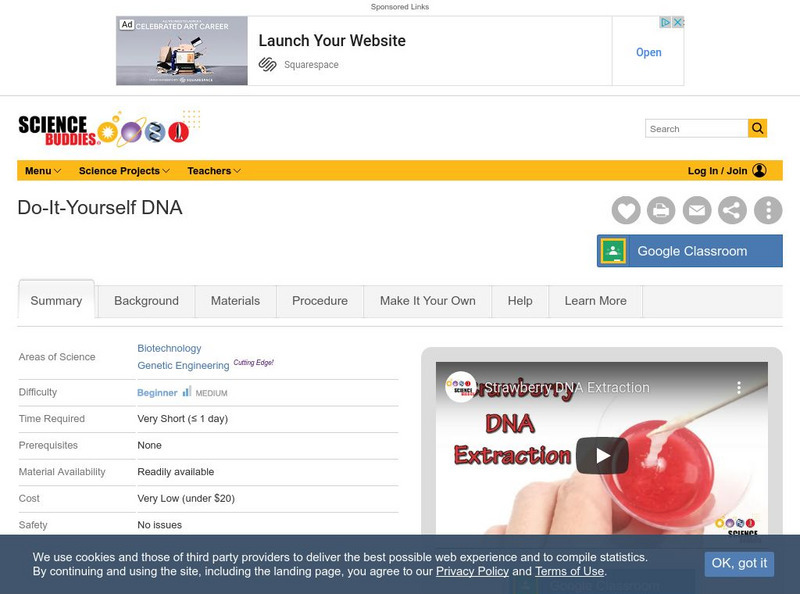
Science Buddies: Do It Yourself Dna
All living things have DNA inside their cells. In this experiment you can make your own DNA extraction kit from household chemicals and use it to extract DNA from strawberries.

Science Buddies
Science Buddies: What Makes a Dna Fingerprint Unique?
Do you like solving mysteries? In this experiment, you can find out how a DNA fingerprint can help you figure out whodunit. The answer might just be in the "sequence" of events.