Hi, what do you want to do?






Government of South Australia
Don't Waste Your Energy
Don't lift another finger, this physical and environmental science unit has everything you need to begin teaching your class about energy. Starting with a look at the greenhouse effect, these lessons and activities take young scientists...

American Chemical Society
Energy Foundations
Only 10 percent of an incandescent bulb's energy is used to create light; the remaining 90 percent is heat. In the unit of activities, young chemists examine energy through hands-on activities, videos, discussions, and...

Royal Society of Chemistry
Energy—Gifted and Talented Chemistry
What has more energy than a room full of pupils after a fire drill? This lesson plan! Explore the changes in energy during different chemical reactions, discover why some reactions feel cold and others feel hot, and tackle the concept of...

Virginia Middle School Engineering Education Initiative
Save the Penguins: An Introduction to Thermodynamics and Heat Transfer
Heat things up in your physical science class with this interactive lesson series on thermodynamics. Through a series of class demonstrations and experiments, young scientists learn how heat is transferred through conduction,...

Next Generation Science Storylines
Why Do Some Things Get Colder (or Hotter) When They React?
Some reactions absorb heat while others release it. Young scholars investigate both types of reactions in a 12-lesson unit. Each lesson presents a lab investigation that monitors temperature and considers the types of reactions taking...

Columbus City Schools
Keeping It Hot!
Hot off the presses, this collection of thermal energy activities, lessons, and printables is sure to amaze. Demonstrate how thermal energy moves about in a system using simple materials. Pupils demonstrate their understanding...

US Department of Energy
Thermodynamics—Teacher Guide
I'm so cool! No, you're exothermic. This thermodynamics lab unit includes an introduction, teacher demonstrations, six labs that students rotate through each class day, homework assignments, application of knowledge, and...

Intel
Plugging into the Sun
What's cooking? A sizzling STEM unit challenges scholars to build a solar cooker that can successfully cook an egg. The unit opens with a study of Earth's rotation, the sun's energy, and shadows. Pupils use a compass and thermometer to...

Teach Engineering
Solar Water: Heat it Up!
Young engineers are instructed to design and build their own solar water heaters. Then, they calculate the efficiency and cost and compare them to commercially available models. This is a full unit for pupils to apply their knowledge.

Columbus City Schools
History Helps When It Comes To Plate Tectonics
Get ready to move, shake, slip, and slide with a well-rounded plate tectonics unit! The engaging resource includes everything you need to inspire eighth grade science scholars, from worksheets to demonstrations. Assess their...

Curated OER
CSAP Preparation: "Strike While the Iron is Hot"
Students survey several concepts in literature, science, history, and geography as a preparation for the CSAP standardized testing experience. This nine lesson unit provides exposure to the format and content of the test.

Curated OER
Our Universe: Always Moving, Always Changing
Students explore the main concepts of astronomy through the eleven lessons of this unit. The past, present, and future methods of studying the science are examined in this unit.

Curated OER
Spinning into Space
Students, through hands-on activities, teacher demonstrations, pictures, and informational books, complete a unit on the Earth and its place in the Universe. They make mobiles of the Milky Way and watch demonstrations of lunar and solar...

Curated OER
Our Solar System
Students study the Earth and Solar System through a variety of activities. They compile a coloring book show the characteristics of the Sun and nine planets.

Curated OER
Astronomy
Students complete a unit of lessons on our solar system, its stars, and astronomers. They record information in a space journal, design constellations, define key vocabulary, observe the phases of the moon, and create a group planet...

Curated OER
Meteorology Madness
Students probe the dynamic weather changes through several hands-0n activities in this seven lessons unit. The hydrologic cycle, clouds, atmosphere, air movement, fronts, and forecasting form the components presented in this unit.
Georgia Department of Education
Ga Virtual Learning: Physical Science: Heat and Temperature
With this learning module, students will understand the difference between heat and temperature, convert temperatures among different temperature scales, and calculate specific heat.
CK-12 Foundation
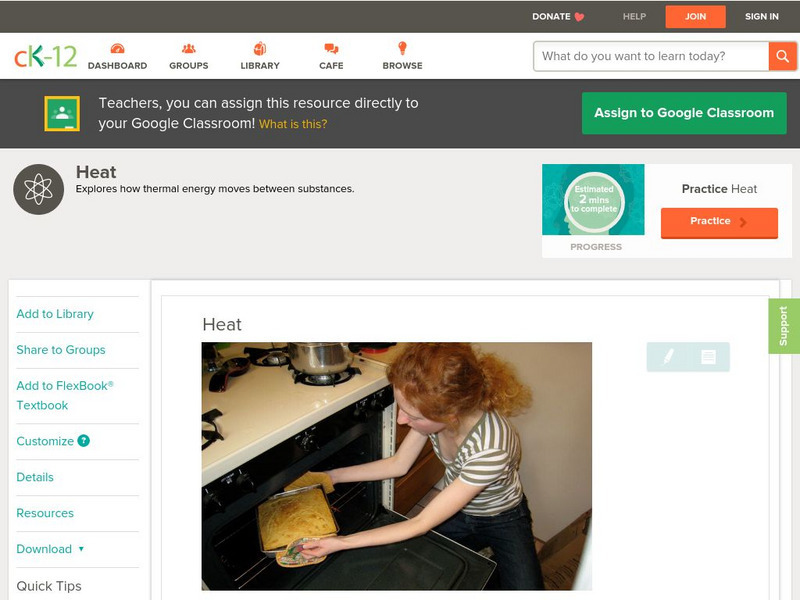
Ck 12: Physical Science: Heat
[Free Registration/Login may be required to access all resource tools.] Definition of heat and how thermal energy is transferred.
CK-12 Foundation
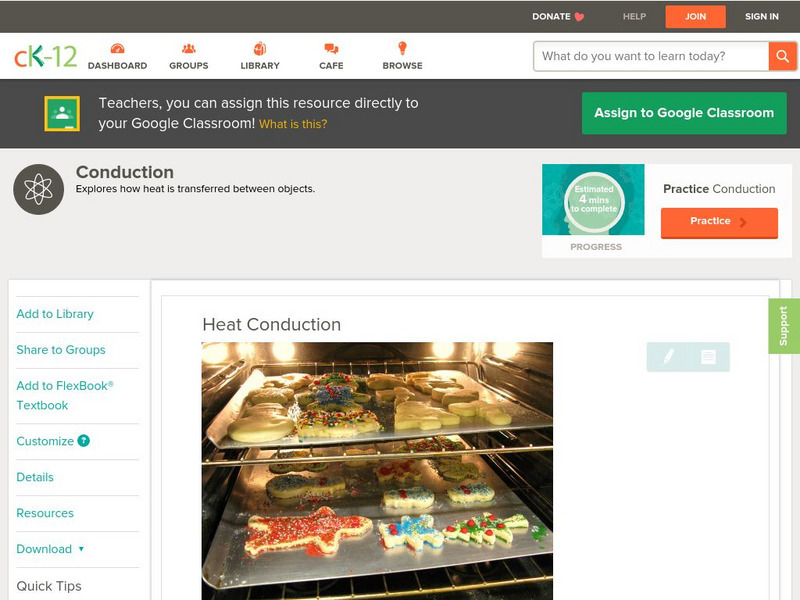
Ck 12: Physical Science: Heat Conduction
[Free Registration/Login may be required to access all resource tools.] Investigates what conduction is, how it works, and gives examples of conduction.

Scholastic
Scholastic: Study Jams! Science: Energy, Light and Sound: Heat
A video and a short quiz on heat, covering its difference from temperature, thermal energy, and the means by which heat is transferred.
E-learning for Kids
E Learning for Kids: Science: Antilles: What Are the Different Forms of Energy?
Students will learn about the different types and sources of energy, including heat and light, electrical, potential, and kinetic energy.
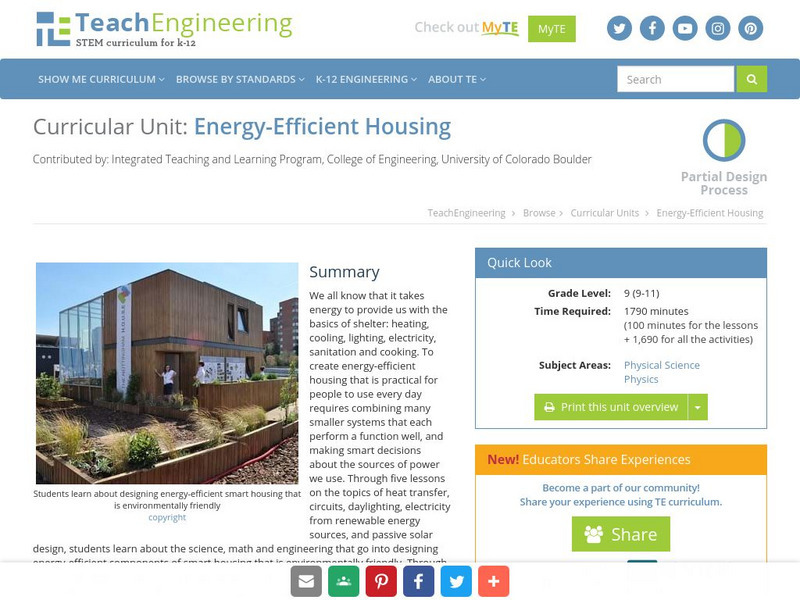
TeachEngineering
Teach Engineering: Energy Efficient Housing
We all know that it takes energy to provide us with the basics of shelter: heating, cooling, lighting, electricity, sanitation and cooking. To create energy-efficient housing that is practical for people to use every day requires...
Utah State Office of Education
Utah Science: Properties and Behaviors of Heat, Light and Sound
How can scientists lump heat, light and sound together when investigating properties and behaviors? This learning module will address that question through a series of activities.
E-learning for Kids
E Learning for Kids: Science: Titanic Shipwreck: How Does Heat Travel?
David is exploring the Titanic shipwreck. He needs to stay warm down below in the water. Help him learn about heat and temperature.