Hi, what do you want to do?






Curated OER
Changing Circuits
Students participate in an online instructional activity to explain how to make bulbs brighter or dimmer in a series circuit by changing the number or type of components.


Curated OER
IS MASS THE SAME AS WEIGHT?
Students see the difference between weight and mass when they examine the method of measuring each of them.

Curated OER
Aquifers: Unlimited or Not
Students understand that an aquifer can become a non-renewable resource if it is not used wisely. Students do an experiment that recreates an aquifer in the classroom.

Curated OER
Fabulous Felines
Students explore the behaviors of cats. In this cat study lesson, students find answers to questions about cat behavior. Students may also participate in cat trivia.

Curated OER
Soda Pop Can Hero Engine
Students view a demonstration on Newton's Laws of Motion using a soda can. In this Newton's law lesson students discuss what they learned from the demonstration.

Curated OER
Earthquake Waves
Fourth graders pour three cups of sand on the top of a plastic table near the edge. They tap the table lightly with the rubber mallet. When they tap the table lightly they see the sand ump into the air.


Curated OER
Watch It Slide!
Students work together to examine inclined planes. They create a plan to raise rocks to build pyramids. They discover the changes that occur when the angle is increased or decreased.

Other
Easy Science for Kids: All About Force: Pushing and Pulling
Students will understand that pushes and pulls can have different strengths and directions. Students investigate the effects of these different pushes and pulls.

E-learning for Kids
E Learning for Kids: Science: Greece: What Are Pushes and Pulls?
Nikos is cleaning up and organizing in his family's theater. He finds out that different movements need different motions; sometimes a push, and sometimes a pull. Help him figure out which force to use.

E-learning for Kids
E Learning for Kids: Science: Seychelles: What Is a Force?
Cody the tour guide is learning about forces on the island. Try to help him learn about pushing and pulling.
Science Buddies
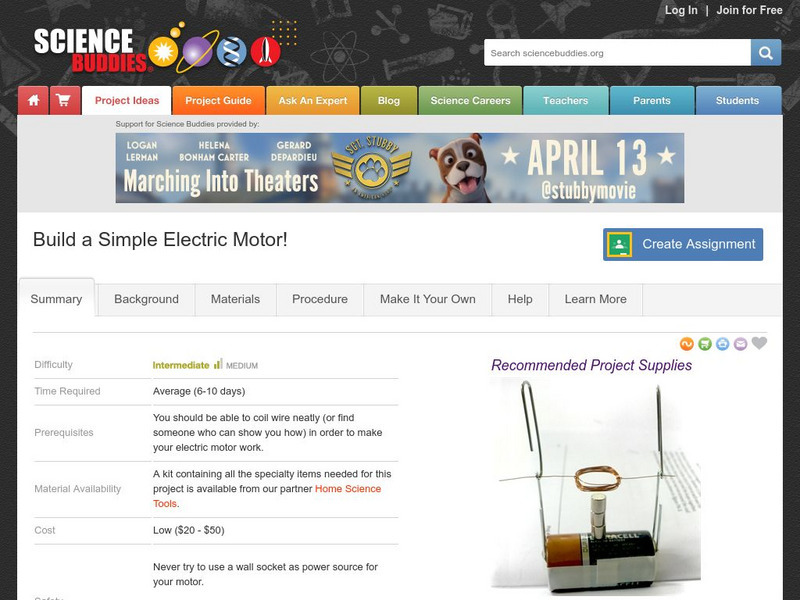
Science Buddies: Spin Right 'Round With This Simple Electric Motor
If you put on clothes that were washed in a washing machine, rode in a car, ate food from a fridge, warmed up lunch in a microwave, or played a video game, you used an electric motor. Try this science fair project and you'll learn how to...

Alabama Learning Exchange
Alex: To Push or Pull, That Is the Question?
In group students will learn to identify pushes and pulls. Students will learn how a push or pull will affect various items. This lesson plan was created as a result of the Girls Engaged in Math and Science University, GEMS-U Project.

E-learning for Kids
E Learning for Kids: Science: Indian Ocean: What Kind of Natural Forces Do We Recognize?
Learn about forces (push or pull), gravity, and friction in this module by training dolphins.
Science Buddies
Science Buddies: Parachutes: Does Size Matter?
Experiment with different sizes of parachutes to find out if size matters when slowing the descent of the parachute. The Science Buddies project ideas are set up consistently beginning with an abstract, objective, and introduction,...
The Wonder of Science
The Wonder of Science: K Ps2 1: Pushes, Pulls, and Motion
Teaching students about pushes, pulls, and motion? Use this site to plan lessons for students to conduct investigations to compare the effects on the motion of an object when pushes or pulls come from different directions or strengths.

E-learning for Kids
E Learning for Kids: Science: Egypt: What Can Forces Do?
A learning module reviewing how much force is needed to push or pull objects. Also learn about the force of gravity.
Better Lesson
Better Lesson: Exploring Force and Motion
Students will explore what they can do with balls, cars, marbles, and ramps and document findings in their science journals. This will engage their curiosity, allow them to make self-discoveries, and explore self-interests.
The Wonder of Science
The Wonder of Science: K Ps2 2: Motion Design Solution
The NSTA vetted source includes resources to teach how to analyze data to determine if a design solution works as intended to change the speed or direction of an object with a push or a pull. Included are assessment ideas, videos,...
Other
Bscs: Forces and Motion Content Background Document
In this document, we will try to answer a fundamental question of physical science, "Why do things start to move, slow down, speed up, stop moving or change direction?" In answering these core questions we can develop concepts that can...
abcteach
Abcteach: Science: Simple Machines
[Free Registration/Login Required] A collection of ready-to-go worksheets and diagrams of simple machines.
CK-12 Foundation
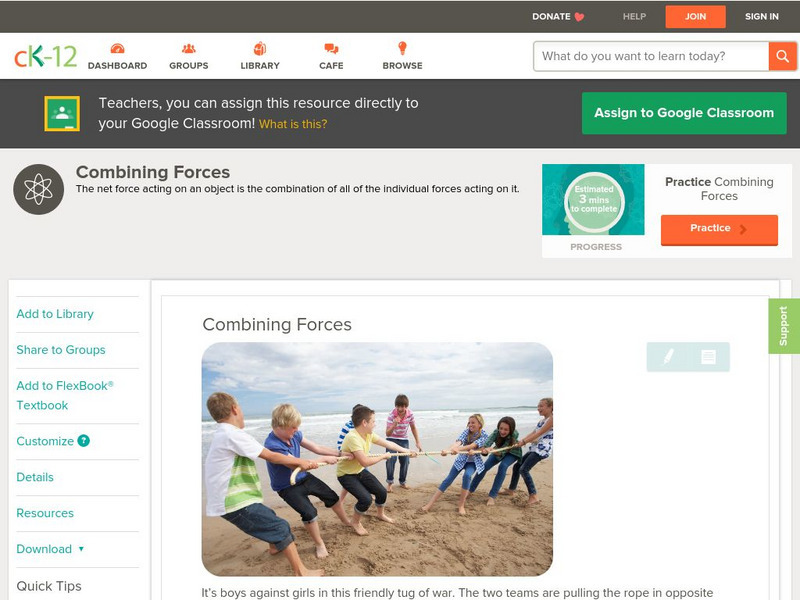
Ck 12: Physical Science: Combining Forces
[Free Registration/Login may be required to access all resource tools.] Featurea the definition of combining forces: Pulling down and pushing up, forces acting in opposite directions, forces acting in the same direction.

Other
University of Tennessee: Football Physics
Classical physics describes and predicts how things work in our everyday environment. Football falls well into the limits of classical physics. In football we encounter many situations where only a few interactions, maybe only one push...