Hi, what do you want to do?






National Institute of Open Schooling
Water Pollution
Fifteen million children under the age of five die each year due to diseases in their drinking water. Water pollution is the topic of lesson 34 in the series of 36. Scholars, through reading and discussing, study numerous aspects of...

National Institute of Open Schooling
The Liquid State
Due to surface tension, dew — a liquid, is spherical in shape. Learners explore the properties of liquids in activity seven in this series of 36. Beginning with its basic properties such as boiling point and moving through to surface...

National Institute of Open Schooling
Adsorption and Catalysis
Adsorption, not absorption, is when atoms stick to the surface of an object, like water sticking to a grain of sand. An informative lesson delves into adsorption, teaching physical and chemisorption and the factors that affect them....

Wilderness Classroom
Ocean Life
Our oceans are composed of many complex relationships. Young oceanographers explore relationships between organisms, understand the world ocean's currents, and discover the effects of water pollution and how it behaves. There are...

Environmental Protection Agency (EPA)
New England's Ground Water Resources
Learn all about where ground water is stored, how it moves, and how it is accessed in a detailed and thorough 10-page reading. Whether supplementing reading for an existing environmental or earth science course or providing background...

It's About Time
Renewable Energy Sources - Solar and Wind
There has been a huge solar energy spill! Let's go outside to play in it. This lesson includes multiple experiments showcasing solar and wind energies. Scholars build a solar heater and an anemometer before testing the results. The...

National Institute of Open Schooling
Air Pollution
Seventy percent of the air pollution in China is due to car exhaust. Under the umbrella of environmental chemistry, learners extensively explore air pollution. From the makeup of our atmosphere to sources of major air pollutants, classes...

Curated OER
First Land Plants Found on Earth
In this first land plants worksheet, students read about the major events that allowed plants to evolve on Earth. Students read about the primary and secondary atmospheres, the formation of the ozone layer to protect from UV light and...

Curated OER
The Earth
In this earth fact worksheet, students look at a picture of the planet earth and read a list of accompanying facts, along with a brief paragraph.

US Geological Survey
Usgs: Earth's Water Surface Water
This site has everything you might want to know about surface water and things you probably didn't even imagine! Click Home to access the site in Spanish.
US Geological Survey
Usgs: Water Use in the United States
This thorough site delves into how we use water on an everyday basis. Ground water, surface water, domestic use, commercial use, irrigation use, are just a few of the topics described on this site. Click Home to access the site in Spanish.
US Geological Survey
U.s. Geological Survey: What Is the Water Cycle?
A quick summary of the water cycle that includes a diagram of the cycle, with links to in-depth explanations of each component of the cycle. Click "water-cycle home" to access water-cycle resources in a variety of languages.
US Geological Survey
Usgs: Water Science Glossary of Terms
The United States Geological Survey offers a complete look at water science in glossary form. Take advantage of the topic guides at the top of the site. You'll find great maps, clipart and activities centers. Click Home to access the...
US Geological Survey
Usgs: Water Science for Schools Water Science Storytime!
This U.S. Geological Survey website features a fictious town, Dryville, and uses it to illustrate every aspect of water management that you might encounter. Click Home to access the site in Spanish.
US Geological Survey
U.s. Geological Survey: Water Science for Schools
A collection of resources--pictures, maps, data, glossary--about water and the water cycle.
US Geological Survey
Usgs: The Water Cycle
Learn about the movement of water from Earth's surface to the atmosphere with this site. Site describes the water cycle in words and with a diagram. Also explored on the page is the distribution of Earth's global water supply.
US Geological Survey
Usgs: How Much Water Is There on (And In) the Earth?
The USGS gives an overview of the amount of water on Earth and where it is located. It gives a few interesting facts about the Earth's supply of water. Click Home to access the site in Spanish.
US Geological Survey
Earth's Water: Rivers and Streams
The USGS explains the definition of a river and how a river is supplied with water. Included is a cross section of a river. Click Home to access the site in Spanish.
Center for Educational Technologies
Earth Science Explorer: The Water Cycle
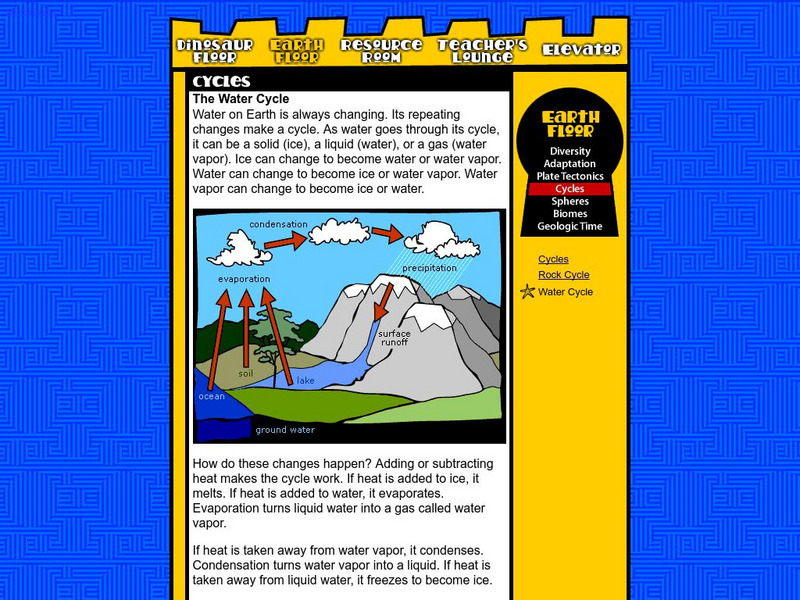
This is a very brief overview of the water cycle, but it does have a nice graphical representation.
US Geological Survey
Usgs: Earth's Water: Lakes and Reservoirs
The USGS reviews the differences between lakes and reservoirs. They discuss the history of freshwater and salt water lakes. Click Home to access the site in Spanish.
NASA
Nasa Space Science Data Archive: Ice on Europa
With the exception of Earth, Europa currently appears to be the only body in the solar system which potentially harbors a global ocean of liquid water. The possibility of liquid water raises the possibility of life, as well. This NASA...
Science Struck
Science Struck: Understanding Deposition in Geology
Explains what is meant by the deposition of sediments by wind and water and provides examples of the resulting landforms.
US Geological Survey
Us Geological Survey: Water Science School: Sinkholes
What is a sinkhole? Where are they found? What causes them? This text based article will provide the answer to these questions, and more!
US Geological Survey
Usgs: Capillary Action
Capillary is described and explained. It is related to surface tension. Examples in botany and human physiology are given.