Hi, what do you want to do?






Curated OER
The Digestive System
Discover how the human body's digestive system works with a brain and stomach friendly activity. Scholars taste test a variety of foods to find out how they behave once in the mouth. Class members then play a game called Move That...

Early Childhood Learning and Knowlege Center
My Body My Senses
In a comprehensive unit of activities, learners explore the five senses. Youngsters discover the many different body parts and their functions that allow humans to have sense of sight, touch, smell, taste, and hearing. The best way to...

Exploratorium
Cardboard Tube Syllabus
Construct paper tubes and then try out a few optical illusion tricks:
See a virtual hole in your own hand
Get a grasp of how the eyes combine images
Notice that one eye is dominant over the other
Reveal how your eyes adjust to...

Baylor College
Neural Network Signals
Using a simple circuit with the battery representing the brain, future physiologists test to see which solutions conduct electrical "nerve impulses." Enlighten learners with plentiful information on electric signals in the nervous system...

Curated OER
Nervous System
Get to know the body's central nervous system through an engaging game of nervous system telephone. But this isn't your average game of telephone. Here, pupils must find a way to communicate a message to the brain without speaking....

American Museum of Natural History
Microbes Coloring Book and Scavenger Hunt
Coloring pages showcase microbes—bacteria, viruses, and protists. Scholars have the option to download a coloring book and scavenger hunt or color the page directly on the computer. Three paragraphs describe each microbe.

Curated OER
Introduction to Biology
Students participate in a variety of activities to introduce them to biology. In this biology lesson plan, students use microscopes, discover bacteria, view human anatomy, and more.
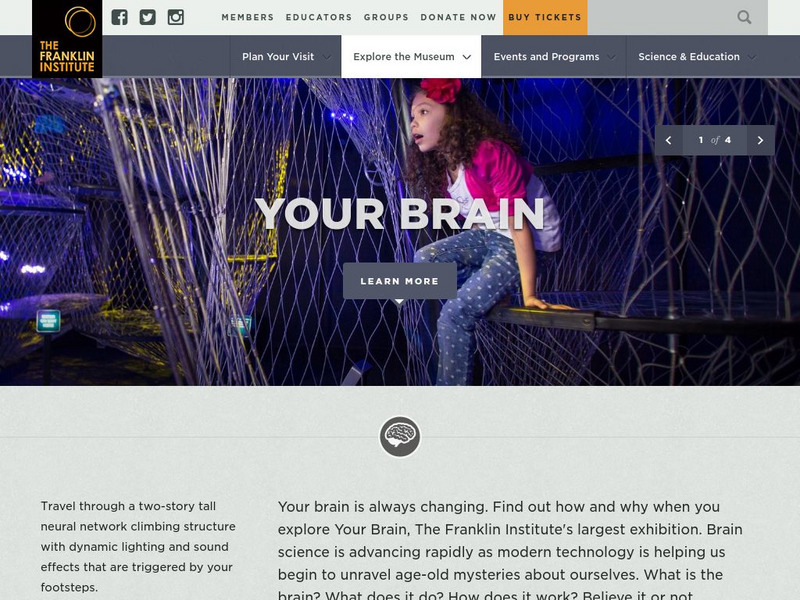
The Franklin Institute
Resources for Science Learning: The Human Brain
Everything you wanted to know about keeping your brain healthy. How should you nourish your brain, how should your brain be protected, and even how to "renew" or stimulate your brain.
Science Buddies
Science Buddies: Multitasking: Brain Drain or Boost in Efficiency?
Think it's a good idea to plug into iTunes, surf the Web, or watch TV while doing homework or trying to read? Many people do it and claim that jumping from one activity to another keeps their attention level up and even gives their brain...
Science Buddies
Science Buddies: Are You Left or Right Sided?
Our brains are split into two parts, right inside our head. One half is the left brain and the other half is the right brain. Each side of your brain controls different parts of your body and most people are more dominant controlling one...
Science Buddies
Science Buddies: The Brains Behind 'Where's Waldo?'
What makes you notice someone in a crowd? Why do some things stand out, while others melt into the background? In this experiment you can investigate the psychology of how things get noticed, by studying how our brains perform a visual...
Science Buddies
Science Buddies: Pinocchio's Arm: A Lie Detector Test
You might be surprised to learn that you have been practicing skills closely tied to lying if you have ever seen someone in pain, or mimicked your favorites sports athlete. In this science fair project, you will discover how your brain...
Science Buddies
Science Buddies: Shaping Your Thoughts?
This is an experiment that explores certain aspects of how your brain pays attention. In this project, you'll have to recruit volunteers to take a simple test: naming a list of printed shapes. What makes the test tricky is that words...
Science Buddies
Science Buddies: Fast Food: Can Peppermint Improve Reaction Times?
Did you know that some teachers give their students a peppermint candy on state testing days? Is it to give the kids sweet-smelling breath? Or are the teachers hoping for something more on the important testing day? In this human biology...
Science Buddies
Science Buddies: What Conflicting Mental Tasks Reveal About Thinking
Can you pat your head with one hand while you rub your stomach with the other? This experiment is kind of like that, but it can actually give you some insight into how your mind works. The task is to name colors. It sounds simple enough,...
Science Buddies
Science Buddies: Warped Words and the Stroop Effect
The Stroop effect describes an experiment about the time it takes to name the color of printed words. When you try to name the color in which color words are printed, it takes longer when the color word differs from the ink color than...

Other
Dana Sourcebook of Brain Science: It's Mindboggling!
Look through this online pamphlet to find brain exercises as well as explanations of how the brain works. Very complete and fun to read.
Science Buddies
Science Buddies: The Nose Knows Smell but How About Taste?
As if sniffles and clogged sinuses are bad enough, everything seems to taste bland and flavorless when we are sick. Gather up a few volunteers, hit the kitchen, and try this experiment to find out if there is really truth to the idea...
Science Buddies
Science Buddies: Twirls, Whirls, Spins, & Turns: Reflexes & Dizziness
Tilt-A-Whirls, Merry-Go-Rounds, Spinning Tea Cups. Just the thought of these rides is enough to make someone dizzy, or queasy. Learn about spins, turns, and the mixed signals that fire in our brains when the sensation of dizziness takes...
Science Buddies
Science Buddies: Measuring Your Threshold of Hearing
How your ears and your brain turn the sound waves out there in the world into the experience of music in your head, remains a mystery to many, but yet we all experience and even enjoy sounds and music. If you're interested in doing a...
Science Buddies
Science Buddies: Think Fast: Do Video Game Players Have Faster Reaction Time
Are you an avid video game player? Do you think this helps you have fast reaction times? This Science Buddies science project lays out an experiment to help you test your hypothesis. The Science Buddies project ideas are set up...
Exploratorium
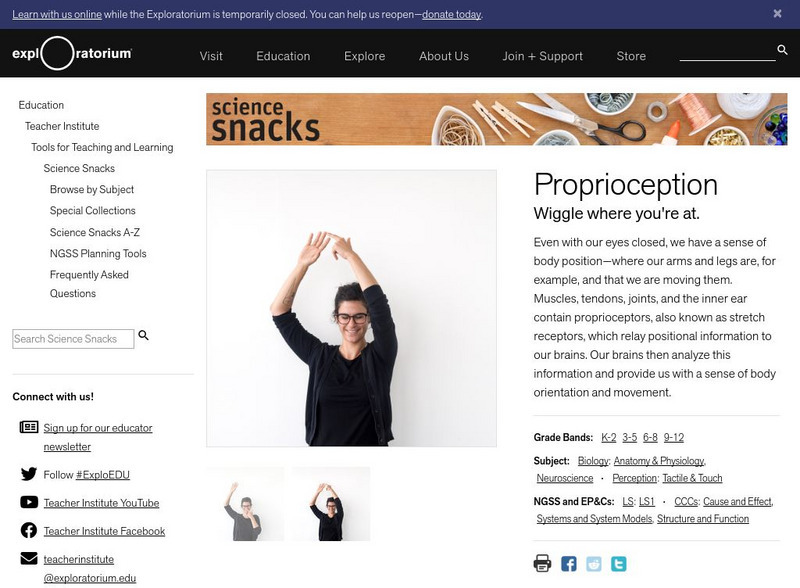
Exploratorium: Science Snacks: Proprioception
The human body has proprioceptors that send signals to the brain so that we are aware of our body's position and movements. Try these simple experiments to learn about proprioception and about other visual and tactile clues that assist...
University of Washington
Neuroscience for Kids: Reflexes
Site provides interactive activities to use in the classroom to test one's reflexes. Also includes more reaction time experiments as well as links to more fun activities.