Hi, what do you want to do?






Crash Course
The World Wide Web: Crash Course Computer Science
Today we’re going to discuss the World Wide Web - not to be confused with the Internet, which is the underlying plumbing for the web as well as other networks. The World Wide Web is built on the foundation of simply linking pages to...
Crash Course
Web Search
Today we’re going to talk about search engines, which are just AI systems that try to help us find what we’re looking for. Search engines can be the sort that serve up a list of results, like during a Google or Bing search, using web...
Curated Video
Way Cool Science II: All About Matter
Friendly and fun host, Max Orbit, asks questions about the world and searches for answers. This DVD series is designed to engage students while introducing scientific principles and concepts in a fun and entertaining way. Host, Max...
Curated Video
Way Cool Science II: Habitats
Max Orbit asks questions about the world and searches for answers. This DVD series is designed to engage students while introducing scientific principles and concepts in a fun and entertaining way. In this program viewers will travel the...
Curated Video
Data Science and Machine Learning (Theory and Projects) A to Z - Feature Engineering: Text Features
In this video, we will cover text features.
<
br/>
This clip is from the chapter "Machine Learning: Feature Engineering and Dimensionality Reduction with Python" of the series "Data Science and Machine Learning (Theory and Projects)...
<
br/>
This clip is from the chapter "Machine Learning: Feature Engineering and Dimensionality Reduction with Python" of the series "Data Science and Machine Learning (Theory and Projects)...
Crash Course
Natural Language Processing
So far in this series, we've mostly focused on how AI can interpret images, but one of the most common ways we interact with computers is through language - we type questions into search engines, use our smart assistants like Siri and...
TED Talks
Zeresenay Alemseged: The search for humanity's roots
Paleoanthropologist Zeresenay Alemseged looks for the roots of humanity in Ethiopia's badlands. Here he talks about finding the oldest skeleton of a humanoid child -- and how Africa holds the clues to our humanity.
TED Talks
Arnav Kapur: How AI could become an extension of your mind
Try talking to yourself without opening your mouth, by simply saying words internally. What if you could search the internet like that -- and get an answer back? In the first live public demo of his new technology, TED Fellow Arnav Kapur...
SciShow
The Grandfather of the Computer was the Loom
In the early 19th century, a French weaver named Joseph-Marie Jacquard was searching for a better way to make fabric. And in so doing, he managed to invent a loom that inspired the first proper computer.
Hosted by: Savannah...
Hosted by: Savannah...
Brainwaves Video Anthology
Stephen Wolfram - Computational Thinking
Stephen Wolfram, (born August 29, 1959, London, England), English physicist and author best known for his contributions to the field of cellular automata and the development of Mathematica, an algebraic software system, and...
Brainwaves Video Anthology
Vicki Cobb - Compelling Nonfiction for Kids
Vicki Cobb is the well-known author of more than eighty-five highly entertaining nonfiction books for children. Ever since 1972, when HarperCollins first published Science Experiments You Can Eat, Cobb's lighthearted approach to hands-on...
Curated Video
One Theory that Connects Everything: AdS/CFT Correspondence Demystified
AdS/CFT suggests that our three-dimensional universe can be perfectly modeled by a two-dimensional surface. On one side is AdS, or Anti-de Sitter space, which is a kind of imaginary universe with some unusual properties...
Brainwaves Video Anthology
Edward D. Hess - NewSmart
Professor Edward D. Hess spent more than 20 years in the business world as a senior executive at Warburg Paribas Becker, Boettcher & Company, the Robert M. Bass Group and Arthur Andersen. He is the author of 12 books, over...
Brainwaves Video Anthology
Charles Fadel - Artificial Intelligence in Education Part 1
Charles Fadel is a global education thought leader and futurist, author and inventor, with several active affiliations; his work spans the continuum of Schools, Higher Education, and Workforce Development/Lifelong...
Curated Video
Modify a data structure : Big O Notation and Calculating the Runtime of a Function
From the section: Linked Lists. Linked Lists: Big O Notation and Calculating the Runtime of a Function<b<br/>r/>
Linked Lists: Big O Notation and Calculating the Runtime of a Function
Linked Lists: Big O Notation and Calculating the Runtime of a Function
Curated Video
Learning Microsoft Power BI - Column Settings and Hierarchies In Power BI
In this video, we will learn how to identify column attributes and change relevant settings for reporting.
• Understand the important differences between column data type and forma
tting
• Learn how to hide key columns...
• Understand the important differences between column data type and forma
tting
• Learn how to hide key columns...
Institute of Art and Ideas
March of the Machines (long form version)
Evil artificial intelligences are luckily confined to fiction. Yet leading scientists claim that intelligent machines are 'the most serious threat facing mankind'. Are they right or could a mind free from human prejudices create a...
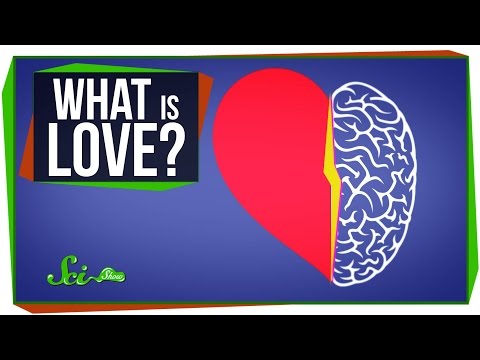
SciShow
World’s Most Asked Questions: What Is Love?
People ask Google everything under the sun. One of the most commonly searched questions in the world is “What Is Love?” Allow us at SciShow to explain. Ask us YOUR most pressing questions with the hashtag #WMAQ in the comments below or...

Domain of Science
Map of Biology
Biology is the subject that studies life in all its forms, from the simple cell through to all the animals that inhabit the planet. In this map I lay out the subject of biology and how all of the sub-disciplines are related to each...

Brainwaves Video Anthology
Vicki Cobb - Teachers Make a Difference - Louis Sarlin
Vicki Cobb is the well-known author of more than eighty-five highly entertaining nonfiction books for children. Ever since 1972, when HarperCollins first published Science Experiments You Can Eat, Cobb's lighthearted approach to hands-on...

Mr. R.'s Songs for Teaching
Magnet Song- Don't Eat Magnets!
A fun song I wrote for my elementary science students- tells the tall tale of what happened when my puppy ate my magnets! Hope you enjoy! LYRICS Magnets, magnets, They’re so cool, I Learned about them at my school, Invisible force can...
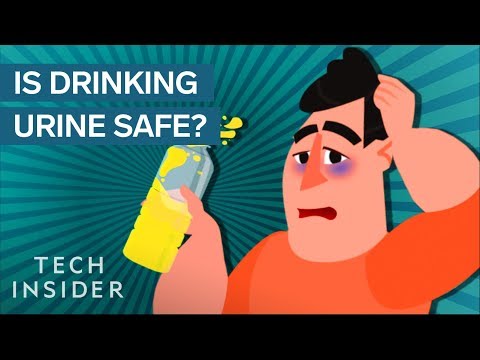
Curated Video
Should You Actually Drink Your Own Pee To Survive?
Many survivalists have cited urine as a great way to avoid being dehydrated in extreme situations but that isn't completely true. Despite being composed of almost 95% water, pee still has waste and trace amounts of bacteria that could...
Science Buddies
How to Add Sprites in Scratch
Learn how to add new sprites to the screen in the graphical programming language Scratch.