Hi, what do you want to do?





CK-12 Foundation
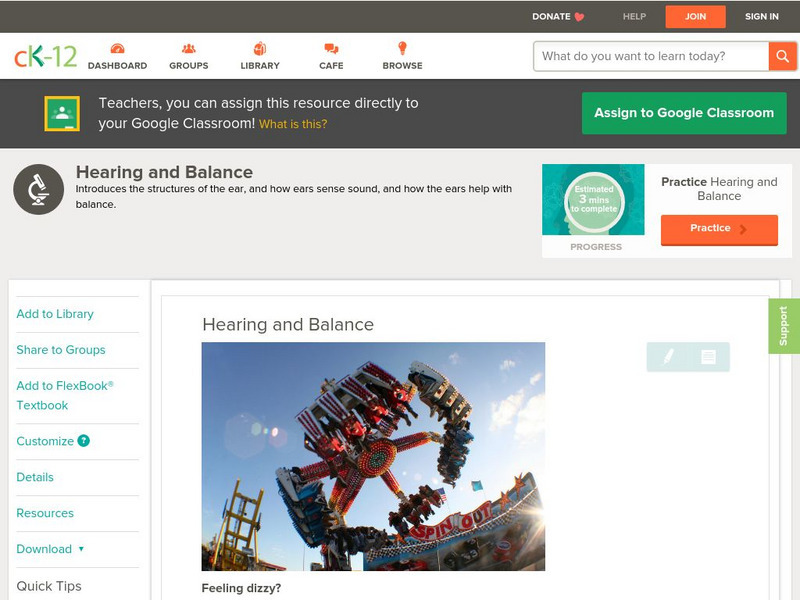
Ck 12: Life Science: Hearing and Balance
[Free Registration/Login may be required to access all resource tools.] What do listening to music and riding a bike have in common? It might surprise you to learn that both activities depend on your ears. The ears do more than just...
University of Washington
Hearing: Activities, Experiments, Models and More
Come and learn more about one of the five senses? Hearing is an integral part of our everyday life. To learn more use the activities, experiments, models and more wrapped into this hearing website.
Science Education Resource Center at Carleton College
Serc: Listening Challenge With Your Ears
In this activity, young scholars will be able to use their sense of hearing to figure out which film containers sound the same and contain the same substance. They will then match their containers and self-check their answers.

The Franklin Institute
The Franklin Institute Online: Coming to Our Senses
Help students make "Sense," of their senses by using them in the classroom. Site provides discovery activities students can do on themselves, in their classrooms and around campus. A scavenger hunt is also provided.
Curated OER
Kids Health: Hearing [Pdf]
We deal with loud noises in our environment all the time - some we can control and some we can't. Noise-induced hearing loss (NIHL) can be a problem for kids and teens, especially with the prevalence of earbuds and handheld devices that...
Scholastic
Scholastic Instructor: Science of Sound
This resource is for teachers who are looking for information, activities, experiments, and more pertaining to the science of sound.
PBS
Pbs: Misunderstood Minds
A wonderful spotlight on scientific explanations behind learning differences and strategies to aid success in school. Includes profiles of the students in the documentary as well as interactive activities designed to give site visitors a...
TeachEngineering
Teach Engineering: Sound From Left or Right?
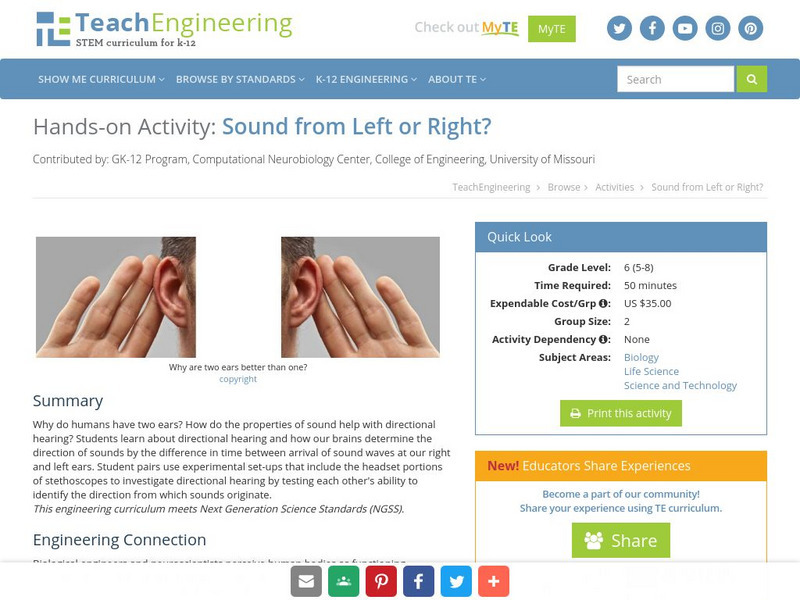
Why do humans have two ears? How do the properties of sound help with directional hearing? Students learn about directional hearing and how our brains determine the direction of sounds by the difference in time between arrival of sound...
TeachEngineering
Teach Engineering: Hearing: How Do Our Ears Work?
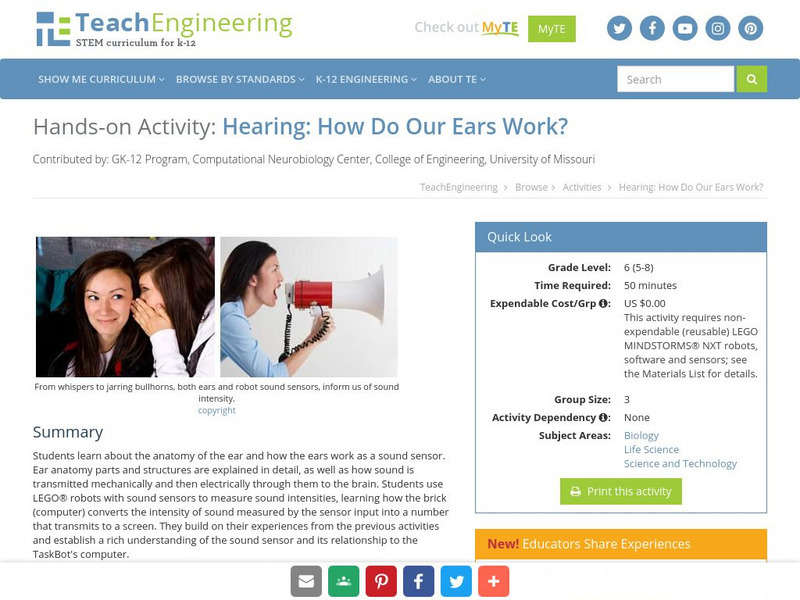
Students learn about the anatomy of the ear and how the ears work as a sound sensor. Ear anatomy parts and structures are explained in detail, as well as how sound is transmitted mechanically and then electrically through them to the...
National Institutes of Health
National Library of Medicine: Using Our Senses
This lesson plan site delves into the senses of smell, touch, taste, sight, and hearing. Students will be able to describe the ways senses affect their lives and how a pediatrician uses his/her senses to examine patients.
University of Washington
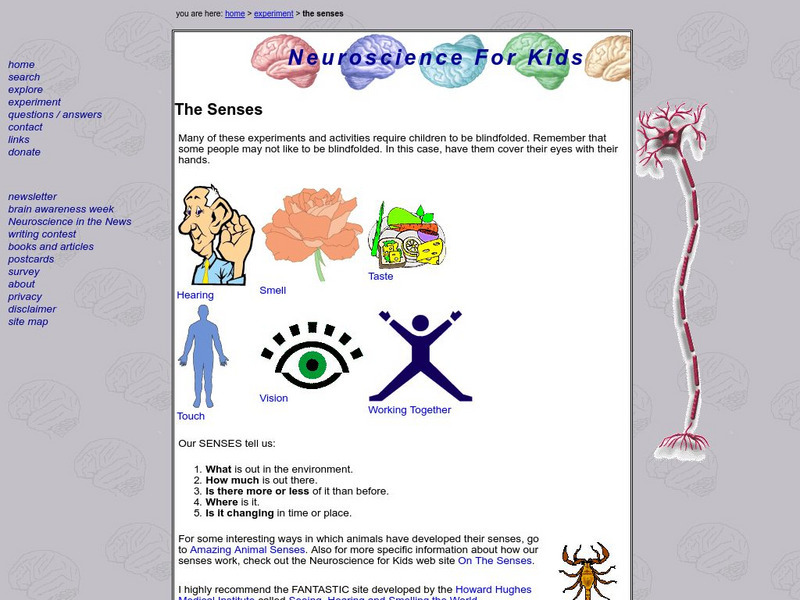
The Senses
This site has a collection of learning activities, games, experiments, and lesson plans on the five senses. Organized by grade level and topic, this site is packed with an assortment of interactive and engaging activities, that would...
SEDL
Sedl: Five Senses
Elementary students will gain great insight into the workings of our five senses through this collection of detailed, integrated lesson plans for grades K-3. Each lesson contains a list of needed materials, hands-on explorations...
TeachEngineering
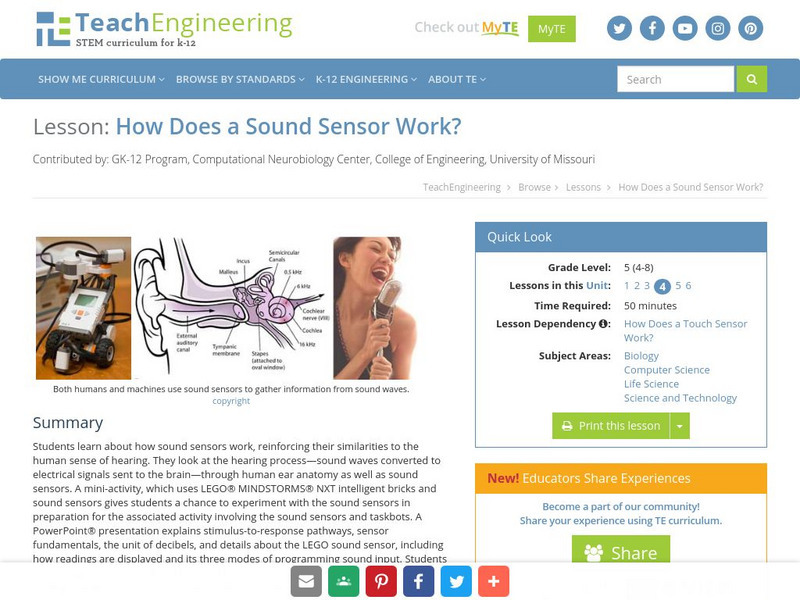
Teach Engineering: How Does a Sound Sensor Work?
Learners learn about how sound sensors work, reinforcing their similarities to the human sense of hearing. This lesson and its associated activity enable students to appreciate how robots can take sensor input and use it to make...
Science Education Resource Center at Carleton College
Serc: Backyard Science the Five Senses
Kindergarten students will use their existing outdoor expertise to help them focus on the scientific study of their five senses in stations.
ABCya
Ab Cya: Five Senses
The Five Senses is an educational activity for kids to learn about taste, smell, vision, hearing, and touch. The lesson will introduce each of the five senses one at a time. Students will then be assessed through a multiple choice...
TeachEngineering
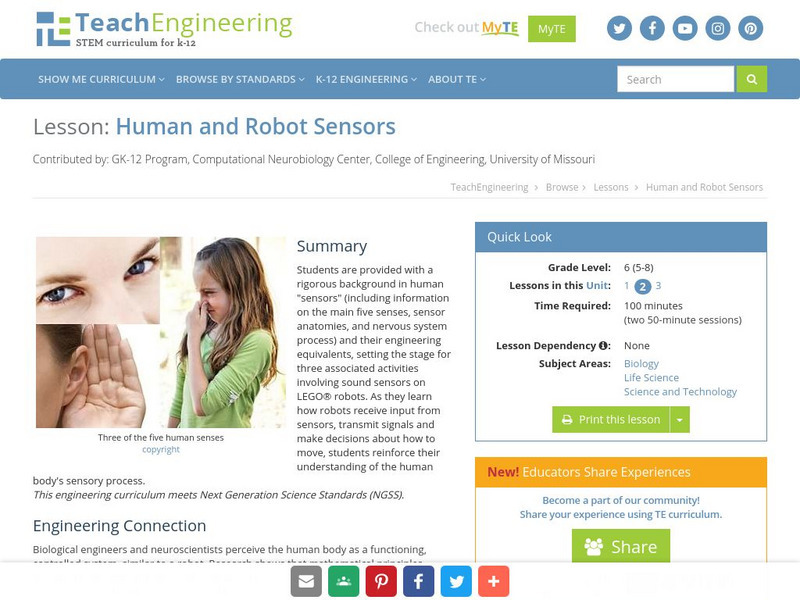
Teach Engineering: Human and Robot Sensors
Students are provided with a rigorous background in human "sensors" (including information on the main five senses, sensor anatomies, and nervous system process) and their engineering equivalents, setting the stage for three associated...