Hi, what do you want to do?





TeachEngineering
Teach Engineering: That's Hot! Robot Brain Programming
With the challenge to program computers to mimic the human reaction after touching a hot object, students program LEGO robots to "react" and move back quickly once their touch sensors bump into something. By relating human senses to...

University of Wisconsin
The Why Files: Got a Jones for Indiana Jones?
Archeologists use radar, magnetic, electrical sensors to see through the ground, find where to dig, sonar, ground-penetrating radar.
TeachEngineering
Teach Engineering: Measuring Pressure
Students learn first-hand the relationship between force, area and pressure. They use a force sensor built from a LEGO MINDSTORMS NXT kit to measure the force required to break through a paper napkin. An interchangeable top at the end of...
TeachEngineering
Teach Engineering: Master Driver
Students learn how rotational sensors measure distance, how mathematics can be used for real-world purposes, and about potential sources of error due to gearing when using rotation sensor readings for distance calculations.
TeachEngineering
Teach Engineering: Music by Touch
Through a hands-on design challenge involving LEGO MINDSTORMS NXT robots, students learn programming skills and logic design as they program robot computers to play sounds and rotate a wheel when a touch sensor is pressed, and then...
TeachEngineering
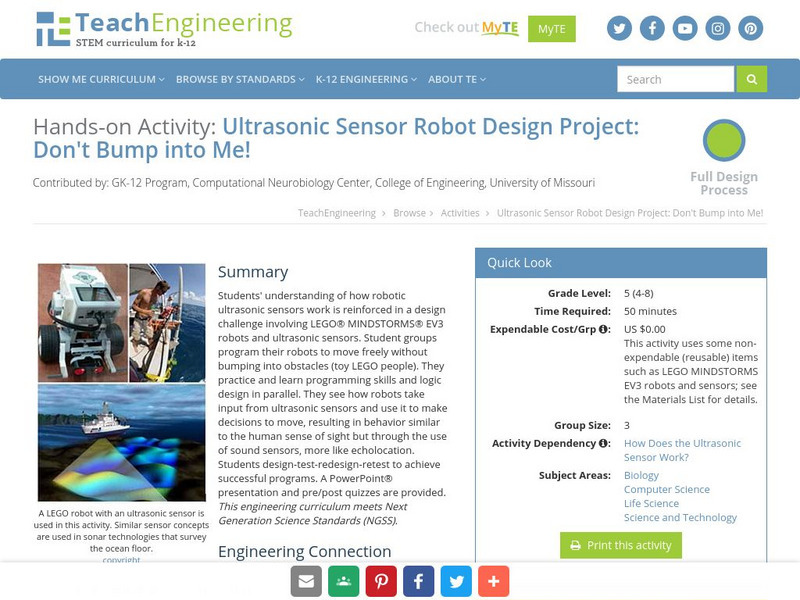
Teach Engineering: Don't Bump Into Me!
Students' understanding of how robotic ultrasonic sensors work is reinforced in a design challenge involving LEGO MINDSTORMS NXT robots and ultrasonic sensors.
TeachEngineering
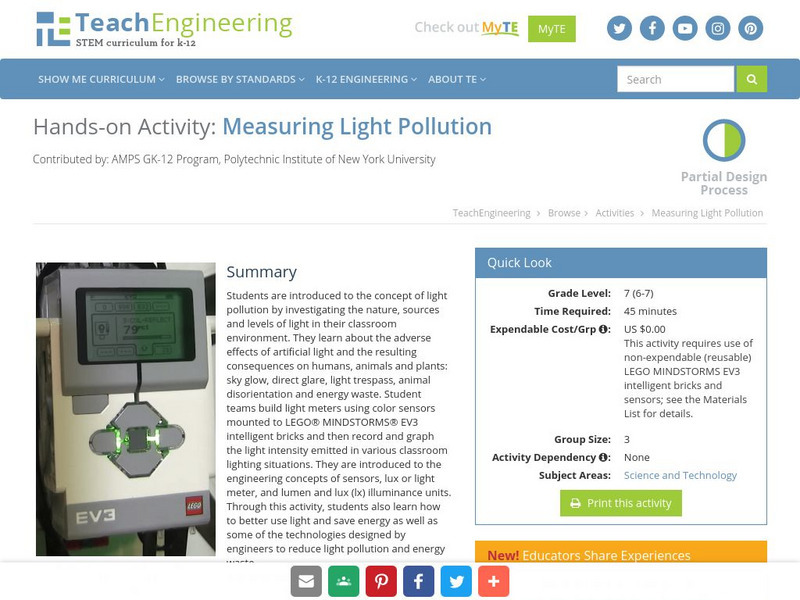
Teach Engineering: Measuring Light Pollution
Students are introduced to the concept of light pollution by investigating the nature, sources and levels of light in their classroom environment. They learn about the adverse effects of artificial light and the resulting consequences on...
TeachEngineering
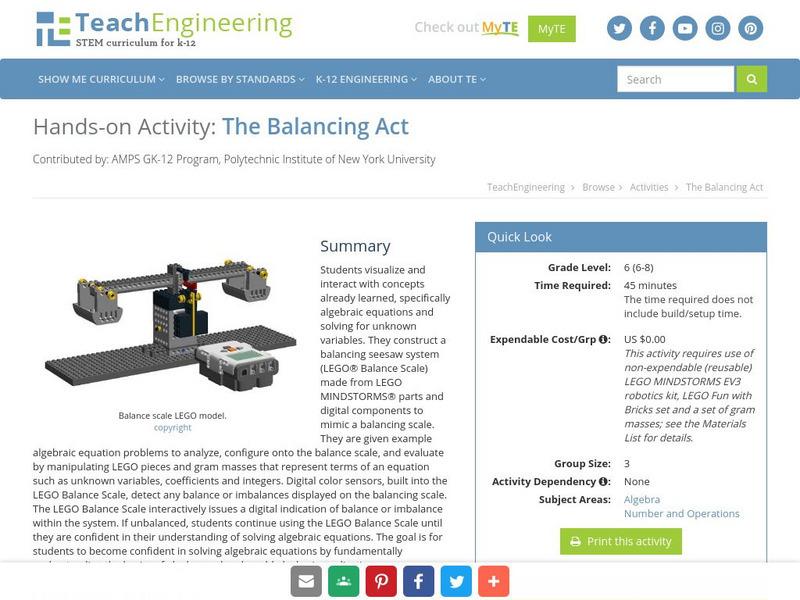
Teach Engineering: The Balancing Act
Students are given the opportunity to visualize and interact with concepts they have already learned, specifically algebraic equations and solving for unknown variables. Students construct a balancing seesaw system (LEGO Balance Scale)...
TeachEngineering
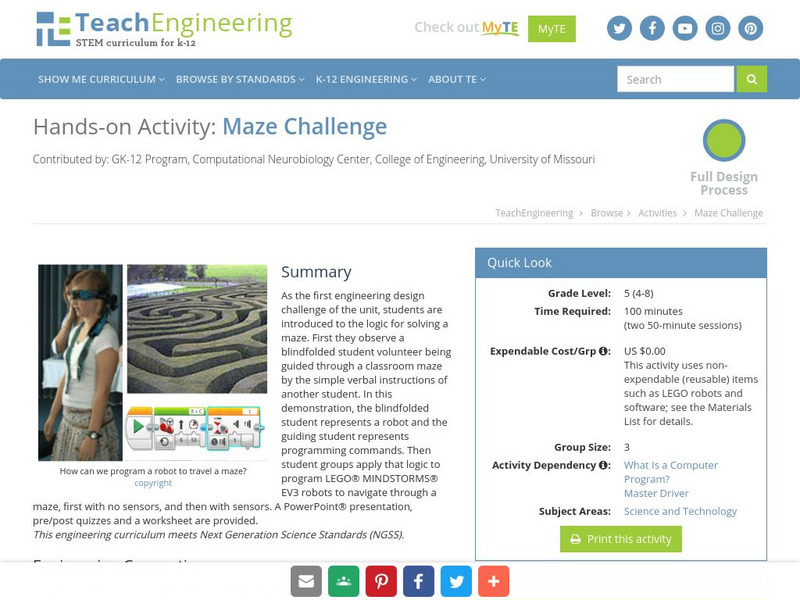
Teach Engineering: Maze Challenge
As the first engineering design challenge of the unit, students are introduced to the logic for solving a maze. student groups apply that logic to program LEGO MINDSTORMS NXT robots to navigate through a maze, first with no sensors, and...
TeachEngineering
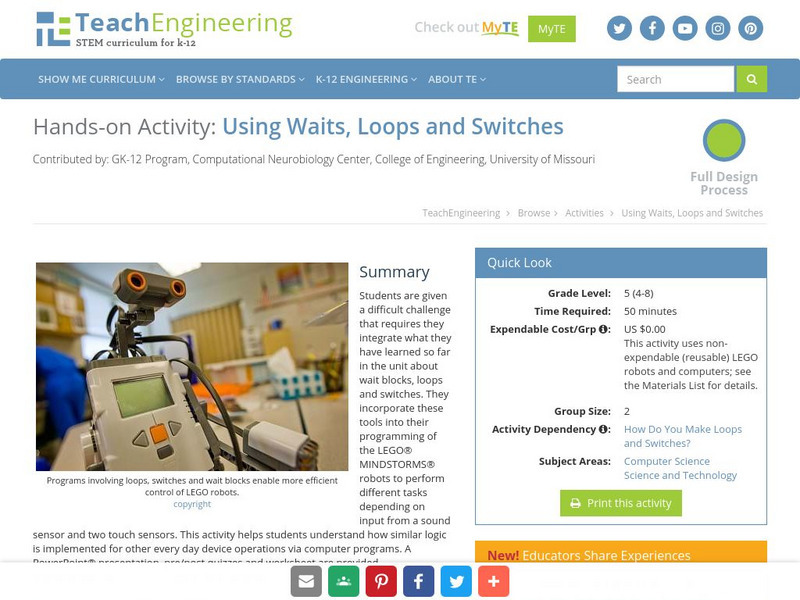
Teach Engineering: Using Waits, Loops and Switches
Students incorporate their knowledge of wait blocks, loops, and switches into their programming of the LEGO MINDSTORMS NXT robots to perform different tasks depending on input from a sound sensor and two touch sensors. This activity...
TeachEngineering
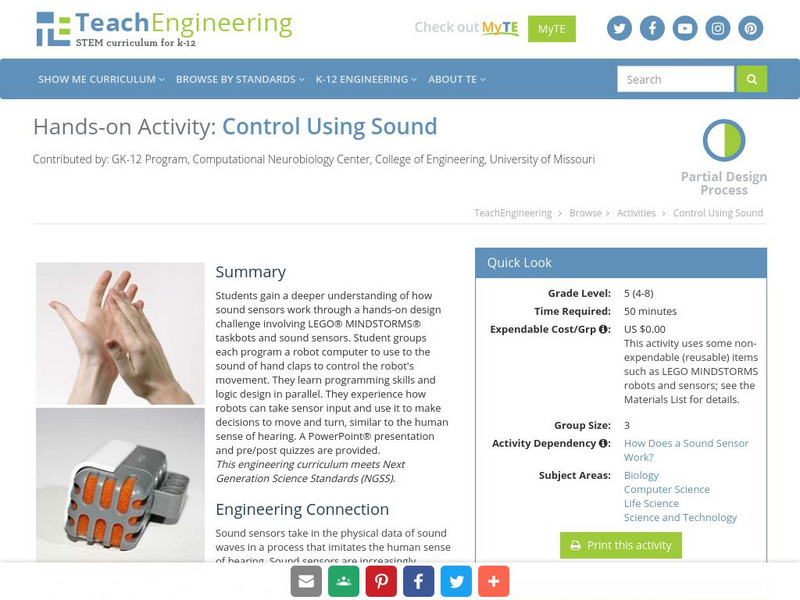
Teach Engineering: Control Using Sound
Students gain a deeper understanding of how sound sensors work through a hands-on design challenge involving LEGO MINDSTORMS NXT taskbots and sound sensors.
TeachEngineering
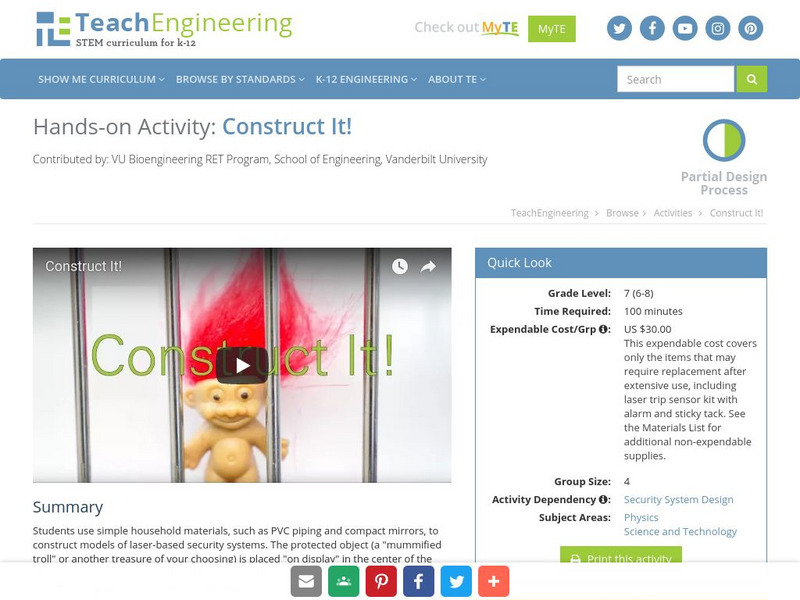
Teach Engineering: Construct It!
Students use simple household materials, such as PVC piping and compact mirrors, to construct models of laser-based security systems. The protected object (a "mummified troll" or another treasure of your choosing) is placed "on display"...
NASA
Nasa: Sea Wi Fs Project: Teachers Resources
SeaWIFS refers to the Sea-viewing Wide Field-of-view Sensor, which is a satellite sensor that can monitor the color of the oceans and send data back to Earth. This page has a collection of scientific and educational resources on ocean...

Concord Consortium
Concord Consortium: Stem Resources: Wind Generator
Using a voltage sensor, students will measure how much "electricity" is produced by the wind turbine that they design and build. Students will experiment with blade designs to see which one collects energy from the wind the most...
TeachEngineering
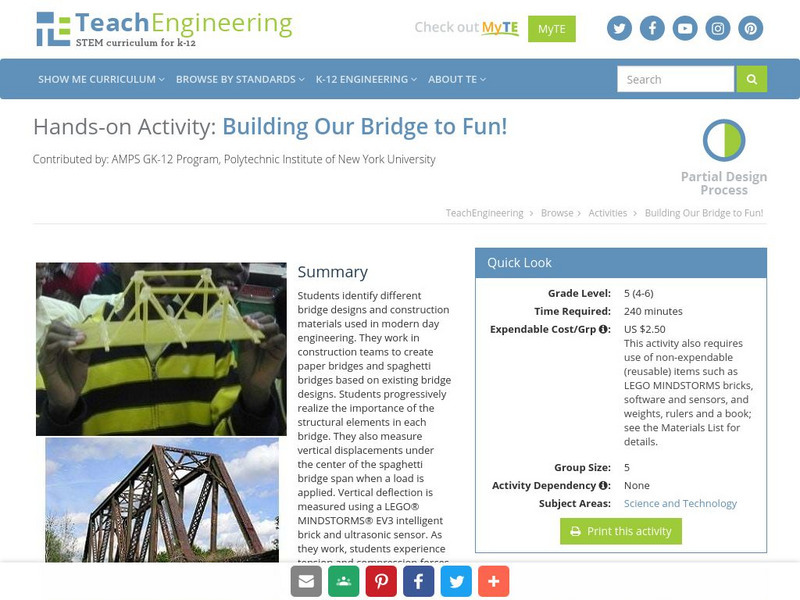
Teach Engineering: Building Our Bridge to Fun!
Students identify different bridge designs and construction materials used in modern day engineering. They work in construction teams to create paper bridges and spaghetti bridges based on existing bridge designs. Students progressively...
TeachEngineering
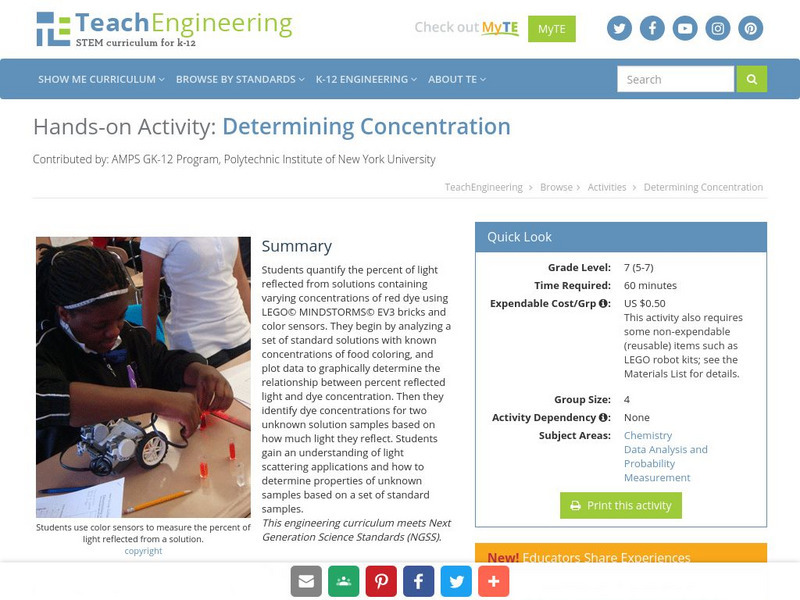
Teach Engineering: Determining Concentration
Students quantify the percent of light reflected from solutions containing varying concentrations of red dye using LEGO MINDSTORMS NXT bricks and light sensors. They begin by analyzing a set of standard solutions with known...
TeachEngineering
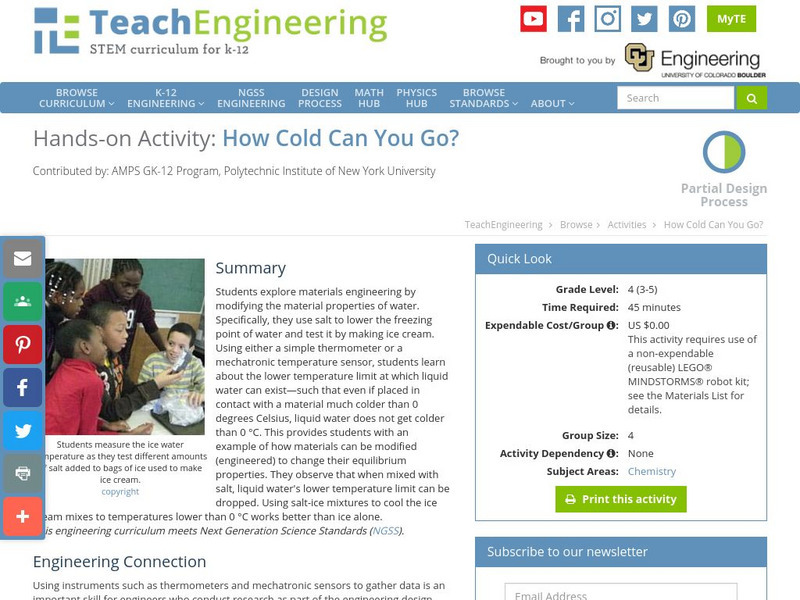
Teach Engineering: How Cold Can You Go?
Students explore materials engineering by modifying the material properties of water. Specifically, they use salt to lower the freezing point of water and test it by making ice cream. Using either a simple thermometer or a mechatronic...
TeachEngineering
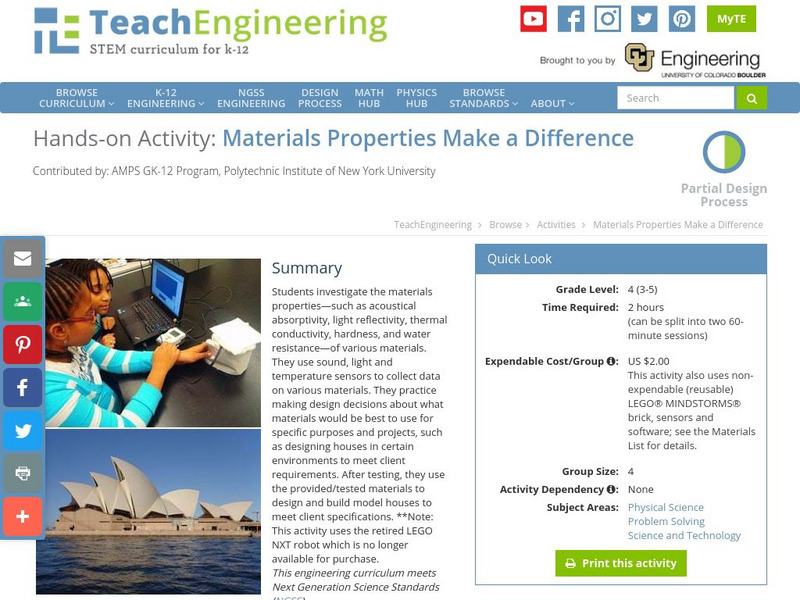
Teach Engineering: Materials Properties Make a Difference
Students investigate the materials properties-such as acoustical absorptivity, light reflectivity, thermal conductivity, hardness, and water resistancea-of various materials. They use sound, light and temperature sensors to collect data...
TeachEngineering
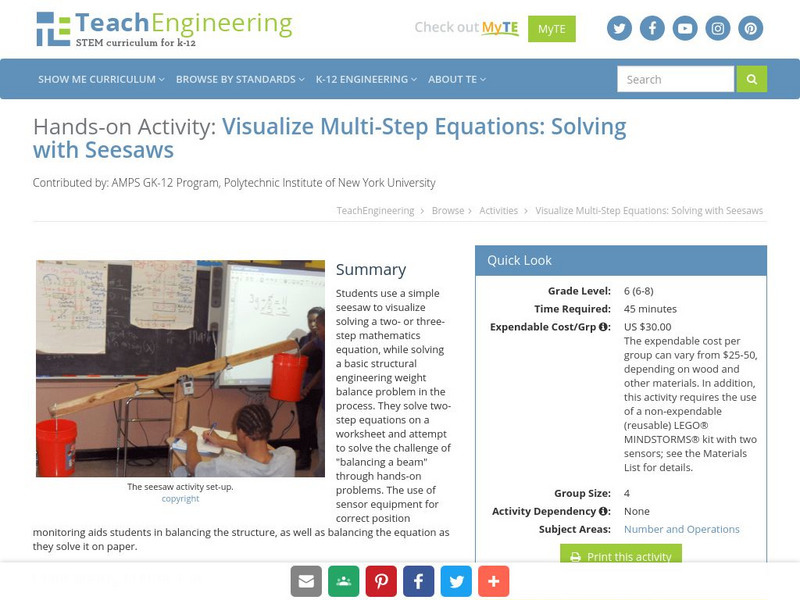
Teach Engineering: Solving With Seesaws
Students use a simple seesaw to visualize solving a two- or three-step mathematics equation, while solving a basic structural engineering weight balance problem in the process. They solve two-step equations on a worksheet and attempt to...
TeachEngineering
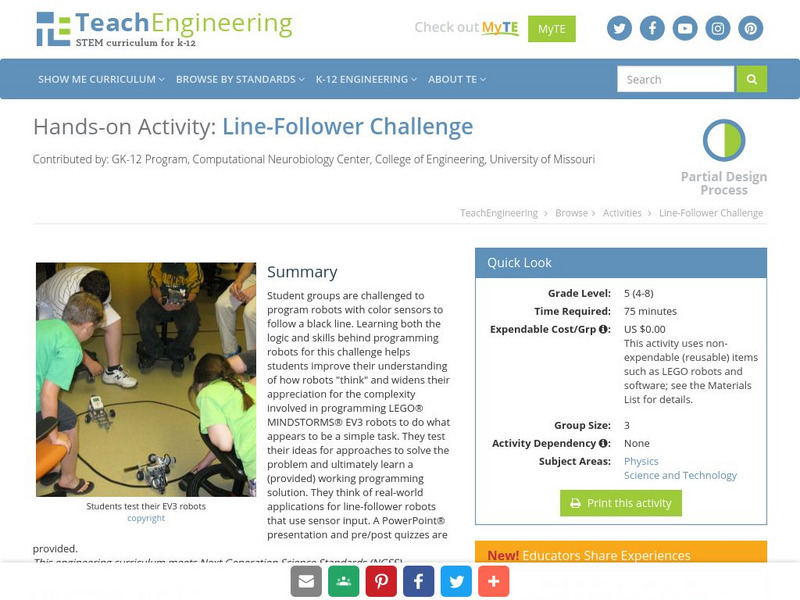
Teach Engineering: Line Follower Challenge
Student groups are challenged to program robots with light sensors to follow a black line. Learning both the logic and skills behind programming robots for this challenge helps students improve their understanding of how robots work, and...
TeachEngineering
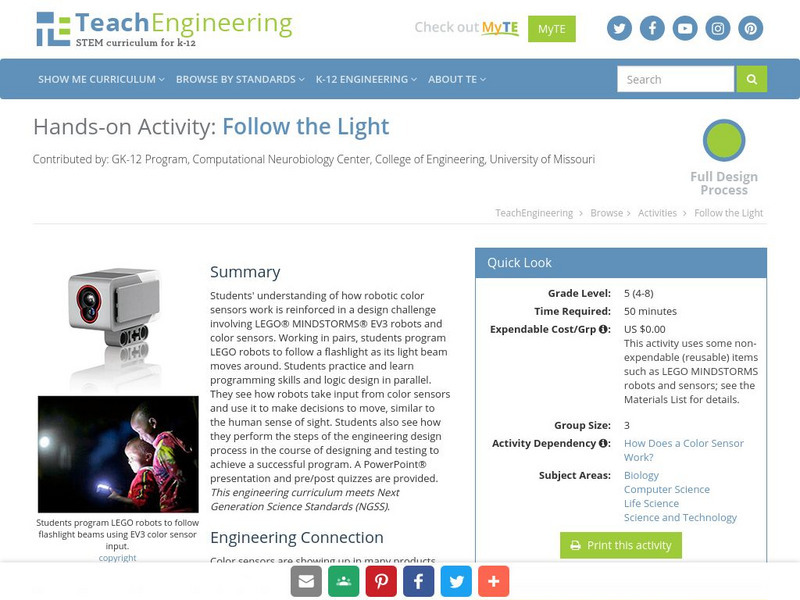
Teach Engineering: Follow the Light
A lesson involving LEGO MINDSTORMS NXT robots and light sensors, student pairs program the robots to follow a flashlight as its light beam moves around.
TeachEngineering
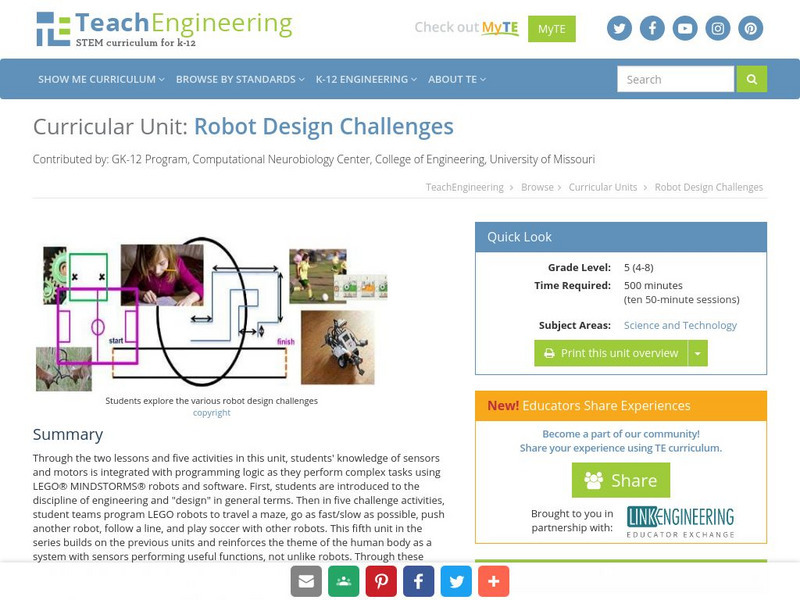
Teach Engineering: Robot Design Challenges
Through the two lessons and five activities in this unit, students' knowledge of sensors and motors is integrated with programming logic as they perform complex tasks using LEGO MINDSTORMS NXT robots and software.
TeachEngineering
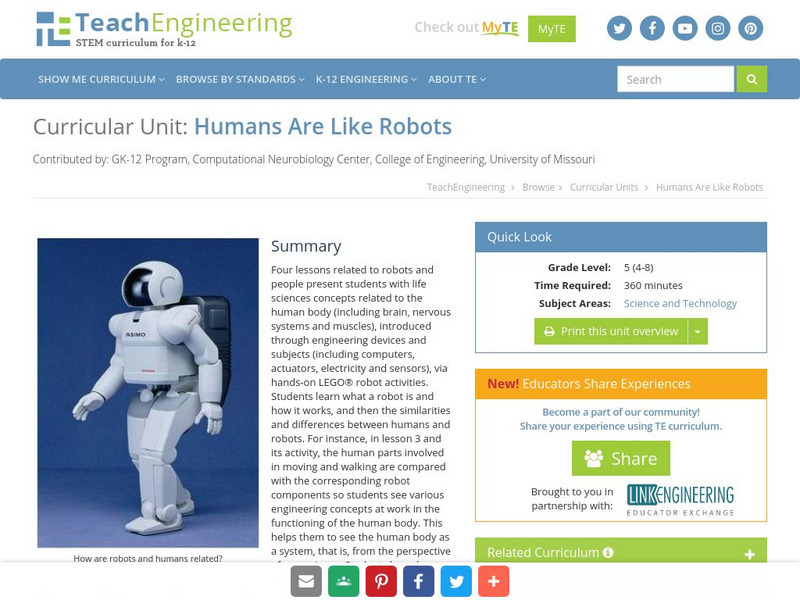
Teach Engineering: Humans Are Like Robots
Four lessons related to robots and people present students with life sciences concepts related to the human body (including brain, nervous systems and muscles), introduced through engineering devices and subjects (including computers,...
TeachEngineering
Teach Engineering: How Do You Make a Program Wait?
Building on the programming basics learned so far in a corresponding Robotics unit, learners learn how to program using sensors rather than by specifying exact durations. Working with the LEGO MINDSTORMS NXT robots and software, they...
Other popular searches
- Sensory
- Sensory Words
- Sensory Details
- Sensory Activities
- Sensory Language
- Sensory Writing
- Sensory Paragraph Writing
- Sensory Details in Writing
- Sensory Images
- Sensory Description
- Identifying Sensory Words
- Multi Sensory