Hi, what do you want to do?






Concord Consortium
Concord Consortium: Stem Resources: Dew Point
For this experiment, students work to find the dew point temperature in their classroom, or the temperature at which water would condense. Includes questions for students to respond to online. Requires free registration in order to save...
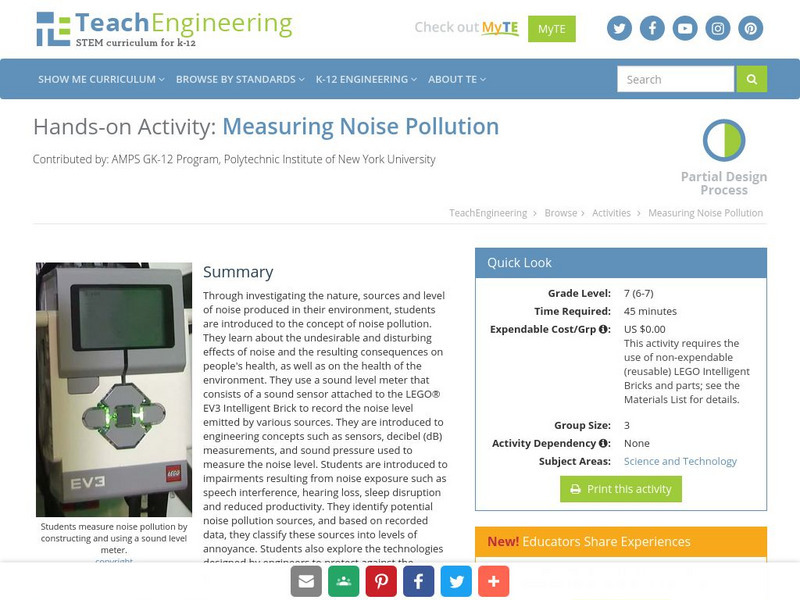
TeachEngineering
Teach Engineering: Measuring Noise Pollution
Through investigating the nature, sources and level of noise produced in their environment, students are introduced to the concept of noise pollution. They learn about the undesirable and disturbing effects of noise and the resulting...
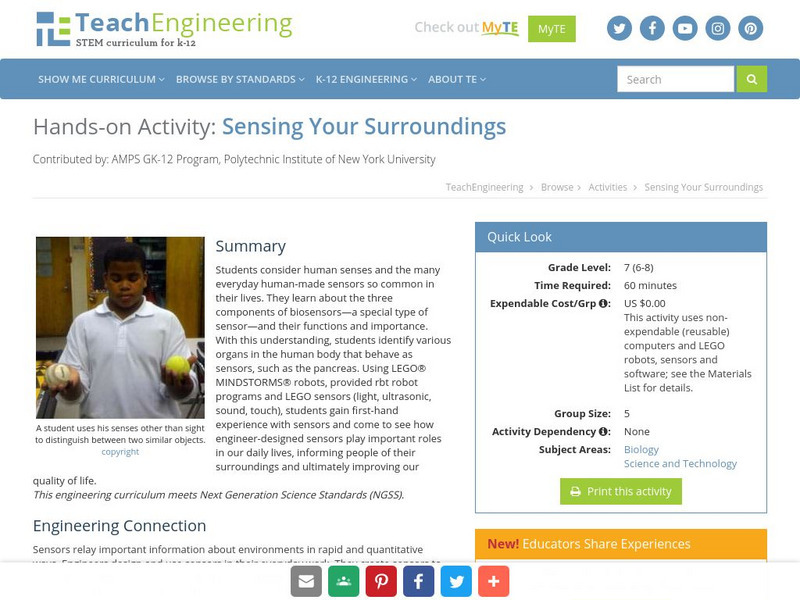
TeachEngineering
Teach Engineering: Sensing Your Surroundings
Students learn about the components and functions of biosensors. Using LEGO MINDSTORMS NXT robots and sensors, they discover how engineer-designed sensors play important roles in our daily lives, informing people of their surroundings...

Concord Consortium
Concord Consortium: Stem Resources: Bridges
A project where students design, build, and a test a bridge made out of file folders. Students will use a force sensor to measure how strong their model bridge is. Then students will compare their results to classmates to conclude what...

Concord Consortium
Concord Consortium: Stem Resources: Building a Bungee Jump
Students are asked to create a bungee jump that will protect a hard-boiled egg from breaking. A force sensor is needed to measure the push/pull forces on the egg. Data is inserted into force-time graphs. After completing three...

Concord Consortium
Concord Consortium: Stem Resources: Building a Zip Line
For this interactive, students plan, create, and test a zip line that will transport a hard-boiled egg without breaking it. They will make improvements on their design based on data about its performance. A motion sensor is required in...

Concord Consortium
Concord Consortium: Stem Resources: Greenhouse Light and Temperature
An interactive tool where students can create a model of a greenhouse and use a light sensor to measure the amount of light it receives from a lamp at various times of the day. Temperature is also measured. Data is plotted on graphs,...
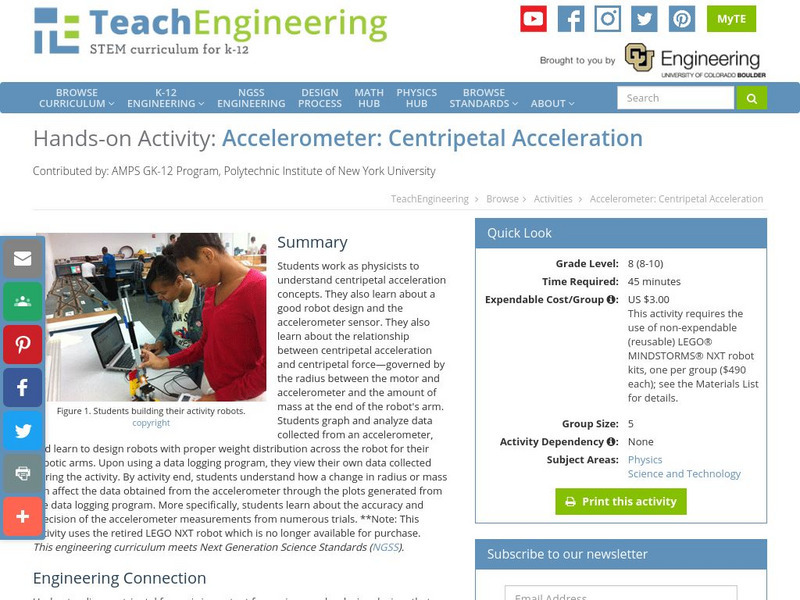
TeachEngineering
Teach Engineering: Accelerometer: Centripetal Acceleration
Students work as physicists to understand centripetal acceleration concepts. They also learn about a good robot design and the accelerometer sensor. They also learn about the relationship between centripetal acceleration and centripetal...
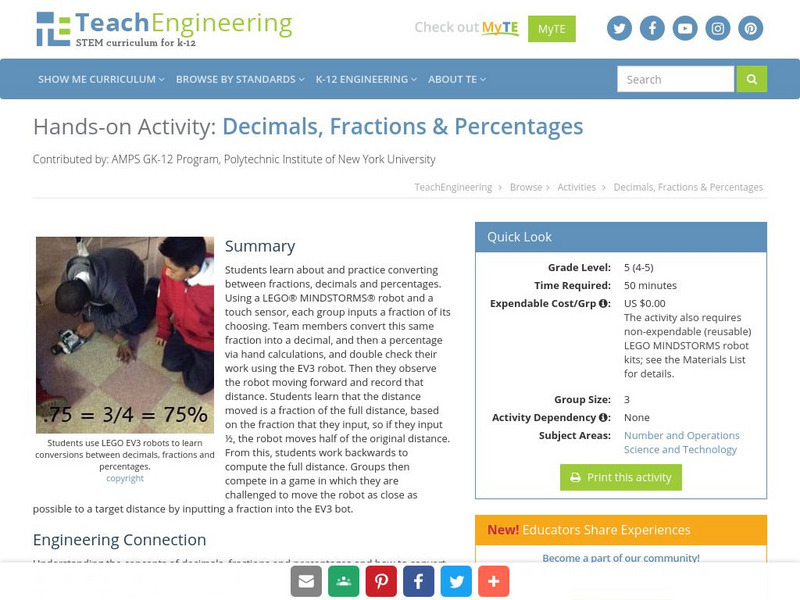
TeachEngineering
Teach Engineering: Decimals, Fractions & Percentages
Students learn about and practice converting between fractions, decimals and percentages. Using a LEGO MINDSTORMS NXT robot and a touch sensor, each group inputs a fraction of its choosing. Team members convert this same fraction into a...
TeachEngineering
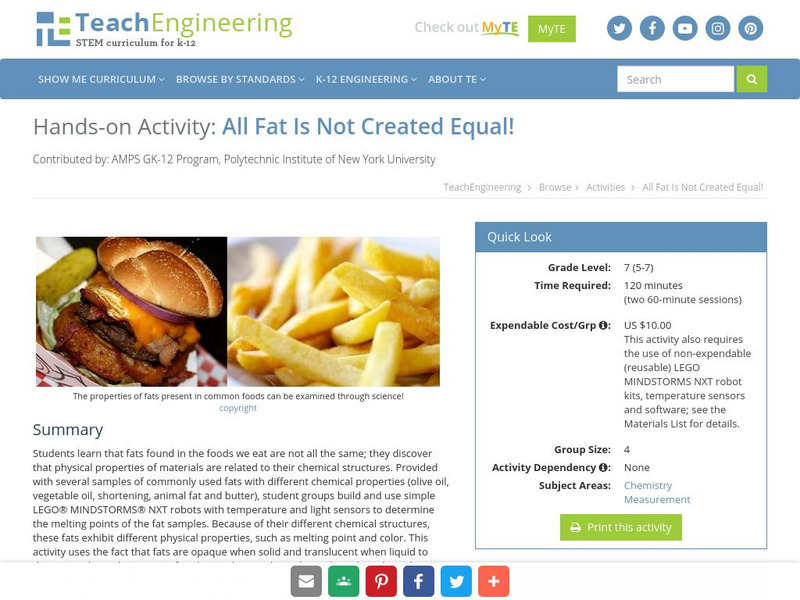
Teach Engineering: All Fat Is Not Created Equally!
Students learn that fats found in the foods we eat are not all the same; they discover that physical properties of materials are related to their chemical structures. Provided with several samples of commonly used fats with different...

TeachEngineering
Teach Engineering: Means, Modes, and Medians
Students experience data collection, analysis and inquiry in this LEGO MINDSTORMS NXT -based activity. They measure the position of an oscillating platform using a ultrasonic sensor and perform statistical analysis to determine the mean,...
TeachEngineering
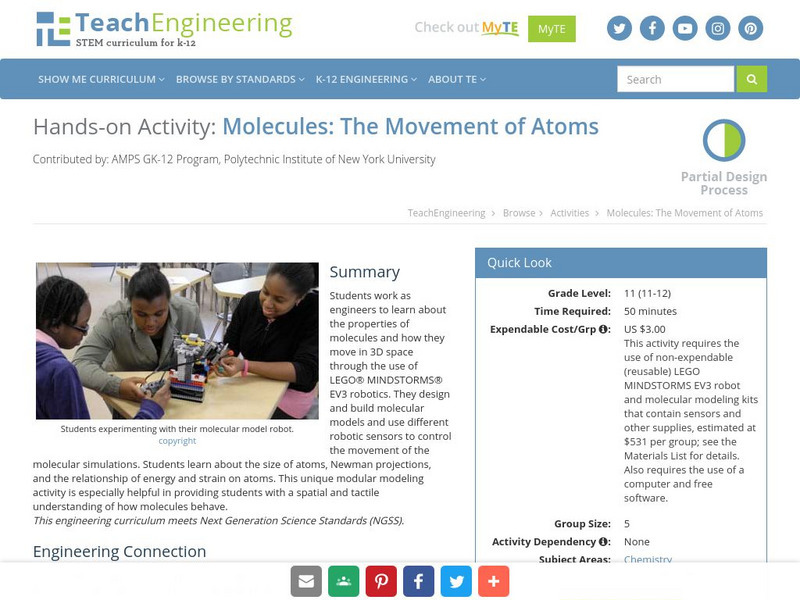
Teach Engineering: Molecules: The Movement of Atoms
Students work as engineers to learn about the properties of molecules and how they move in 3D space through the use of LEGO MINDSTORMS NXT robotics. They design and build molecular models and use different robotic sensors to control the...
TeachEngineering
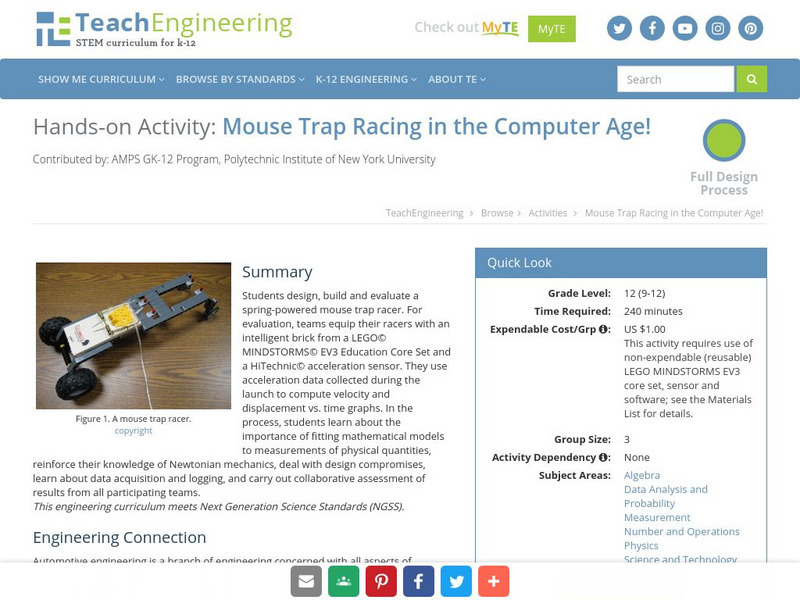
Teach Engineering: Mouse Trap Racing in the Computer Age!
Students design, build and evaluate a spring-powered mouse trap racer. For evaluation, teams equip their racers with an intelligent brick from a LEGO MINDSTORMS NXT Education Base Set and a HiTechnic acceleration sensor. They use...

TeachEngineering
Teach Engineering: Measuring Distance With Sound Waves
Students learn about sound waves and use them to measure distances between objects. They explore how engineers incorporate ultrasound waves into medical sonogram devices and ocean sonar equipment. Students learn about properties, sources...
TeachEngineering
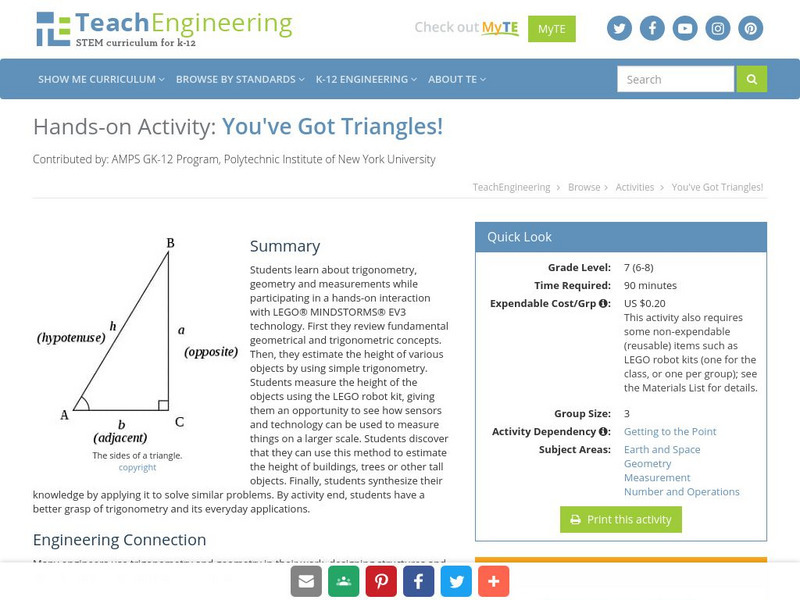
Teach Engineering: You've Got Triangles!
Students learn about trigonometry, geometry and measurements while participating in a hands-on interaction with LEGO MINDSTORMS NXT technology. First they review fundamental geometrical and trigonometric concepts. Then, they estimate the...
TeachEngineering
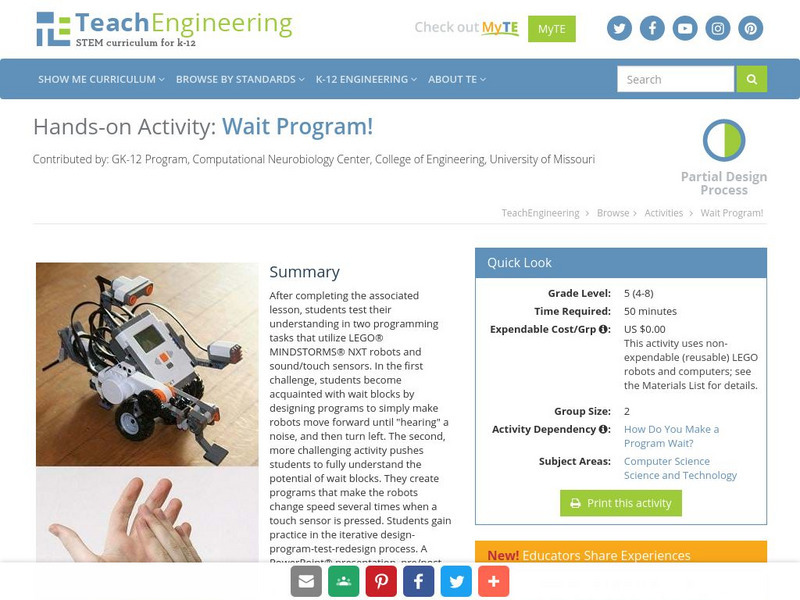
Teach Engineering: Wait Program!
After completing an associated lesson, students test their understanding in two programming tasks that utilize LEGO MINDSTORMS NXT robots and sound/touch sensors. Students gain practice in the iterative design-program-test-redesign process.
TeachEngineering
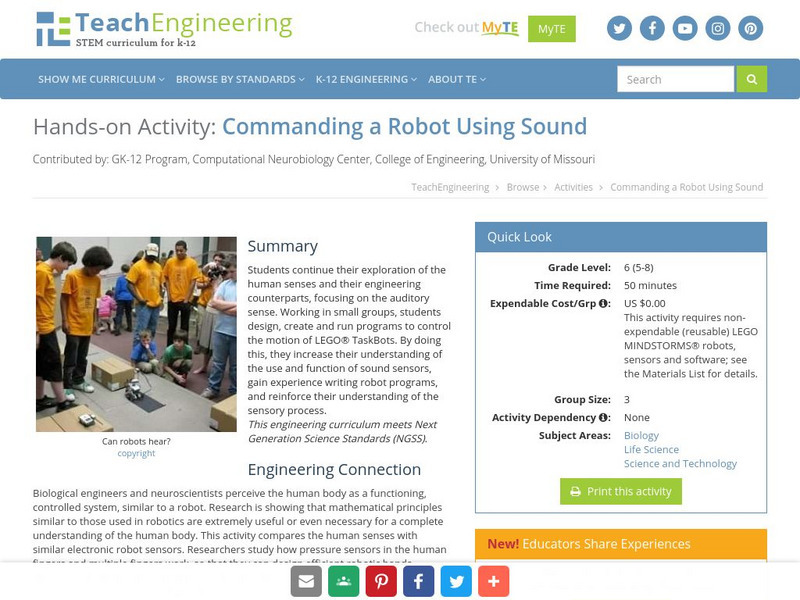
Teach Engineering: Commanding a Robot Using Sound
Students continue their exploration of the human senses and their engineering counterparts, focusing on the auditory sense. Working in small groups, students design, create and run programs to control the motion of LEGO TaskBots. By...
TeachEngineering
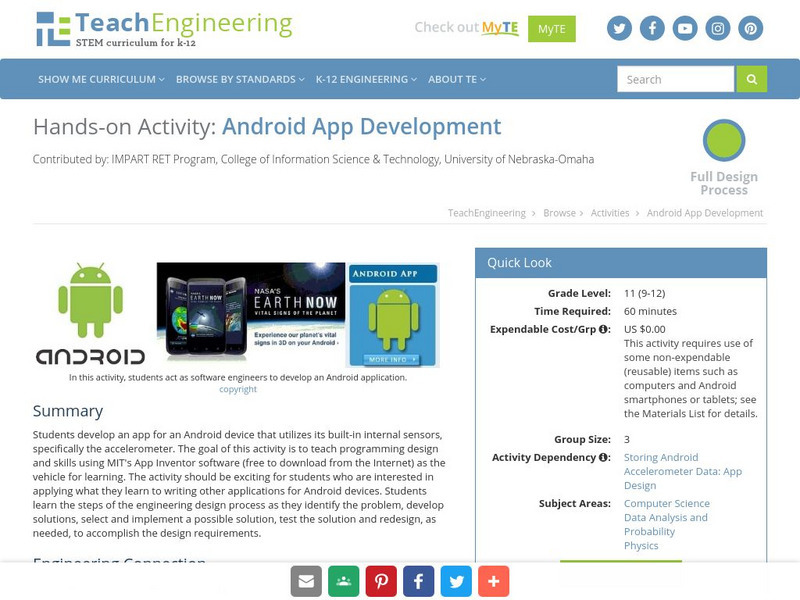
Teach Engineering: Android App Development
Students develop an app for an Android device that utilizes its built-in internal sensors, specifically the accelerometer. The goal of this activity is to teach programming design and skills using MIT's App Inventor software (free to...
TeachEngineering
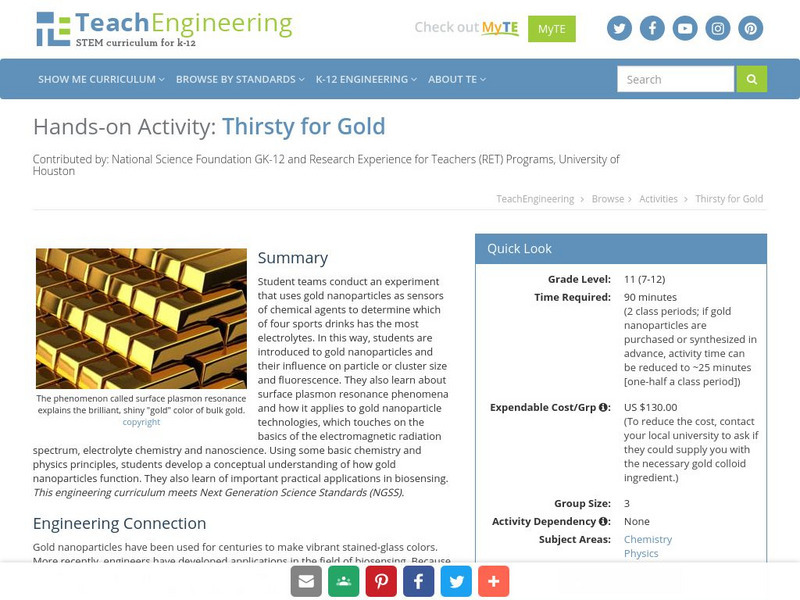
Teach Engineering: Thirsty for Gold
Student teams conduct an experiment that uses gold nanoparticles as sensors of chemical agents to determine which of four sports drinks has the most electrolytes. In this way, students are introduced to gold nanoparticles and their...
TeachEngineering
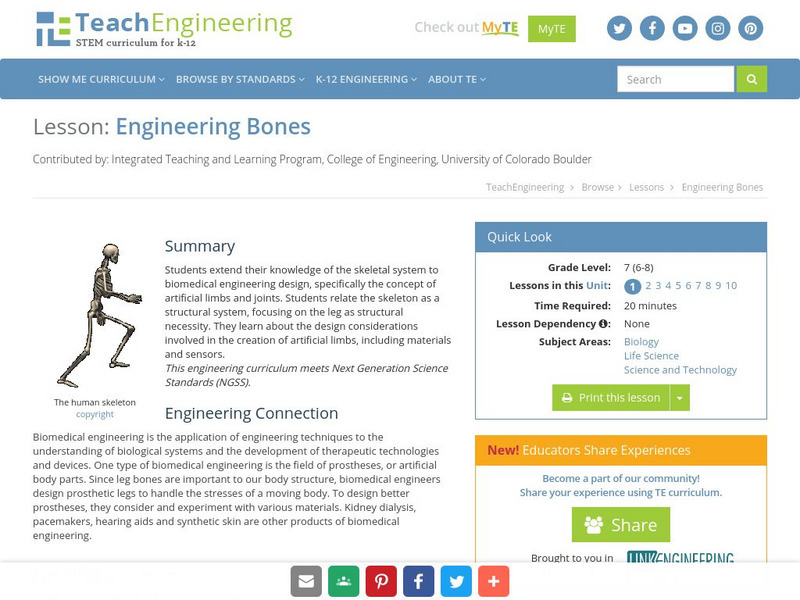
Teach Engineering: Engineering Bones
Middle schoolers extend their knowledge of the skeletal system to biomedical engineering design, specifically the concept of artificial limbs. Students relate the skeleton as a structural system, focusing on the leg as structural...
TeachEngineering
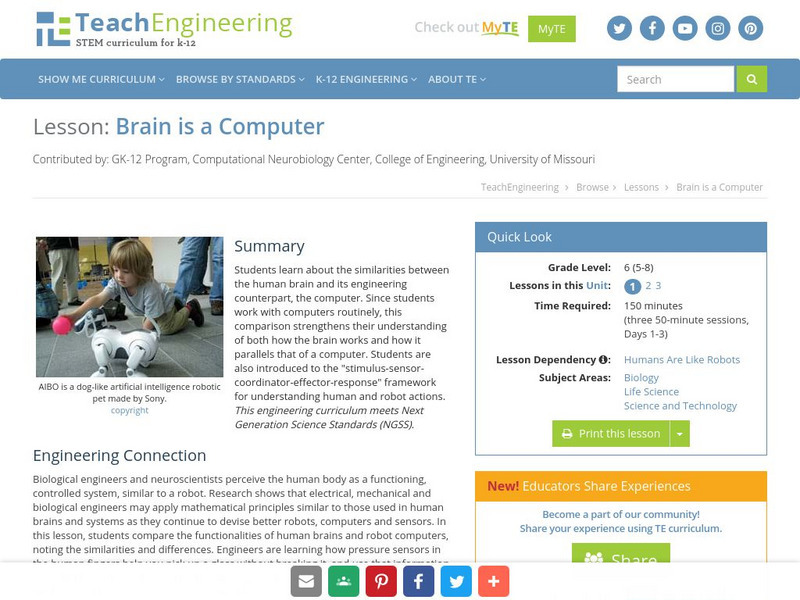
Teach Engineering: Brain Is a Computer
Students learn about the similarities between the human brain and its engineering counterpart, the computer. Since students work with computers routinely, this comparison strengthens their understanding of both how the brain works and...
Concord Consortium
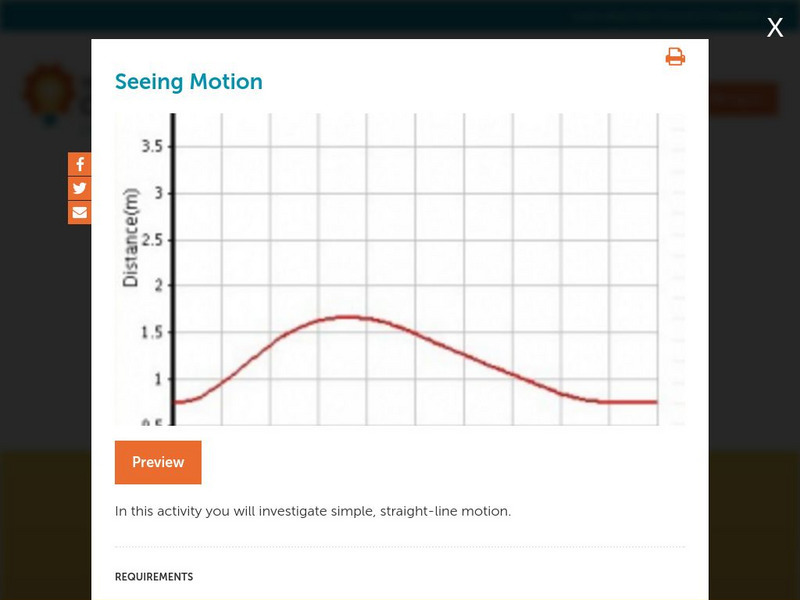
Concord Consortium: Stem Resources: Seeing Motion
With this interactive tool and the use of a motion sensor, students will track their own motion and, as they collect data in several experiments, they will plot it on a distance-time graph. After completing the three experiments, they...
TeachEngineering
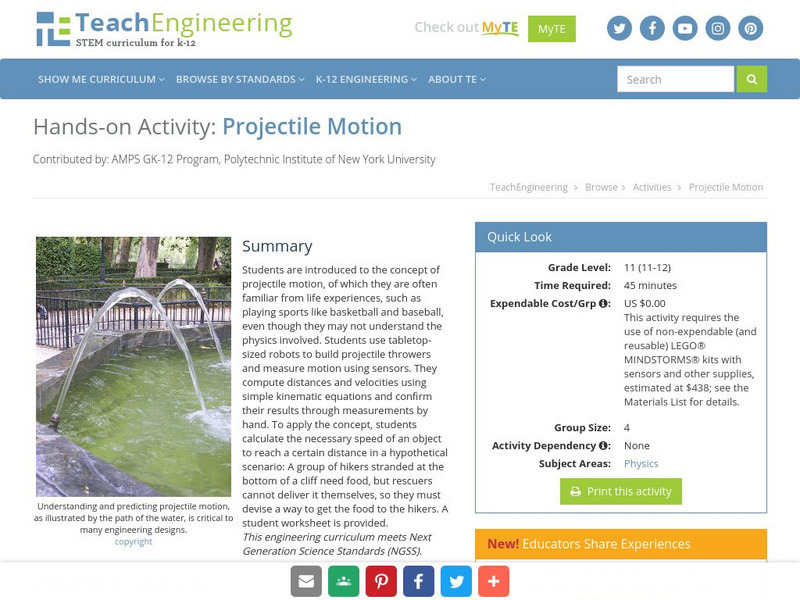
Teach Engineering: Projectile Motion
Students are introduced to the concept of projectile motion, of which they are often familiar from life experiences,such as playing sports such as basketball or baseball, even though they may not understand the physics involved. Students...

Technovation
Curiosity Machine: Challenges: Engineer a Fuel Level Detector
This site contains a challenge for students to engineer a sensor that can detect how much fuel is in your tank. The site also contains tips, a lesson plan, and a place for students to document their engineering design process.
Other popular searches
- Sensory
- Sensory Words
- Sensory Details
- Sensory Activities
- Sensory Language
- Sensory Writing
- Sensory Paragraph Writing
- Sensory Details in Writing
- Sensory Images
- Sensory Description
- Identifying Sensory Words
- Multi Sensory