Hi, what do you want to do?





Texas Instruments
Texas Instruments: Vernier Boyle's Law
The primary objective of this experiment is to determine the relationship between the pressure and volume of a confined gas. The gas we use will be air, and it will be confined in a syringe connected to a Pressure Sensor (see Figure 1)....
Texas Instruments
Texas Instruments: Probing an Aquatic Ecosystem
In this activity, students' use a pH sensor and Temperature Sensor to measure and compare the pH and temperature of three aquariums over a period of several weeks. They will compare and understand how plants and animals affect the water...
Other
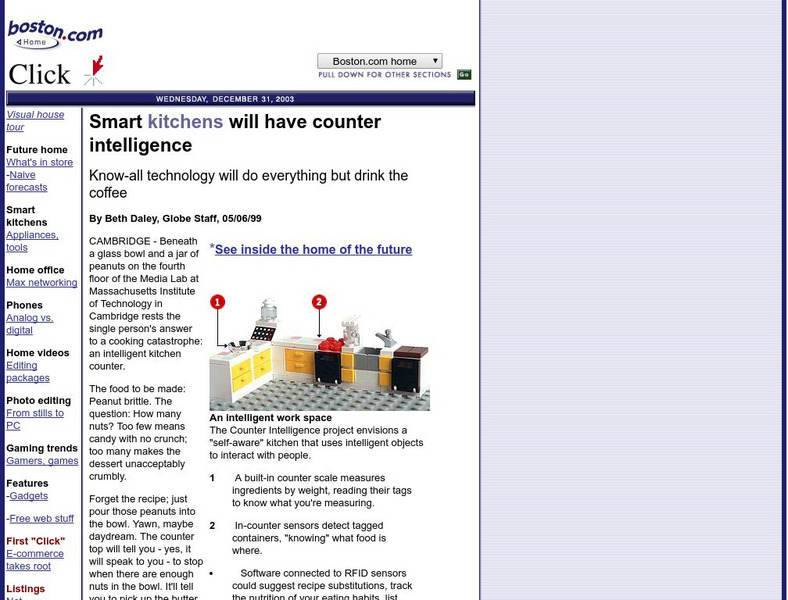
Smart Kitchens Will Have Counter Intelligence
Look at a futuristic kitchen that has an intelligent workspace with built in counter scales, detection sensors for kinds of food, and software connected to RFID sensors to suggest ingredients for recipes and order groceries. Learn more...

TeachEngineering
Teach Engineering: Hands on Activity: Designing a Thermostat
By building a basic thermostat, students will explore basic circuitry and electricity. The thermostat built out of a breadboard, temperature sensor chip, amplifier, and battery creates a linear relationship between temperature of the...
Texas Instruments
Texas Instruments: Sunrise, Sunset: Weather Match
Students determine the relationship between temperature and light intensity. They use a Temperature Sensor and a Light Intensity Sensor to collect temperature and light intensity data for a period of 24 hours. They understand the effect...
Scholastic
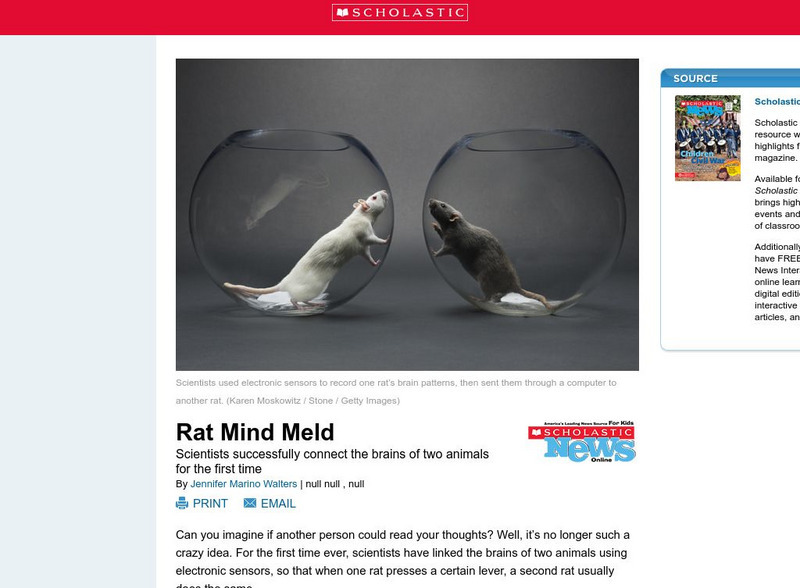
Scholastic News: Rat Mind Meld
This article describes how scientists connected the minds of two rats using electronic sensors.
Texas Instruments
Texas Instruments: Wet Sand / Dry Sand
In this activity, Students can use temperature sensors to compare the heating rates of wet sand and dry sand. They will use the results of the experiment to understand more about the effects of evaporation.
Texas Instruments
Texas Instruments: Energy From Foods Part Ii
In this activity, students explore how an electrochemical cell works. They use a Voltage Sensor to measure the electrical energy produced when the distance between the electrodes is varied. They also determine the factors that affect the...
Texas Instruments
Texas Instruments: Keep It Bottled Up: Linear Rates of Pressure Increase
In this activity, students' examine how temperature affects the rate of gas production during a chemical reaction. They measure this rate by recording the pressure variation using a pressure sensor and model the pressure data using a...
Texas Instruments
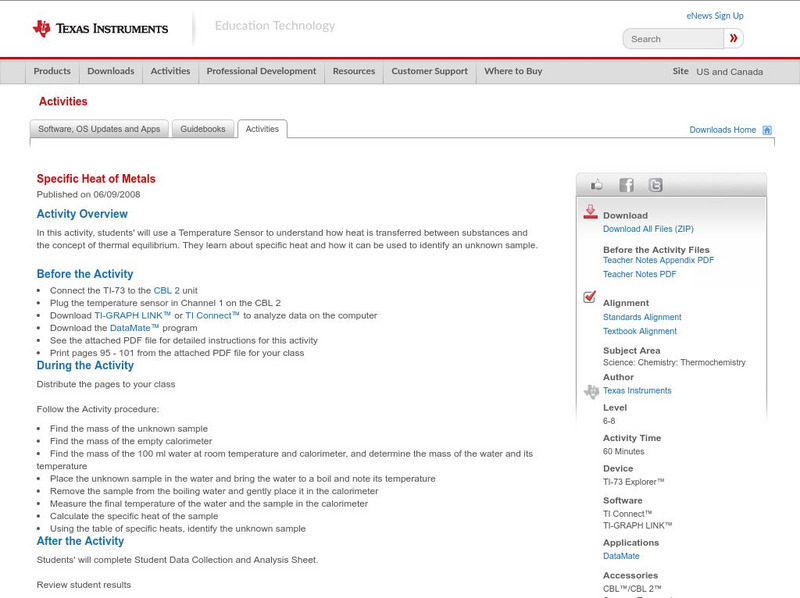
Texas Instruments: Specific Heat of Metals
In this activity, students' will use a Temperature Sensor to understand how heat is transferred between substances and the concept of thermal equilibrium. They learn about specific heat and how it can be used to identify an unknown sample.
Texas Instruments
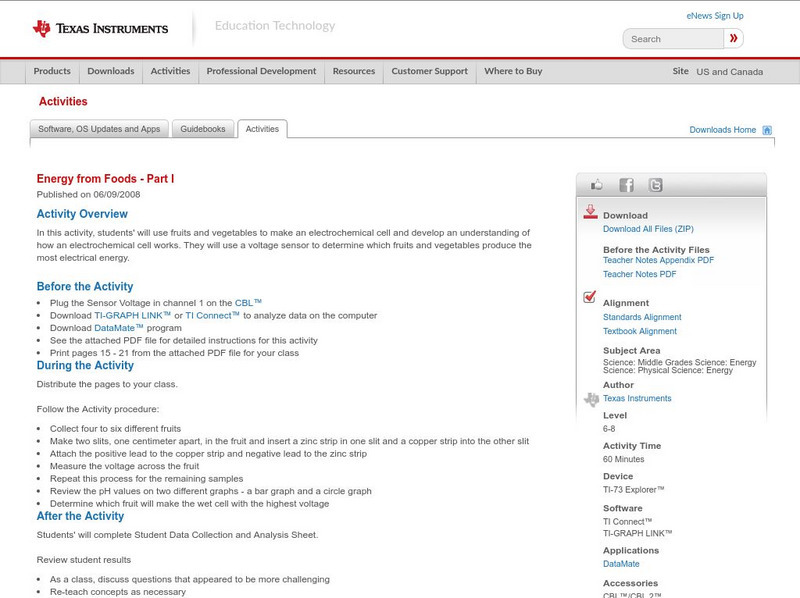
Texas Instruments: Energy From Foods: Part I
In this activity, students' will use fruits and vegetables to make an electrochemical cell and develop an understanding of how an electrochemical cell works. They will use a voltage sensor to determine which fruits and vegetables produce...
Texas Instruments
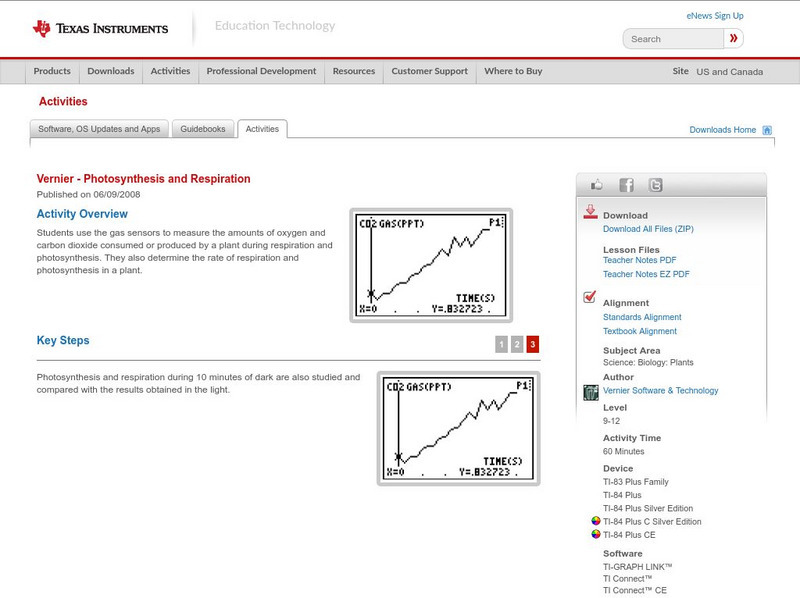
Texas Instruments: Photosynthesis and Respiration
Students use the gas sensors to measure the amounts of oxygen and carbon dioxide consumed or produced by a plant during respiration and photosynthesis. They also determine the rate of respiration and photosynthesis in a plant.

Texas Instruments
Texas Instruments: P H
Students use a pH sensor to measure the pH level of water in a stream or lake. They examine how air pollutants like sulphur dioxide, nitrogen oxides, and carbon dioxide cause acid rain, which affects the pH of water bodies and aquatic...
Texas Instruments
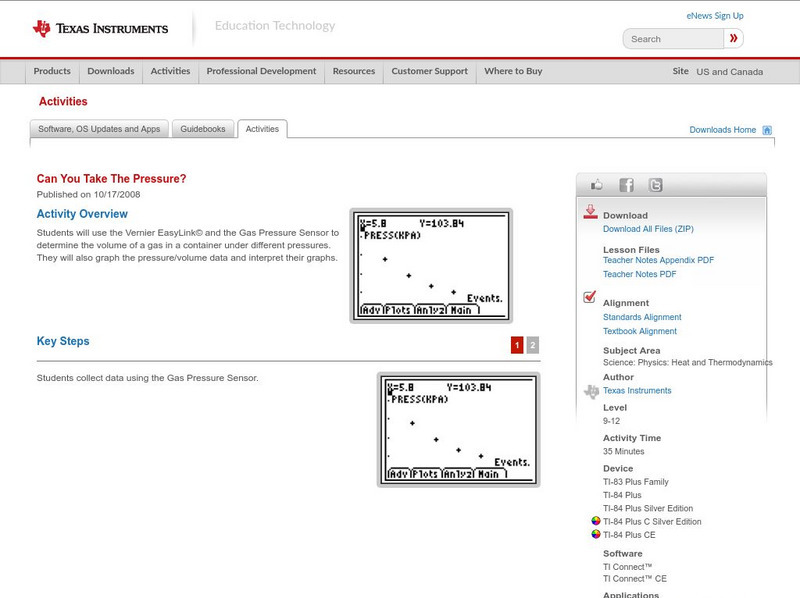
Texas Instruments: Can You Take the Pressure?
In this activity you will: Use the EasyLink and the Gas Pressure Sensor. Determine the volume of a gas in a container under different pressures. Graph pressure/Volume data. Interpret the graphs.
Texas Instruments
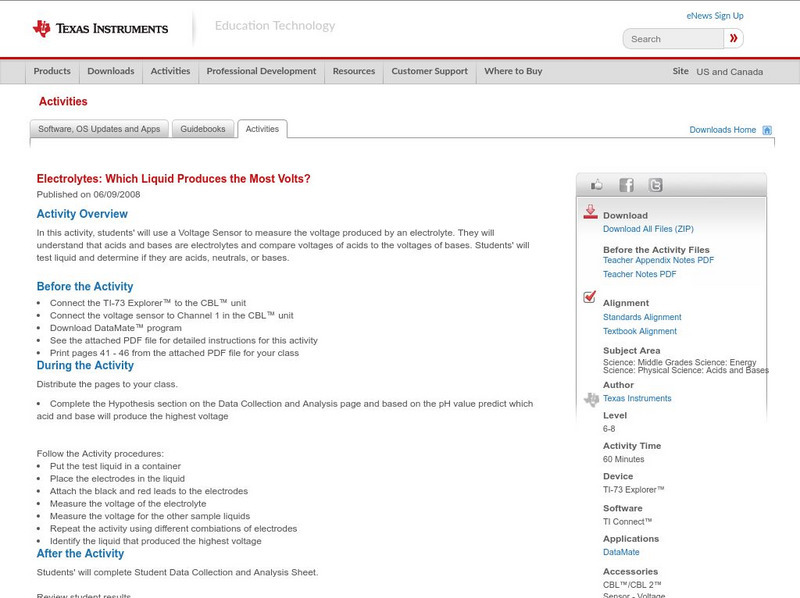
Texas Instruments: Electrolytes: Which Liquid Produces the Most Volts?
In this activity, students' will use a Voltage Sensor to measure the voltage produced by an electrolyte. They will understand that acids and bases are electrolytes and compare voltages of acids to the voltages of bases. Students' will...
Texas Instruments
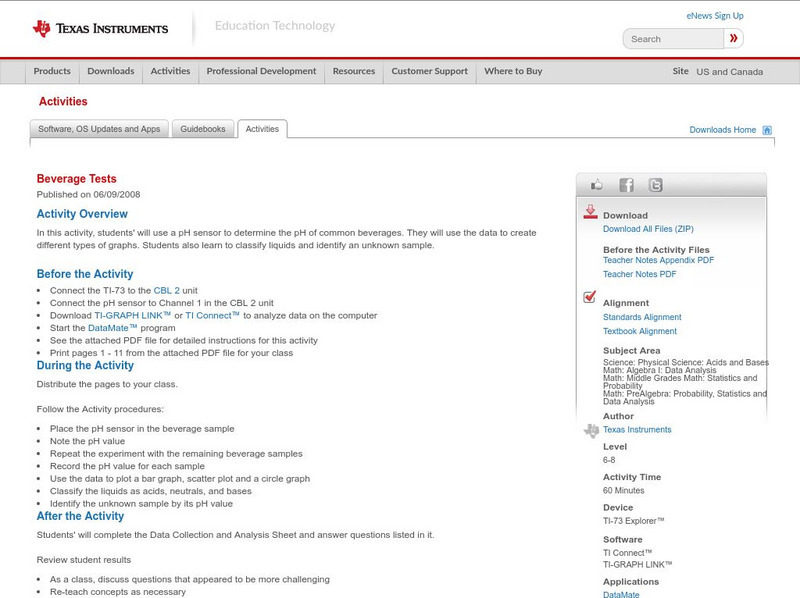
Texas Instruments: Beverage Tests
In this activity, students' will use a pH sensor to determine the pH of common beverages. They will use the data to create different types of graphs. Students also learn to classify liquids and identify an unknown sample.
Texas Instruments
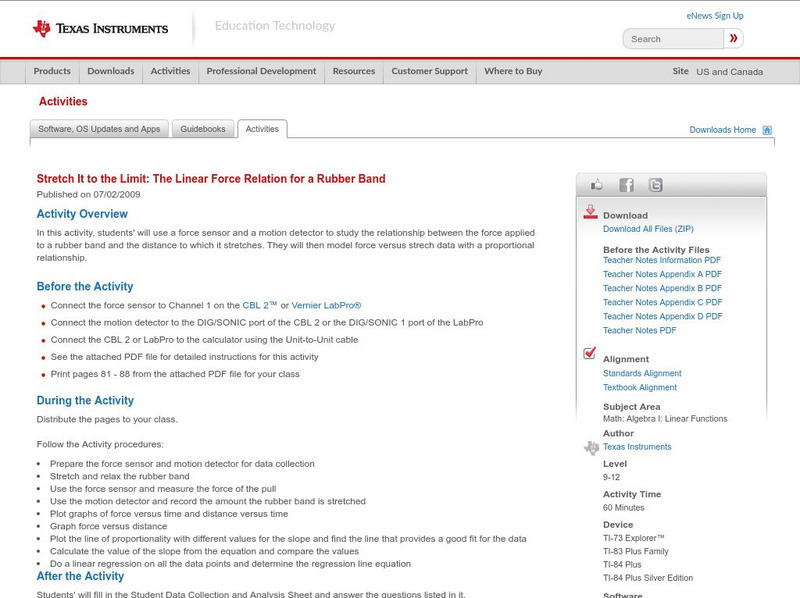
Texas Instruments: The Linear Force Relation for a Rubber Band
In this activity, students' will use a force sensor and a motion detector to study the relationship between the force applied to a rubber band and the distance to which it stretches. They will then model force versus strech data with a...

Texas Instruments
Texas Instruments: Titration Curves: An Application of the Logistic Function
In this activity, Students can use a pH sensor to record pH versus base volume data for an acid base titration. They will manually model the curve using a logistic function.
Texas Instruments
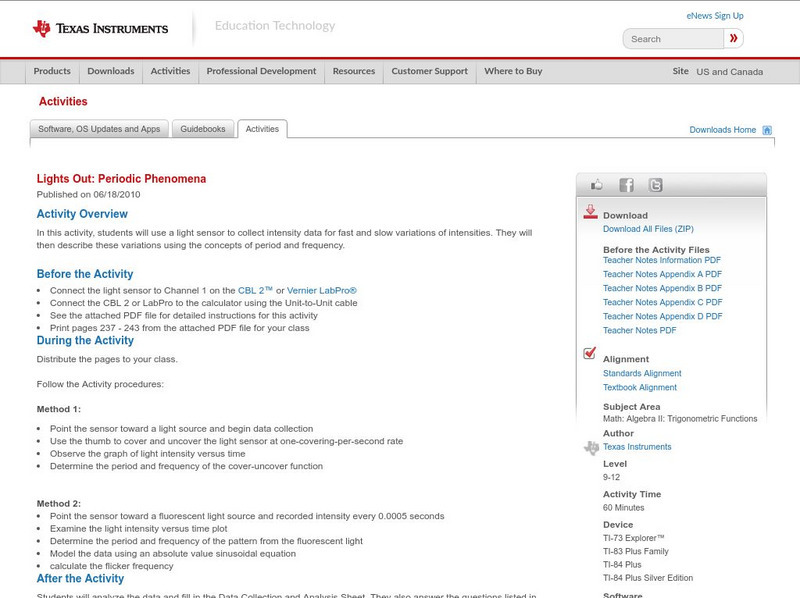
Texas Instruments: Lights Out: Periodic Phenomena
In this activity, students can use a light sensor to collect intensity data for fast and slow variations of intensities. They will then describe these variations using the concepts of period and frequency.
Texas Instruments
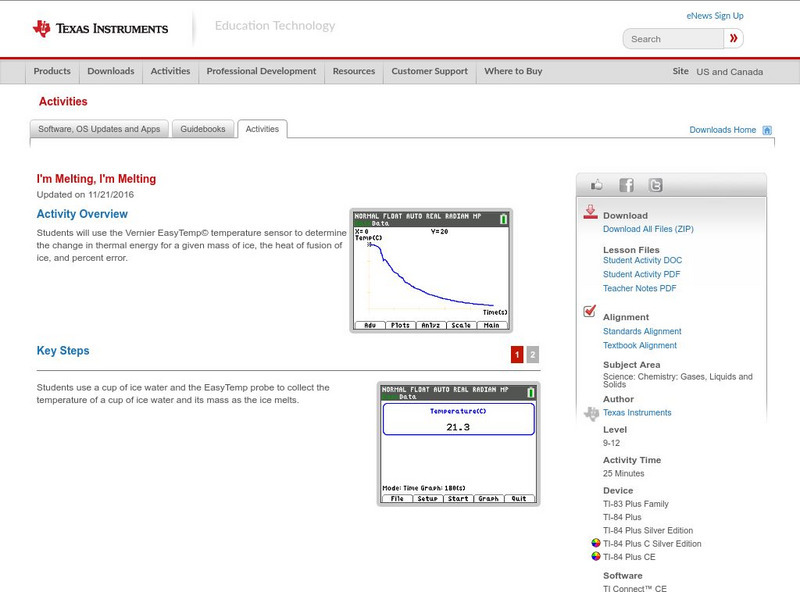
Texas Instruments: I'm Melting, I'm Melting
In this activity you will use the EasyTemp temperature sensor. Determine the change in thermal energy for a given mass of ice. Determine the heat of fusion of ice and the percent error.
Texas Instruments
Texas Instruments: Water Quality
In this activity, students' will use a pH sensor to check and compare the pH values of various water samples. They will understand the meaning and effect of pH and factors that affect pH.
Texas Instruments
Texas Instruments: Light at a Distance: Distance and Light Intensity
In this activity, students can use a light sensor to record the light intensity at various distances from a bulb. They will compare the data to an inverse square and a power law model.
Texas Instruments
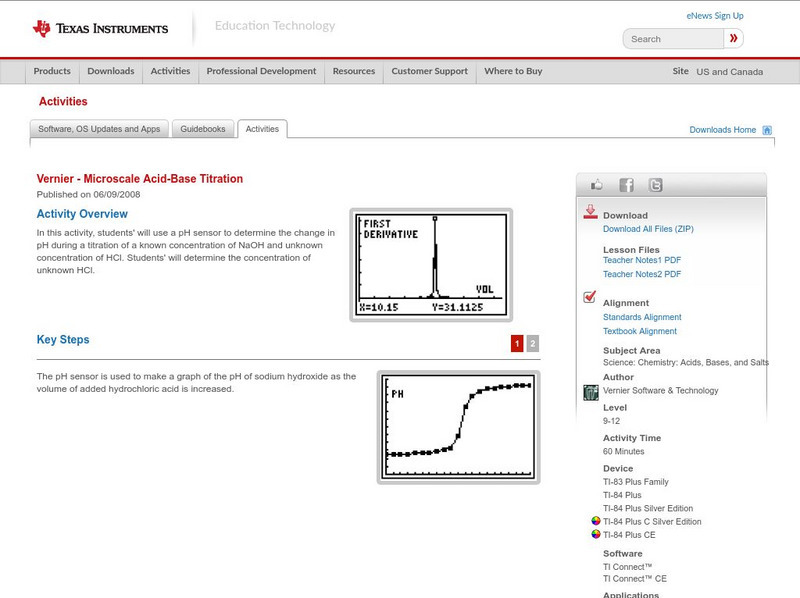
Texas Instruments: Microscale Acid Base Titration
In this activity, students' will use a pH sensor to determine the change in pH during a titration of a known concentration of NaOH and unknown concentration of HCl. Students' will determine the concentration of unknown HCl.
Texas Instruments
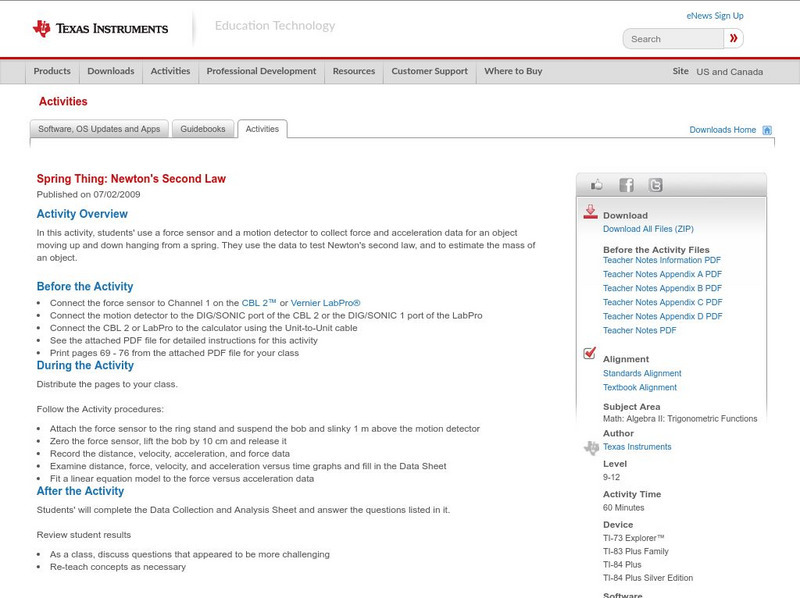
Texas Instruments: Spring Thing: Newton's Second Law
In this activity, students' use a force sensor and a motion detector to collect force and acceleration data for an object moving up and down hanging from a spring. They use the data to test Newton's second law, and to estimate the mass...
Other popular searches
- Sensory
- Sensory Words
- Sensory Details
- Sensory Activities
- Sensory Language
- Sensory Writing
- Sensory Paragraph Writing
- Sensory Details in Writing
- Sensory Images
- Sensory Description
- Identifying Sensory Words
- Multi Sensory