Hi, what do you want to do?





ReadWriteThink
Read Write Think: Gingerbread Phonics
Through a shared reading of the familiar text, "The Gingerbread Man," students can learn to sound out familiar words. You will find step-by-step instructions as well as supplemental materials.
Utah Education Network
Uen: K Act. 04: Shared Reading: Wishy Washy Day
This two-day lesson plan engages students in reading comprehension strategies related to Joy Cowley's Wishy-Washy Day and Audrey Wood's book, King Bidgood's in the Bathtub. Students will participate in making predictions, sequencing, and...
Utah Education Network
Uen: Share "The Fight" Oral Fluency Practice
This module provides a reading fluency lesson. To help second grade students improve their reading fluency, teachers will use Helen Moore's poem "The Fight" during the lesson.

ReadWriteThink
Read Write Think: Vocabulary Instruction Lesson Plan
This lesson plan uses a virtual trip to the moon to teach vocabulary practice. Included in the lesson plan is an overview, practice, objectives, resources, preparation, and more.
ReadWriteThink
Read Write Think: Oral Storytelling and Dramatization
Students begin this instructional activity by discussing what makes a good, vivid story and creating a working checklist of the criteria for a good story. They explore background information about the Mercury Theatre production of the...
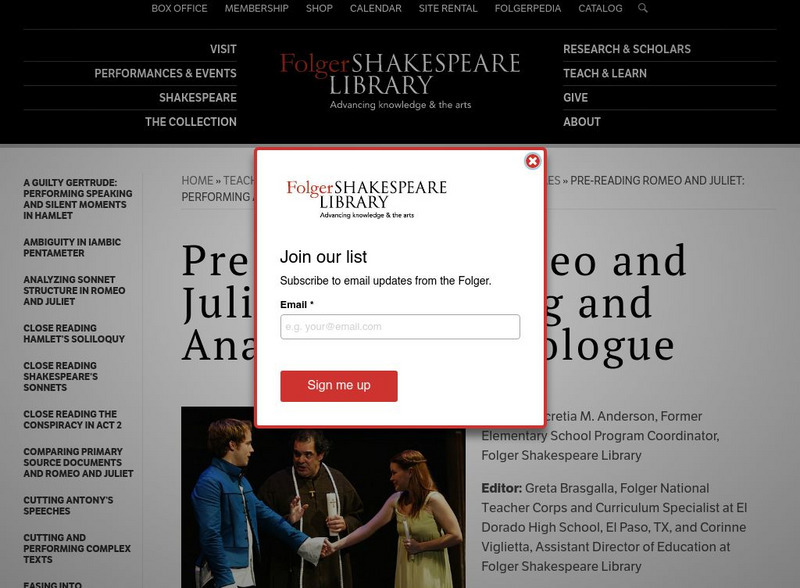
Folger Shakespeare Library
Folger Shakespeare Library: Pre Reading Romeo and Juliet
This site shares a two-day lesson that will help students prepare for reading Romeo and Juliet. Students will read and perform the prologue of Romeo and Juliet and engage in the analysis of the play's meaning, get to know the style and...

Better Lesson
Better Lesson: Writing an Opinion in Response to the Story
Learners need to have lots of opportunities to share their opinions based on text. In this instructional activity, the teacher will read the story, Jack and the Beanstalk, multiple times before the students create their opinion. The...

Scholastic
Scholastic: Investigating Nonfiction Part 3: Independent and Guided Reading
This article provides tips for using nonfiction with guided reading and independent reading. The following strategies are shared: ways to help kids select "just right" nonfiction books; lessons to use with nonfiction in guided reading...
Alabama Learning Exchange
Alex: Interactive Reading Project
In this lesson plan, learners are motivated to read and learn how to discuss literature by discussing books they are reading via e-mail.
ReadWriteThink
Read Write Think: Creating Question and Answer Books Through Guided Research
Contains plans for five lessons that develop research skills in primary students by having them create their own question and answer books. In addition to objectives and standards, this instructional plan contains links to sites used in...
ReadWriteThink
Read Write Think: Shared Spelling Strategies
Contains plans for a lesson that will provide students with strategies for spelling unfamiliar words. Students are asked to use phonological awareness and visual recall, analyze alternative spellings, and use a variety of resources...
ReadWriteThink
Read Write Think: Designing Museum Exhibits for "The Grapesof Wrath"
Integrating various creative formats with solid, researched fact, allows students to show what they have learned. The resulting "museum" can be shared with an audience in any of a number of ways. Includes handouts, rubric, and...
ReadWriteThink
Read Write Think: Exploring Audience in Persuasive Letter Writing
Effective communication skills are critical for the present century. This unit plan stresses clear, persuasive communication that is meant to be shared with an audience beyond the classroom.
ReadWriteThink
Read Write Think: Guess What's in the Bag a Language Based Activity
Contains plans for a language activity called "Guess What's in the Bag." Students try to guess the object in a bag in order to develop descriptive language, listening, and problem solving skills. In addition to objectives and standards,...
Common Sense Media
Common Sense Media: Education: Story Elements Retelling
In this lesson plan, learners will learn to retell a story using story elements to improve their comprehension of the story. The students will actively listen to a story and complete a graphic organizer to share and discuss with a partner.

ReadWriteThink
Read Write Think: Writing Leads in the Middle School Class
Great lesson in which students read various examples of "leads," or attention-grabbing introductions, in literature. Students then contemplate and develop their own interesting "lead" for a short story and share it with the class. Great...

Sophia Learning
Sophia: Referencing the Author's Purpose
This lesson explains how to reference an author's purpose when answering a reading comprehension question. This tutorial shares an audio version of the lesson's content. [3:14] RI.11-12.6 Eval Purpose, Rhetoric, Style
BioEd Online
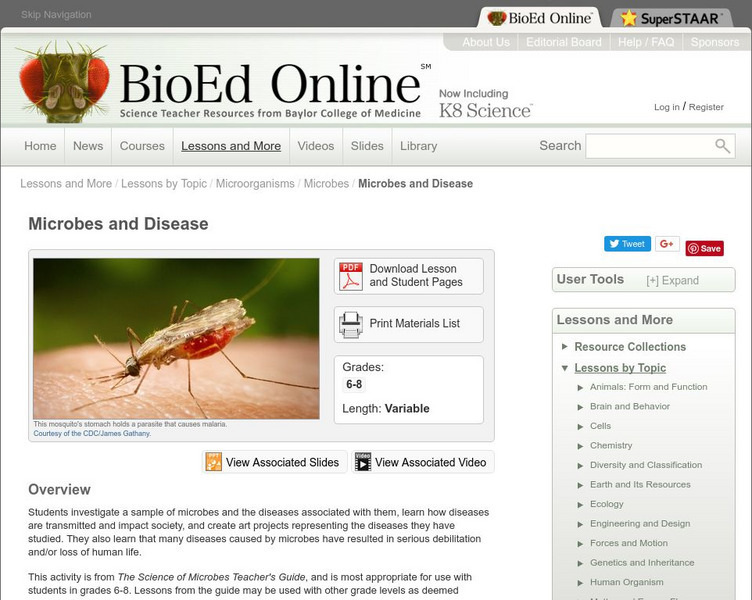
Bio Ed Online: The Science of Microbes: Microbes and Disease
Students learn about six diseases caused by microorganisms. A video that looks at the impact disease has had on human history and society is provided. Students work in groups to read information about one disease, then share what they...

Alabama Learning Exchange
Alex: Three Meals for Gregory
Lesson begins with a review of the food guide pyramid. The book Gregory the Terrible Eater by Mitchell Sharmat (not provided through lesson) is read and discussed in light of healthy eating. In groups, learners create healthy meals from...

Writing Fix
Writing Fix: Truth Be Told
This lesson plan extends student understanding of the concept of "truisms" and "writing hooks" to introduce writings. Gretchen Bernabei's Reviving the Essay, the book Fox, written by Margaret Wild and Ron Brooks, will be read aloud and...