Hi, what do you want to do?






Curated OER
Botany: What are the types of rice?
Learners explore the different types of rice. In this botany lesson, students match characteristics of rice with its variety.

Curated OER
Business Writing Genres
In this grammar learning exercise, students, working with a partner, read eighteen sentences to each other filling in an adjective in each blank.

Curated OER
Orbital Motion
Students use a formula to measure the eccentricity of an ellipse, then state Kepler's Law of Elliptical Orbits. They predict the solar energy received at different positions in a planet's orbit.

Curated OER
Worksheet 22 - Spring 1996
students examine the potential of creating the involute for a circle. They use the concept to create new parametric equations. They graph the picture for each.

Museum of Science
Gadget Anatomy: Understanding Machines
Students observe a machine closely from several angles while it operates. Identify the elements of machines combined in different gadgets. Create a clear diagram of how a machine works.

Curated OER
"Umbrellas"
In this reading comprehension activity, students read a passage about the origin of the umbrella. Students answer 10 multiple choice questions about the text.

Curated OER
Why Do Birds Sing
In this reading comprehension worksheet, students read a passage about why birds sing. They then answer the 10 questions about the reading.

Curated OER
Human Genetics
This is a worksheet regarding human genetics where students can poll the class regarding specific traits.

Curated OER
Networks: Distances
In this networks worksheet, students solve 10 problems in which they calculate the shortest driving route between two cities. This page is intended to be an online activity, but can be completed on paper.

Curated OER
The Golden Rectangle
Students explore the concept of the golden ratio. In this golden ratio instructional activity, students measure objects to determine if their measurements fit the golden ratio. Students calculate the average measurements of the class.

Curated OER
Hello, Sunshine!
Students investigate how the sun travels across the sky at different latitudes using Solar Motion Demonstrator. In this earth science instructional activity, students explain why seasons change. They study how the tilt of the Earth's...

Curated OER
Paper Chromatography
Students participate in an experiment determining how to separate a mixture of dyes in water-soluble ink.

Curated OER
Lumping vs. Splitting
Students transform ordinary long-scrolling page into a logically connected web of information.

Curated OER
Water Prism
Students using a glass prism filled with water are able to see all of the visible colors found the sunlight.

Curated OER
Strong Fingers
Students discover strength resistance of arms in different positions by practicing personal defense positions.

Curated OER
Short Stories: The Puzzle Pieces of Life
Students distinguish the elements of fiction in a short story. In this fiction elements lesson, students complete nine lessons of activities to learn about the elements of fiction in short stories.

Better Lesson
Better Lesson: Chrysanthemum: Shorter and Longer Names
To introduce these terms, 1st graders get to learn a little mouse with a LONG name! After reading Chrysanthemum, students look at how long all of their names are and use the terms, "shorter, equal to and longer than" to compare the lengths.

Illustrative Mathematics
Illustrative Mathematics: Longer and Heavier? Shorter and Heavier?
Students will compare the length and weight of several pairs of objects to learn that weight and length are separate measurable attributes, and not always related.
Science Buddies
Science Buddies: Kinesthetic Astronomy: Longer Days, Shorter Nights
This kinesthetic activity demonstrates to students that the Earth's tilt is what is responsible for shifting light patterns and the change in seasons.
CK-12 Foundation
Ck 12: Elem Math: Objects Longer Than a Foot or a Yard
[Free Registration/Login may be required to access all resource tools.] For this learning module, students are asked to compare the lengths of everyday objects to a foot or a yard and state whether they are longer or shorter. Includes...
Illustrative Mathematics
Illustrative Mathematics: Longer and Shorter
Young scholars will use their shoe as a measuring item to learn about length. Students will compare classroom items by holding their shoe against the item and deciding if it is longer or shorter than their shoe. Young scholars will...
Illustrative Mathematics
Illustrative Mathematics: Which Is Longer?
Learners are introduced to the concept of length with this hands-on activity. Each student will choose two objects to compare by laying them next to each other and comparing which is longer. Students will record and discuss their findings.
Louisiana Department of Education
Louisiana Doe: Louisiana Believes: Eureka Math Parent Guide: Comparison of Length, Weight, Capacity, and Numbers to 10
A guide to support parents as they work with their students in comparison of length, weight, capacity, and numbers to 10.
Other
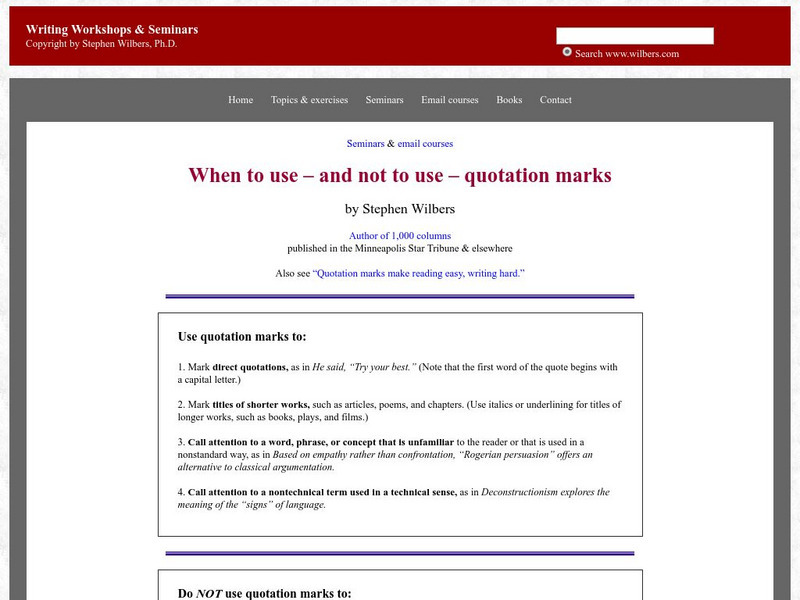
When to Use and Not to Use Quotation Marks
This site provides information on the correct usage of quotation marks, along with examples for each rule discussed.