Hi, what do you want to do?





Mocomi & Anibrain Digital Technologies
Mocomi: Buoyancy
Ever wonder why/how things float? This concept is called buoyancy. Take this interactive journey to learn and understand how and why certain materials float and others sink to the ocean floor.
![The Engineering Place: Balloon Flinking [Pdf] Lesson Plan](https://content.lessonplanet.com/knovation/original/172615-2de503a48a3b9f1faaa61527a0b2e7e4.jpg?1661554798 "The Engineering Place: Balloon Flinking [Pdf] Lesson Plan")
Google
The Engineering Place: Balloon Flinking [Pdf]
A lesson and activity sheet on buoyancy. Students add weight to a helium-filled balloon to keep it suspended so that it won't float or sink, but instead will 'flink.'

Other
National Engineers Week Foundation: Flinker
Students investigate with common objects to see if they can make something that neither floats nor sinks, but rather "flinks" in the middle.
Texas Education Agency
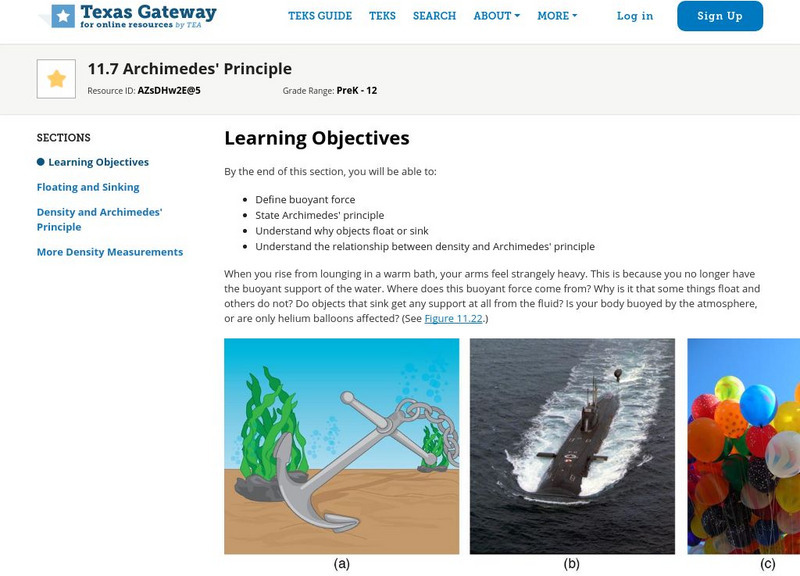
Texas Gateway: Ap Physics: Fluid Statics: Archimedes' Principle
By the end of this section, you will be able to define buoyant force, state Archimedes' principle, understand why objects float or sink, and understand the relationship between density and Archimedes' principle.
OpenStax
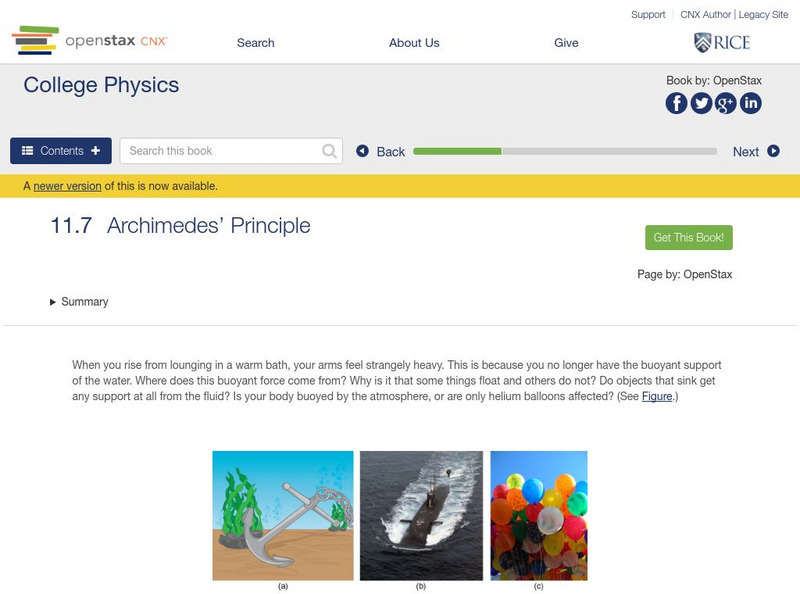
Open Stax: Physics: Archimedes' Principle
From a chapter on Fluid Statics in a Physics textbook. This section of the chapter provides a detailed discussion of Archimedes' principle, buoyant force, floating and sinking, and the role of density. Includes questions, problems and...

PBS
Pbs Teachers: Scientific American: Beneath the Sea: Blowing Ballast
Explore the use of ballast to manipulate buoyancy in submarines by building a model of a submersible using two-liter bottles and balloons. Describe the balance of forces that is responsible for the surfacing and diving of submersibles.
TeachEngineering
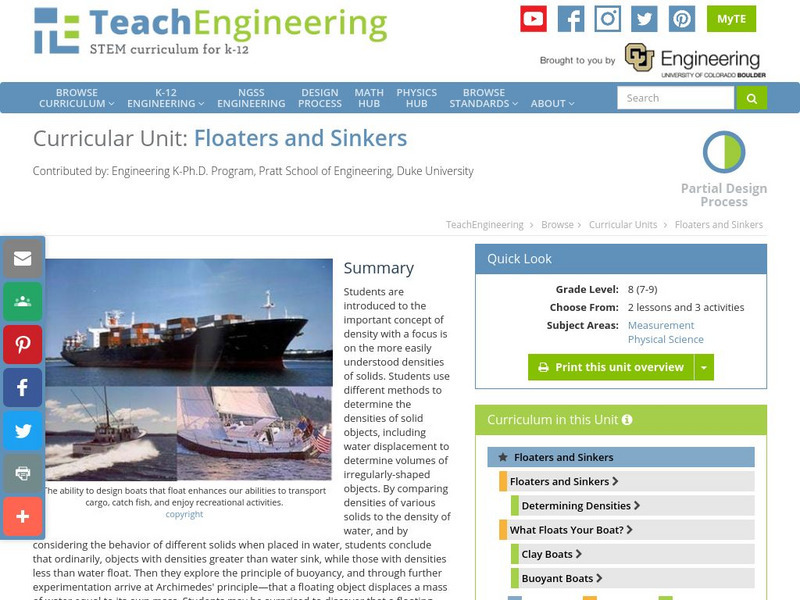
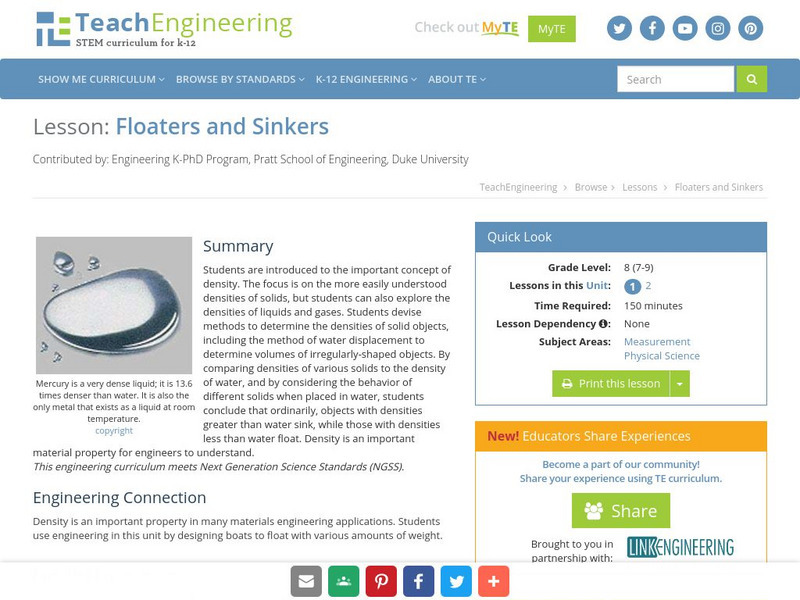
Teach Engineering: Floaters and Sinkers
Through this curricular unit, students are introduced to the important concept of density. The focus is on the more easily understood densities of solids, but students may also explore the densities of liquids and gases. Students devise...
TeachEngineering
Teach Engineering: Floaters and Sinkers
This lesson introduces students to the important concept of density. The focus is on the more easily understood densities of solids, but students can also explore the densities of liquids and gases. Students devise methods to determine...

Alabama Learning Exchange
Alex: Teaching Measurement: Literature and Manipulatives
The tradebook, Who Sank the Boat? by Pamela Allen, is an excellent tool in teaching measurement. Learners will engage in activities involving different types of measurement. In the story, five animal friends decide to take a boat ride....

Alabama Learning Exchange
Alex: What's the Matter: A Sinker or Floater?
Students will explore matter that sinks or floats when submerged in water and that matter is categorized as either a sinker or a floater. Students will work actively in small, cooperative learning groups as well as gather in a whole...
TeachEngineering
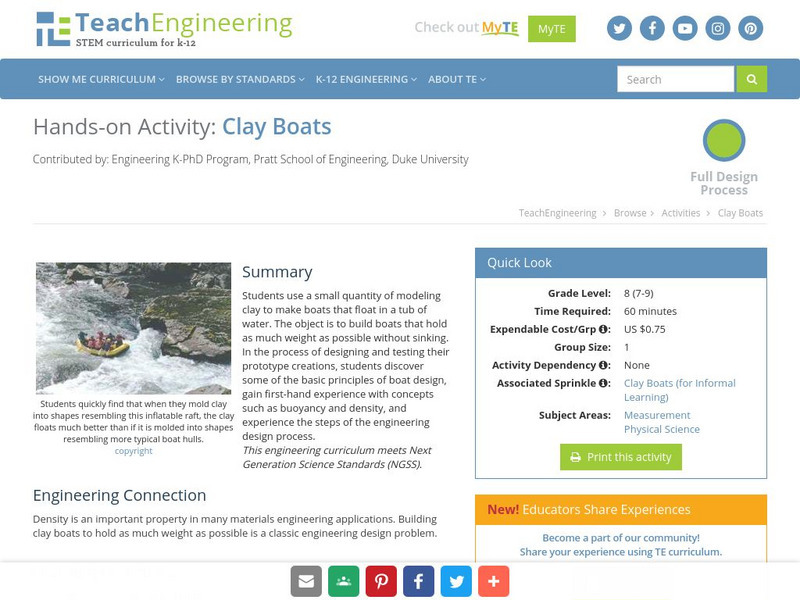
Teach Engineering: Clay Boats
Each student uses a small quantity of modeling clay to make a boat that will float in a tub of water. The object is to build a boat that will hold as much weight as possible without sinking. In the process of designing and testing their...
![Cosi Columbus: Buoyant Bubble [Pdf] Activity](https://static.lp.lexp.cloud/images/attachment_defaults/resource/large/FPO-knovation.png "Cosi Columbus: Buoyant Bubble [Pdf] Activity")
Center of Science and Industry
Cosi Columbus: Buoyant Bubble [Pdf]
Learn about density in this hands-on science experiment. Includes full list of materials, procedures, and scientific explanation of what makes an object float or sink. [PDF]
Exploratorium
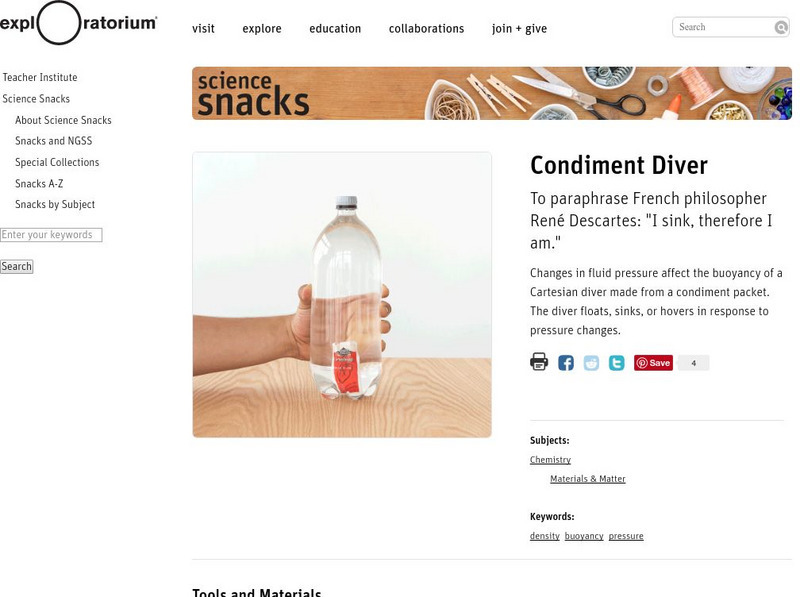
Exploratorium: Science Snacks: Condiment Diver
Use a condiment packet as a Cartesian diver to show how pressure changes cause the "diver" to float, sink or hover.