Hi, what do you want to do?






Tennessee State Museum
An Emancipation Proclamation Map Lesson
Did the Emancipation Proclamation free all slaves during the Civil War? Why was it written, and what were its immediate and long-term effects? After reading primary source materials, constructing political maps representing information...

ESRI
Juneteenth: An American History through Maps
An interactive website traces the history of Juneteenth celebrations from their origin in Galveston, Texas, on June 19th to the present day. Using interactive maps, learners can find information about the African-American...

Curated OER
Slavery's Opponents and Defenders
Young scholars explore the wide-ranging debate over American slavery and the lives of its leading opponents and defenders and the views they held about America's "peculiar institution."

Curated OER
The Civil War (1861-1865) Through Maps, Charts, Graphs, & Pictures
True to its titles, this engaging and appealing presentation brings the 1860's into close focus with a number of images and statistics that would delight any Civil War buff. A few graphs allow for pupil input, such as listing the...

Curated OER
Reconstruction (1865-1876)
Easily broken into pieces for several class sessions, this presentation is a great way to transition your class out of a Civil War unit and closer to the 20th century. Engaging photographs, including relevant maps and humorous political...

Curated OER
Slavery by the Numbers
Young scholars examine the role of slavery in the United States. In this American history lesson, students watch segments of the video "Slavery and the Making of America." Young scholars conduct further research pertaining to Thomas...

Center for History Education
Maryland During the Secession Crisis
While many think the United States was neatly divided between Northern and Southern states during the Civil War, border states like Maryland are more complicated. Using hands-on activities to measure distance and primary sources,...

Curated OER
Gold Rush Abolitionists: How different was the role of Spanish-speaking blacks under Mexican rule from the role of English-speaking blacks under U.S. rule?
Students determine how Spanish-speaking blacks and English speaking blacks were treated differently. In this emancipation lesson, students compare the Mexican and American rules regarding slavery.

Curated OER
Criminal or Hero
Fifth graders explore the origins of slavery. In this US History lesson, 5th graders create a map of the United States that shows where slavery existed. Students examine the life of a Northern slave through the use of a...

Curated OER
Civil War Prison Camps
Fourth graders work with a partner to create a puppet show that demonstrates the condition of the prisoners in Andersonville, Georgia during the Civil War.

Curated OER
Point of View: Accounts of Former Slaveholders
Students examine the housing and living conditions of slaves. They discuss the concerns of slaveholders concerning the health and well-being of their slaves. They analyze the importance of religion to the slaves as well.

Curated OER
My Brother, My Enemy
Pupils visit the West Virginia Museum, with the goal of creating and publishing a newsletter that demonstrates learning. Students complete vocabulary activities, and are given web site resources to this end. Pupils choose from 5...

Curated OER
A Lesson on Reconstruction Legislation and Amendments
Students study the legislation and Amendments of Reconstruction period in America. For this Reconstruction lesson, students work in groups to dissect the Black Codes, an article in the US Constitution, as well as the 13th, 14th, and...

Curated OER
History Close to Home
Students examine primary sources as related to Nevada and the Civil War. In this United States history lesson, students gather and analyze various primary sources in small groups and interpret unknown vocabulary words by using context...
University of Richmond
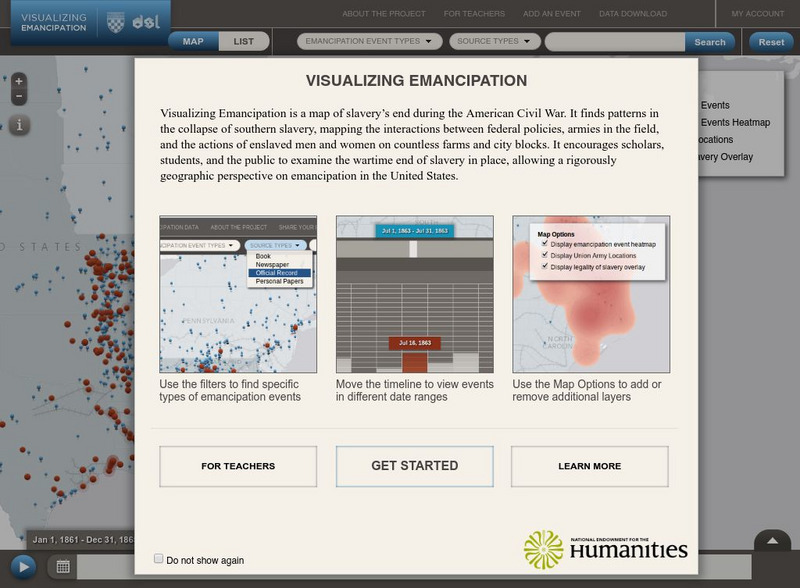
Dsl: University of Richmond: Visualizing Emancipation
A map of slavery's end during the American Civil War. It finds patterns in the collapse of southern slavery, mapping the interactions between federal policies, armies in the field, and the actions of enslaved men and women on countless...

Independence Hall Association
U.s. History: The Emancipation Proclamation
The Emancipation Proclamation in 1863 really didn't free a single slave. Read about why that was true, but also find out why Abraham Lincoln felt is was absolutely necessary to make a stand on ending slavery when he did, and how the...