Hi, what do you want to do?






TED Talks
Ted: Ted Ed: The Law of Conservation of Mass
Everything in our universe has mass- from the smallest atom to the largest star. But the amount of mass has remained constant throughout existence even during the birth and death of stars, planets and you. How can the universe grow while...

CK-12 Foundation
Ck 12: Elem Math: Comparing the Values of Numbers in a Table
[Free Registration/Login may be required to access all resource tools.] The video shows how to compare four different 3-digit numbers to answer a series of questions of the number being the largest or the smallest. The video is followed...

Other
H Twins: The Scale of the Universe 2
Use the scroll bar on this site to zoom in and out of this site which will show you the relative sizes of hundreds of things in our univers, from the smallest currently known - quantum foam - to the largest - our universe. Click on any...

PBS
Pbs: Standard Measures and Conversions: Liquid Volume, Milliliters and Liters
In this Cyberchase Media Gallery, explore key concepts about liquid volume, including standard units of liquid measure and how to convert between them. In the accompanying classroom activity, students create a complete conversion chart...
Starfall
Starfall: Measurement
This interactive focuses on measuring objects using coins as units of measurement. They measure tools, trains, mice, and shoes.
San Diego State University
Lesson Plan: Place Value Card Game
Using a deck of cards this lesson plan has students arrange the cards they draw to make the largest (or smallest) number possible. This activity helps demonstrate the positional property of the numeration system we use.
Smithsonian Institution
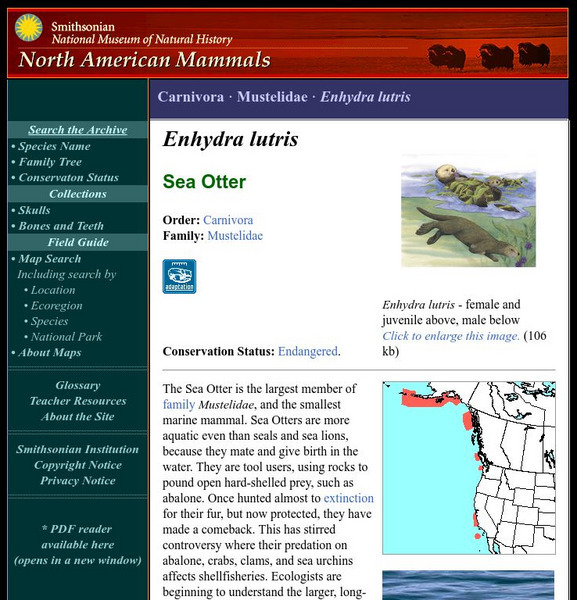
National Museum of Natural History: American Mammals: Sea Otter
The Sea Otter is the largest member of family Mustelidae, and the smallest marine mammal. Sea Otters are more aquatic even than seals and sea lions, because they mate and give birth in the water. Learn more about the Enhydra lutris, more...
Smithsonian Institution
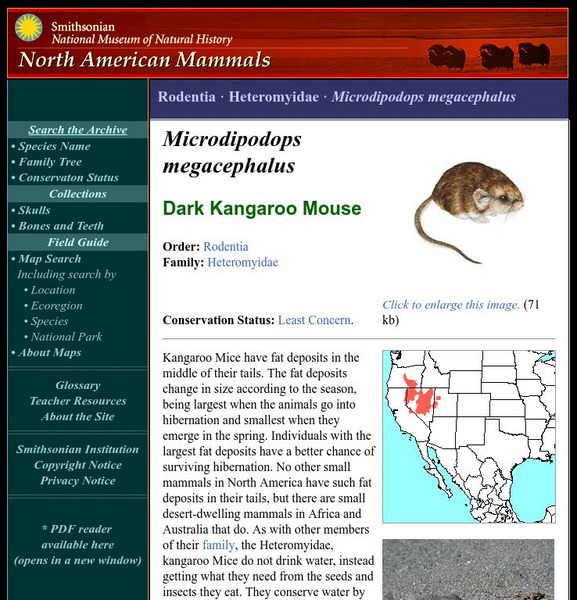
National Museum of Natural History: American Mammals: Dark Kangaroo Mouse
Kangaroo Mice have fat deposits in the middle of their tails. The fat deposits change in size according to the season, being largest when the animals go into hibernation and smallest when they emerge in the spring. Learn more about the...