Hi, what do you want to do?






Curated OER
Working With Hypotheses
In this science worksheet, students examine the topic in order to solidify knowledge covered in the curriculum using puzzles and creative games.

NASA
Auroras
In this auroras worksheet, students define 11 terms related to space phenomena such as auroras, coronal mass ejections and auroral ovals. Students use a given website to help them define the terms and they write a 500 word essay about...

Curated OER
CONVECTION
Students experiment to produce a visual convection current in the classroom and compare it to the images taken of convection cells in the Sun. They analyze the source of the Sun's energy and this type of energy transport.

Curated OER
Origins: Earth Is Born
Students develop a timeline of all the major events involved in the formation of the Earth and the emergence of humans. In groups, they focus on a specific topic by watching a PBS program and taking notes. After the video, they list...

Curated OER
Build a Simple Ammeter
Pupils build and work with a simple ammeter to test theories on why solar cells connected in parallel produce more current that in series. Students use the ammeter to indicate the presence, direction, and strength of an electric current...

Curated OER
Plasmasphere
In this plasmasphere learning exercise, students determine how long the plasmasphere takes to rotate around the Earth using two satellite images taken three hours apart.

Curated OER
Lesson 4 Activity 1: Mapping the Third Dimension
Students work in pairs to construct a simple stereoscope.

Curated OER
Ways to See the Sun
Students examine how the regions of the Sun are studied using spectroscopy. They investigate the electromagnetic spectrum and the types of radiation that are associated with it. They use prisms and CD's to examine the light spectrum....

Curated OER
What’s That, I Can’t Hear You?
Students investigate forms of energy as well as light and sound. In this science lesson, students participate in hands-on activities that require them to evaluate how sound affects astronauts in flight. A video of this lesson being...
CK-12 Foundation
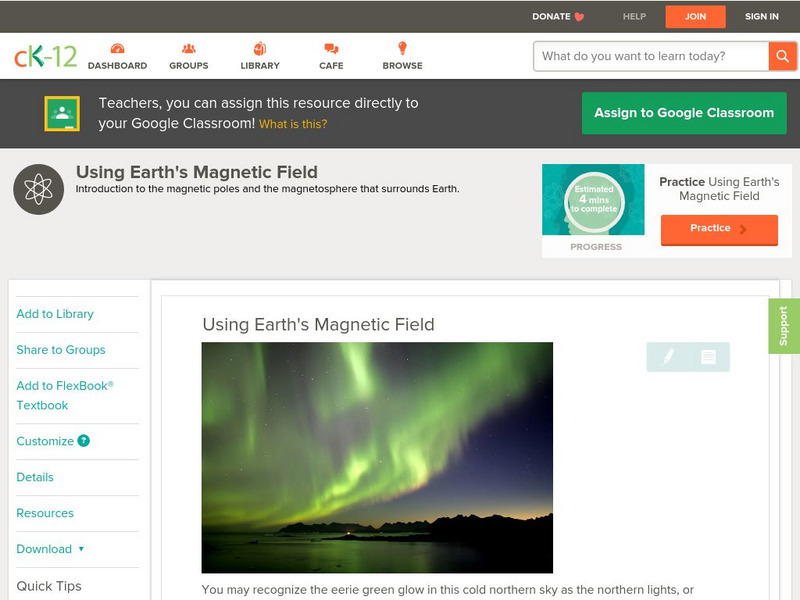
Ck 12: Physical Science: Using Earth's Magnetic Field
[Free Registration/Login may be required to access all resource tools.] The Earth's magnetic field and how it protects life on Earth, and how it is used for navigation.
Georgia State University
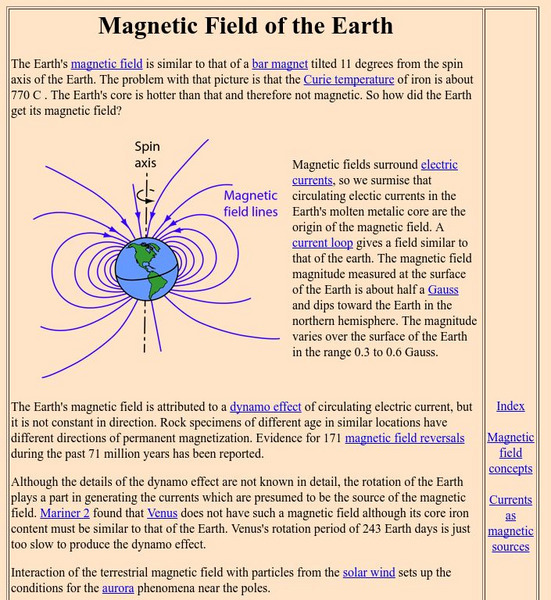
Georgia State University: Hyper Physics: Magnetic Field of the Earth
This site is a description of the earth's magnetic field, including a section on the "Dynamo effect," a proposed explanation for the origin of the earth's magnetic field.

National Geographic
National Geographic: Build a Magnetometer
Hands-on project where the learner constructs a magnetometer to monitor and measure changes in earth's magnetic field. These changes can then be used to track solar storms.

NASA
Nasa Space Place: Sunspots and Solar Flares
Learn about sunspots and solar flares and the effects of solar activity on Earth.

Cosmos 4 kids
Cosmos4 kids.com: Solar System Details
This comprehensive site delves into other aspects of our solar system besides the planets and the sun. Click on the topics on the right like solar winds, the heliosphere, the heliopause, asteroids, comets, and more.
NASA
Nasa: Image Science Center: Ask the Space Scientist
A NASA space scientist provides 98 questions and answers about the sun, the center of our solar system.
Other
Space weather.com
Want to know what the current weather conditions are in space? Find everything here you may want to know about the latest solar flares, sunspots, asteroids and more. Site also includes essential web links to quench any user's thirst for...
Exploratorium
Exploratorium: Auroras Paintings in the Sky
This site offers a very nice, detailed explanation of auroras along with some inspiring images and videos.
Other
Solar and Astrophysics Lab: Trace Analysis Guide
This site provides a detailed overview of the TRACE (Transition Region and Coronal Explorer) satellite mission, data received, details about the instrumentation, and how to interpret the data.
NASA
Nasa: Image Science Center: Ask the Space Scientist Earth
Site from NASA contains a collection of 91 questions pertaining to the Earth's atmosphere, magnetic field, ionosphere, rotation and origin of life.
Other
Space Weather Center: Our Protective Shield
The Earth's magnetosphere helps shield us from cosmic and solar radiation. This segment offers a great explanation of this abstract concept along with numerous images and diagrams. An interactive game is provided as well.
NASA
Nasa: World Book at Nasa: Sun
World Book Encyclopedia article, hosted by NASA, covers key details about the sun, incuding size, composition, radiations, rotation, vibration, magnetic fields, zones of the sun, solar wind, sun spots, and related topics.
Curated OER
Wikipedia: National Historic Landmarks in California: Hale Solar Observatory
Laboratory of George Ellery Hale, inventor of the spectroheliograph, with which he made his discoveries of the solar vortices and magnetic fields of sun spots.
Curated OER
Solar Flare
We rely on the sun to sustain life, but there are many things about the sun that the human eye is unable to detect. This media rich site offers a spectacular look at coronal mass ejections, magnetic loops, and solar flares. Interactive...
NASA
Nasa: Imagine the Universe: "Burst Behind the Sun"
Site provides the article, "Burst Behind the Sun Reveals Magnetic Charm of Distant Explosion," that details on a gamma-ray burst that occurred on December 6, 2002. Provides graphics and links to learn more about gamma-ray bursts.