Hi, what do you want to do?






Curated OER
Measurement: Cylinders
Math scholars observe and demonstrate how to calculate the surface area and volume of cylinders. They analyze pictures of various cylinders on a handout, solve problems on two worksheets independently, and discuss the answers to the...

Curated OER
Polydron Fun
Students investigate nets as they relate to volume and area. In this geometry lesson, students use nets as a visual to deepen their understanding of surface area and volume of objects. They make conjectures about different objects and...

Curated OER
Polyhedra Book
In this math worksheet, students are asked to read the book that focuses upon the creation and explanation of three dimensional shapes.

Curated OER
Folding to Make Shapes
Second graders identify different polygons and their attributes. In this geometry instructional activity, 2nd graders get to know polygons by studying the vocabulary and finding polygons in their classroom. They create these shapes and...

Curated OER
Polyhedra
Seventh graders explore the characteristics of three-dimensional figures. They compare the nets of figures. Students describe the relationship between the nets draw and the solid. They identify the vertices, edges and faces of the...

Curated OER
Spatial Relations - Week 9
In this spatial relations worksheet, students solve three-dimensional problems. They find the total number of triangles in a given figure, the number of line segments that endpoints and use integer points to solve two problems. This...

Curated OER
Spatial Relations - Week 9
In this spatial relations worksheet, students identify the number of triangles in a given figure, identify the number of cubes that a plane intersects, and determine the number of line segments in a given cube. This three-page worksheet...

Curated OER
It's a Ball, It's a Sphere ... No, It's a Dodecahedron
Third graders construct a dodecahedron that displays facts about two and three-dimensional figures. They use a pattern to construct a dodecahedron after writing facts about geometry onto each of the figure's twelve faces.

Curated OER
Pyramids & Prisms: Guler's Formula
Sixth graders compare and contrast two-dimensional shapes to three-dimensional shapes. After watching a demonstration, they make their own shapes using nets printed on paper. To end the lesson, they use the shapes they made and...

Curated OER
Exploring Projective Geometry
For this exploring projective geometry worksheet, students use computer software for instruction, then answer 9 questions about 3D drawings.

Cuemath
Cuemath: Polyhedron
Introduces the concept of polyhedrons by learning the definition, types, and where they are found. Check-out the solved examples for better understanding and try your hand at solving a few interactive questions at the end of the page.
Cuemath
Cuemath: Platonic Solids
Learn more about platonic sold geometry, understand the platonic solid names, view some solved examples, and try your hand at some interactive problems.
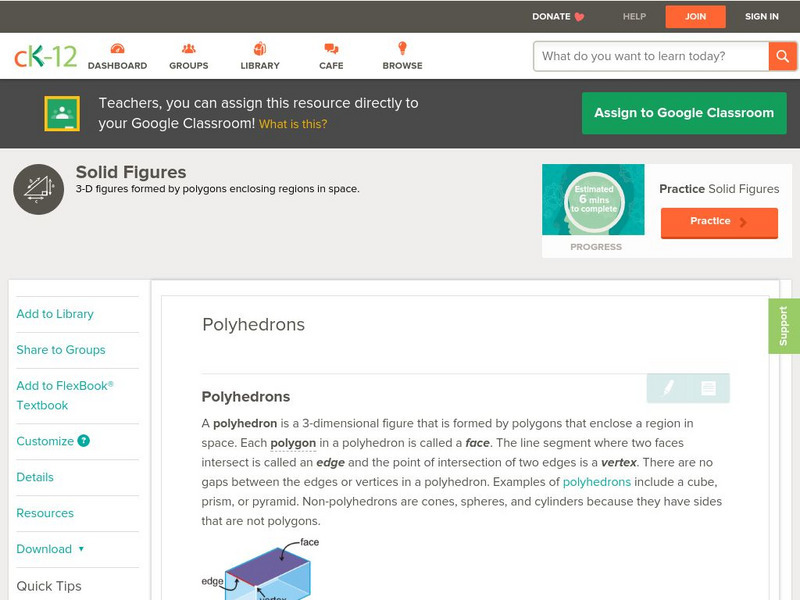
CK-12 Foundation
Ck 12: Geometry: Polyhedrons
[Free Registration/Login may be required to access all resource tools.] This concept teaches students about polyhedrons, Euler's Theorem, and regular polyhedrons.
Mathigon
Mathigon: Geometry: Polygons and Polyhedra: More on Polyhedra
This lesson focuses on polyhedra other than the platonic solids; these include an Archimedean solid, a polyhedron made up of different kinds of regular polygons, that looks the same from every direction. There are 13 different...

Oswego City School District
Regents Exam Prep Center: Platonic Solids
Did you know that the five regular platonic solids (tetrahedron, octahedron, icosahedron, cube, and dodecahedron) were thought to represent earth, air, fire, water, and the universe? This chart shows an image and provides a description...
University of Georgia
University of Georgia: Inter Math: Platonic Solids
This site gives a description of platonic solids along with a visual representation of each of the five platonic solids. At the bottom of the page are links to cut-out-templates for each of the platonic solids. Be sure to follow the...
Annenberg Foundation
Annenberg Learner: Geometry 3 D Shapes: Platonic Solids
Learn about platonic solids, a special type of polyhedra. Read a definition, make three-dimensional models using printouts, and play with an interactive animation, which will show you the faces, vertices, and edges on platonic solids:...
Mathigon
Mathigon: Geometry: Polygons and Polyhedra: Platonic Solids
A Platonic solid is a polyhedron made up of only one kind of regular polygon, that looks the same from every direction. (In other words, the same number of faces meet at every vertex.) There are only five different Platonic solids:...
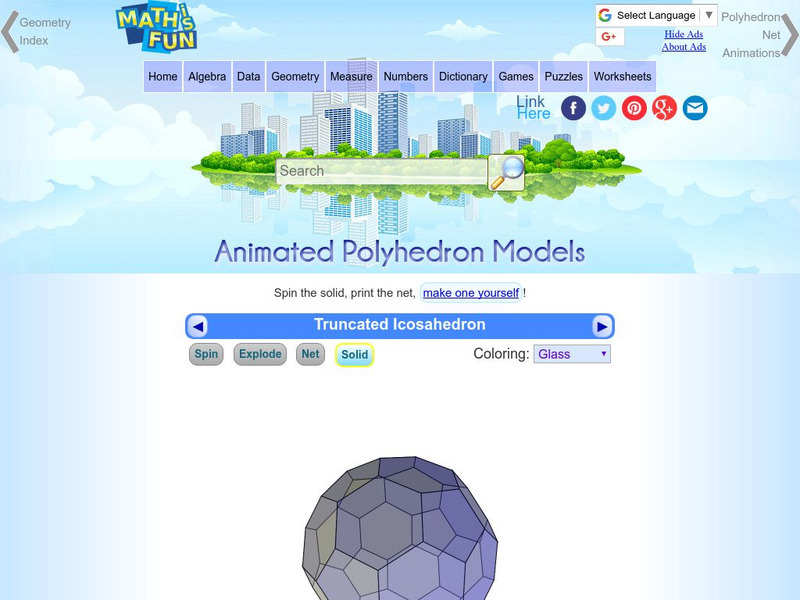
Math Is Fun
Math Is Fun: Animated Polyhedron Models
Use this tool to see animated models of over 100 different types of polyhedra. There are five options for how they appear, and you can also see the net, 'explode' the solid so that the faces are separated, or drag it to rotate it...
Mathigon
Mathigon: Geometry: Polygons and Polyhedra: Polyhedra
This lesson focuses on polyhedra; a polyhedron (the plural is polyhedra) is a 3-dimensional solid object that is made up of polygons. Euler's Polyhedron Formula: In every polyhedron, the number of faces (F) plus the number of vertices...

Annenberg Foundation
Annenberg Learner: Geometry 3 D Shapes: Polyhedra, Prisms, and Pyramids
An introduction to a type of three-dimensional shape called a polyhedron. See examples and play with an interactive animation, showing the faces, vertices, and edges of pyramids, which are a type of polyhedron.
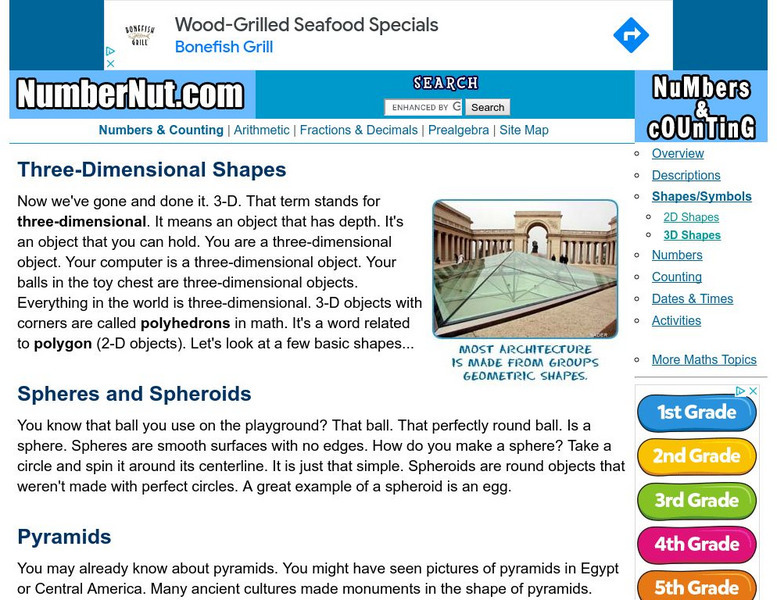
NumberNut
Number Nut: Shapes, Symbols, and Colors: 3 D Shapes
This lesson describes three dimensional shapes and provides two interactive practice activities.
Cuemath
Cuemath: Tetrahedron
A comprehensive guide for learning all about tetrahedrons with definitions, properties, formulas, examples, and practice questions.
CK-12 Foundation
Ck 12: Geometry: Polyhedra Study Guide
[Free Registration/Login may be required to access all resource tools.] This study guide reviews how to classify polyhedra, Euler's formula, and regular polyhedra.