Hi, what do you want to do?





Science Buddies
Science Buddies: Solubility of Proteins
Some proteins are soluble in aqueous solutions and some are not. Insoluble proteins can be a problem because the proteins can form large aggregates in solution which are difficult to purify, crystallize, and use in experiments. Compare...
Other
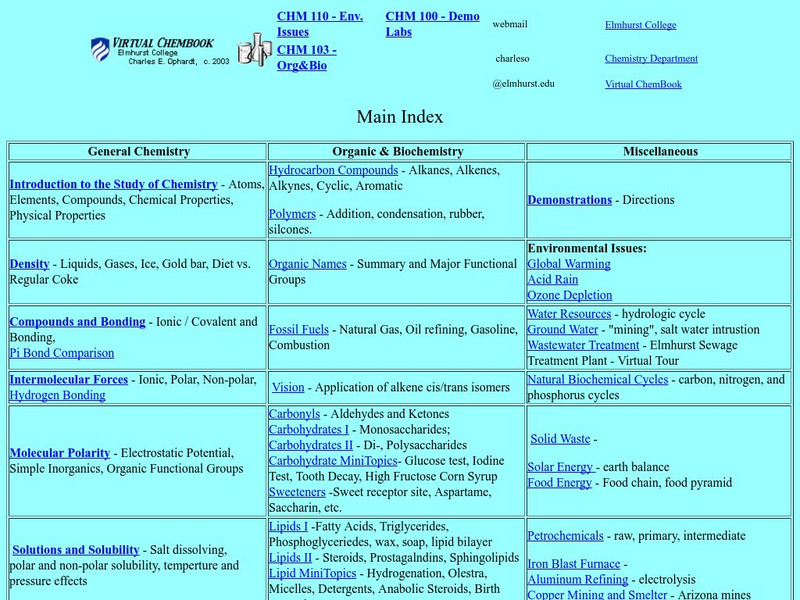
Elmhurst College: Virtual Chembook: What Are Physical Properties and Changes?
Brief descriptions of physical properties, physical changes, and the process of sublimation. The three states of matter, melting point, and boiling point are described. There is one link on the page, which leads to an explanation of...
CK-12 Foundation
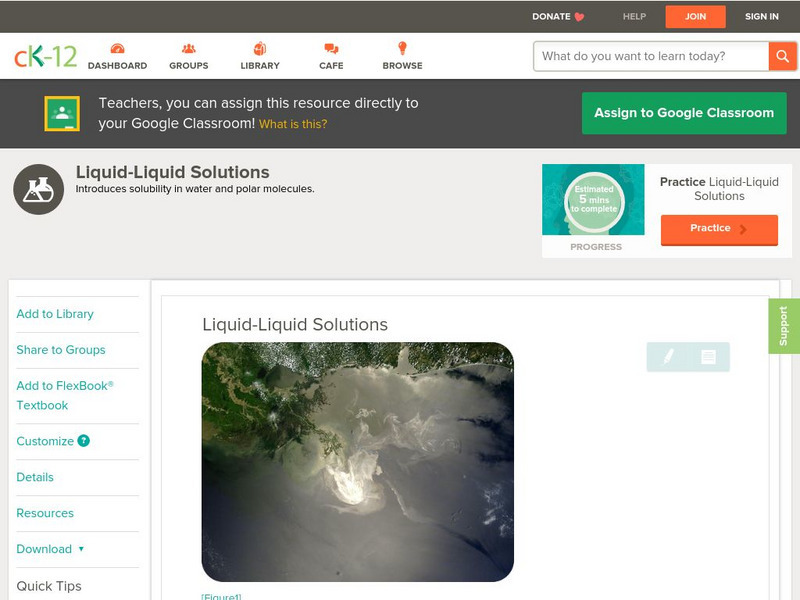
Ck 12: Chemistry: Liquid Liquid Solutions
[Free Registration/Login may be required to access all resource tools.] Covers solubility in water and polar molecules.

Concord Consortium
Concord Consortium: Stem Resources: Intermolecular Attractions
Learn that boiling point, solubility, and DNA are affect by intermolecular forces in this module. Module includes lessons with questions and animations to explain London dispersion and dipole-dipole attractions. To conclude the lessons,...

Other
Solubility of Things: Factors Affecting Solubility
Find out how temperature, polarity, pressure, molecular size, and stirring affects the speed of dissolving.
American Chemical Society
Middle School Chemistry: Lesson Plans: Can Liquids Dissolve in Water?
Lesson plan with mulitmedia links in which students identify and control variables to help design a solubility test for different liquids in water.
American Chemical Society
Middle School Chemistry: Lesson Plans: Temperature Changes in Dissolving
Media-rich lesson in which learners discover that it takes energy to break bonds, and that energy is released when bonds are formed during the process of dissolving. They also determine whether dissolving is either exothermic or...
American Chemical Society
Middle School Chemistry: Lesson Plans: Why Does Water Dissolve Salt?
Students use their own model of a salt crystal and water molecule to show how water dissolves salt. Then, they relate their observations to the structure of salt, water, and alcohol on the molecular level.
Science Education Resource Center at Carleton College
Serc: Mn Step: Spotting Chromatography
A lab activity that introduces chromatography using markers, plus water and acetone as the solvents. Students will take measurements to compare the mobile and stationary phases of the inks, and find the polarity of the inks and solvents....