Hi, what do you want to do?






Curated OER
Submarines
In this online interactive submarines worksheet, students respond to 11 fill in the blank and multiple choice questions regarding the information included in the provided paragraph.

Curated OER
Selections on Islamic Fundamentalism
In this Islamic fundamentalism worksheet, learners read a 3-page selection on the topic and then respond to 2 short answer questions based on the selection.

Curated OER
National Security
Young scholars discuss the Rosenberg spy case during the Cold War. They research and report on a recent or current investigation into espionage by people working for the U.S. government. Students find out what they can from newspapers,...

Curated OER
Andersonville Prison: A Civil War Economic Microcosm
Students develop the concept of economic systems. In this economic system lesson, students create command and market economic systems.
ibiblio
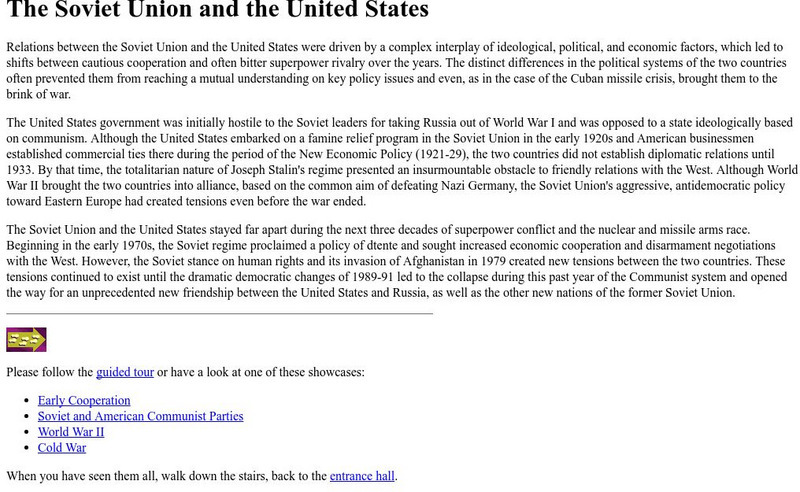
Ibiblio: The Soviet Union and the United States
This site from ibiblio.org gives information about the historical relationship between the Soviet Union and the United States. After reading the summary on this page, click on the links at the bottom of the page to read about early...
ibiblio
Ibiblio: Soviet Archives Exhibit
This ibiblio.org exhibit discusses in detail the history of the Soviet Union. The site is grouped into two main categories with several sub-headings. One is Internal Workings of the Soviet System including: Repression and Terror: Stalin...

PBS
Pbs Online News Hour: Cuba and the United States
Site is an Online NewsHour report on the relations between Cuba and the U.S. Trade, trade embargo, life in Cuba, Cuban Missile Crisis, and many more topics are discussed.
Digital History
Digital History: Cuban Missile Crisis
In October 1962, the Soviet Union and the United States went eyeball-to-eyeball and were on the brink of nuclear war. Surveillance photographs taken by a U-2 spy plane over Cuba revealed that the Soviet Union was installing...
The Guardian
Guardian: Stalin and the Soviet State
This article discusses the growing tensions between Russia and the United States, focusing on Stalin's desire to strengthen his country's military security. (August 2, 1950)
Library of Congress
Loc: Revelations From the Russian Archives
This particular page from the Library of Congress is the homepage with an outline of hyperlinks to numerous articles that could provide background information regarding the former Soviet Union.
Federation of American Scientists
Fas: Soviet Union Security Concerns
This article examines the Soviet Union's concerns about its sphere of influence during the Cold War and its desire to protect its interests.
San Diego State University
World History for Us All: Two Big Powers and Their Cold War 1945 1990 [Pdf]
After completing this unit, students will be able to describe major differences in the political ideologies of the United States and the Soviet Union, explain the causes of the Korean War and the Cuban Missile Crisis, and explain how...
Harry S. Truman Library and Museum
Harry S. Truman Library and Museum: The Long Telegram
This primary source document reveals Russia's growing distrust of the United States and its desire to strengthen its position in the global community through greater military security.
BBC
Bbc: Truman Doctrine and Marshall Plan
This article details the significance of the Truman Doctrine and the Marshall Plan, focusing on how these documents demonstrate the growing tensions between the United States and Russia during the Cold War. Archived.
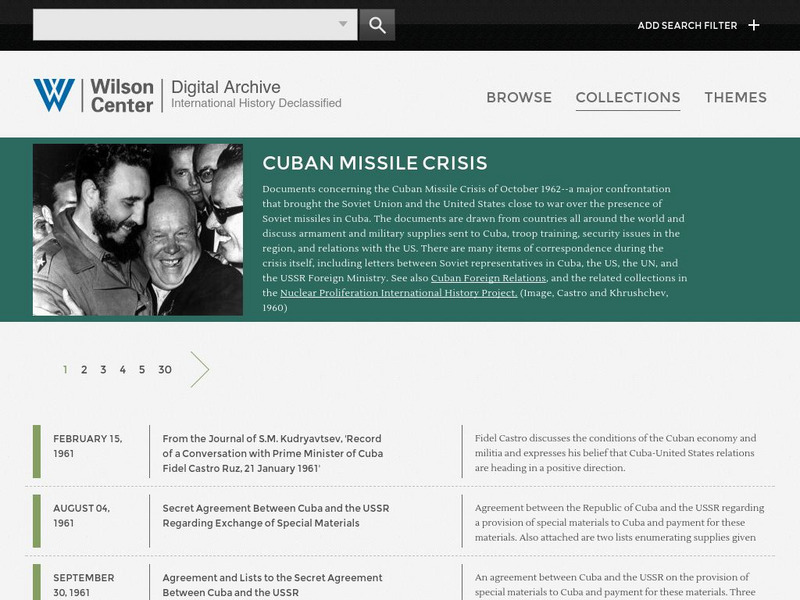
Woodrow Wilson International Center for Scholars
Woodrow Wilson Center: Digital Archive: Cuban Missile Crisis
Documents concerning the Cuban Missile Crisis of October 1962-a major confrontation that brought the Soviet Union and the United States close to war over the presence of Soviet missiles in Cuba.
Woodrow Wilson International Center for Scholars
Woodrow Wilson Center: Digital Archive: Chinese Foreign Policy
Documents on China's foreign relations, focusing on its relationship with the Soviet Union and the United States.
Thinkport Education
Thinkport: Comparing the u.s., Soviet Union & China During Ww2
Students analyze both quantitative and qualitative forms of information in order to answer compelling questions about the impact of World War II on the military and civilian populations of the United States, the Soviet Union and China.
Michigan State University
Michigan State University: United States History Since 1920: Truman Loyalty Oath, 1947
In March, 1947, President Truman issued an executive order requiring that all Federal employees take a loyalty oath swearing loyalty to the United States. This was a time of fear of Communists and the Soviet Union. Read the entire...

PBS
Pbs: American Experience: The Berlin Airlift
A comprehensive overview of the Berlin Airlift provides links to maps, timelines, and other resources. The entire film is not available at this time, however, a short clip can be viewed. Coverage of the Chocolate Pilot and the support by...
CommonLit
Common Lit: Courage in Denmark: Resistance to the Nazis in Wwii by Us Holocaust
World War II (WWII), a global conflict that lasted from 1939 to 1945 involved more than 100 million people and over 30 countries. The Allied powers - including the United States, the United Kingdom, and the Soviet Union - worked together...

Other
American Jewish Historical Society: Timeline of American Soviet Jewry Movement
In the late 1800's and most of the 1900's countries made many efforts to help Jews in the Soviet Union gain freedom to practice their faith. Countries such as the United States and Israel offered exile to many Jews to escape the...

National Geographic
National Geographic: The Impact of the Bay of Pigs Invasion on Fidel Castro
This lesson focuses on how the Bay of Pigs invasion influenced the attitude of Fidel Castro towards Kennedy and the United States. Includes role play, discussion, and research. Students then write a letter from Nikita Krushchev to Fidel...
US Holocaust Memorial Museum
U.s. Holocaust Memorial Museum: Einsatzgruppen and Other Ss and Police Units
Article about the use of the Einsatzgruppen by the Nazis, especially in the Soviet Union, to commit mass murder in their effort to defeat the Soviet Union in World War II.
Independence Hall Association
U.s. History: The Cold War Erupts
World War II ended in 1945 and the Cold War began immediately. Read about the mistrust Western Europe and the United States felt towards the Soviet Union and Joseph Stalin. Learn how the Soviets expanded their realm of influence and...