Hi, what do you want to do?





Kidport
Kidport: The Space Shuttle
Students can see actual photos of a space shuttle launching from earth as well as the people who now could go because of technology. Learn about some of the equipment and vehicles used to make it happen.
NASA
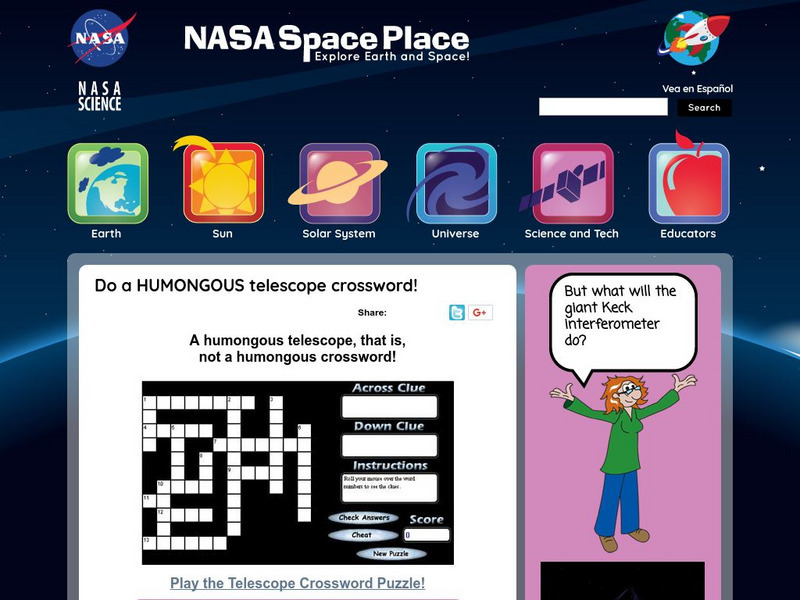
Nasa: The Space Place: Keck Interferometer
This site from the National Aeronautics and Space Administration provides the opportunity to solve a crossword and learn about the world's biggest telescopes.
Society for Science and the Public
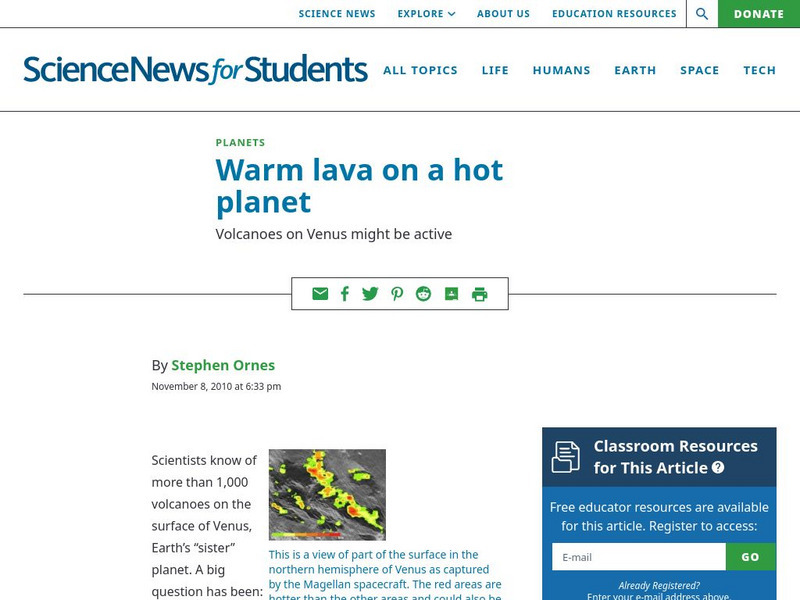
Science News for Students: Warm Lava on a Hot Planet
Describes scientific research into volcanic activity on the surface of Venus. Using information transmitted from the orbiting Magellan spacecraft, data is collected. Includes a glossary of vocabulary terms. [ November 8, 2010]

Other
Canal Kids: Ciencias (Science for Portuguese Speakers)
Colorful, engagingly written information about astronomy and biology for Portuguese-speaking English language learners. Both subjects are broken down into a broad array of related subtopics. The biology section is particularly helpful...
PBS
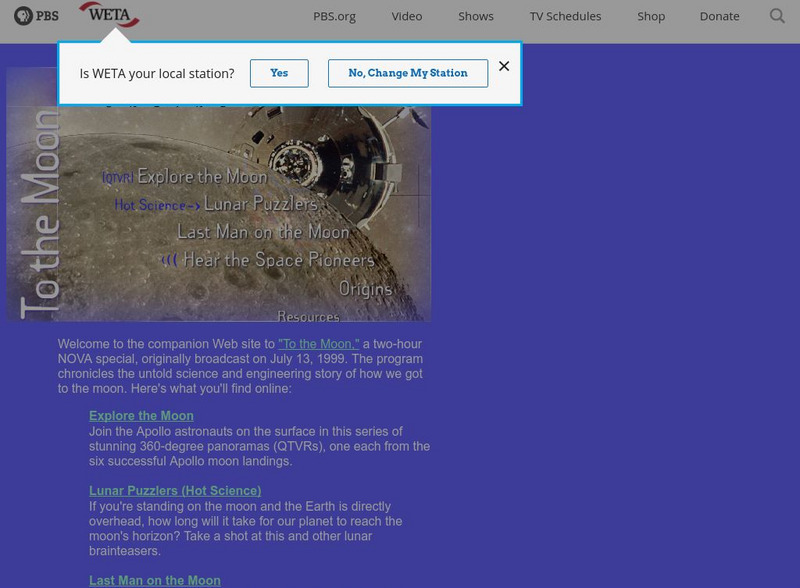
Nova: To the Moon
This companion website of a NOVA program that aired in 1999 features extensive information that focuses on moon research and includes a history of the Apollo missions as well as the science of the moon's origins.
NASA
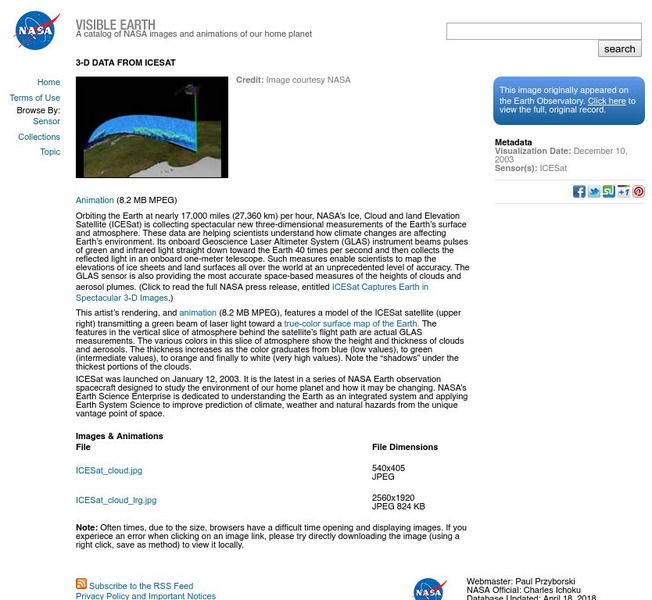
Nasa: Visible Earth: 3 D Data From Ice Sat
3-D Data from ICESat: Orbiting the Earth at nearly 17,000 miles per hour, NASA's Ice, Cloud and land Elevation Satellite (ICESat) is collecting spectacular new three-dimensional measurements of the Earth's surface and atmosphere.

BBC
Bb Ci Space: Earth
The BBC provides a general overview of the planet Earth. Content includes statistical information, a focus on the four seasons, moon information, and more.

Society for Science and the Public
Science News for Students: Small but Wise
Describes the WISE Project, which has an infrared telescope orbiting the Earth taking photographs of never before seen areas of space.
Digital Public Library of America
Dpla: Race to the Moon
In 1955, the US and the USSR each announced plans to launch a satellite into orbit. Thus began the race to the moon. Throughout the 1960s and 1970s, the American space program and its new classes of astronauts achieved breakthroughs in...

Enchanted Learning
Enchanted Learning: Zoom Astronomy
Where is our Solar System? How far away is the sun? What makes up the sun? Find out all you want to know about our solar system. This is a comprehensive on-line site about space and astronomy. Check out all of the excitement!
NASA
Nasa: Cassini Huygens Mission
NASA site surveys the satellite Cassini's mission to Saturn as well as the ejection of the Huygens probe.
American Association of Physics Teachers
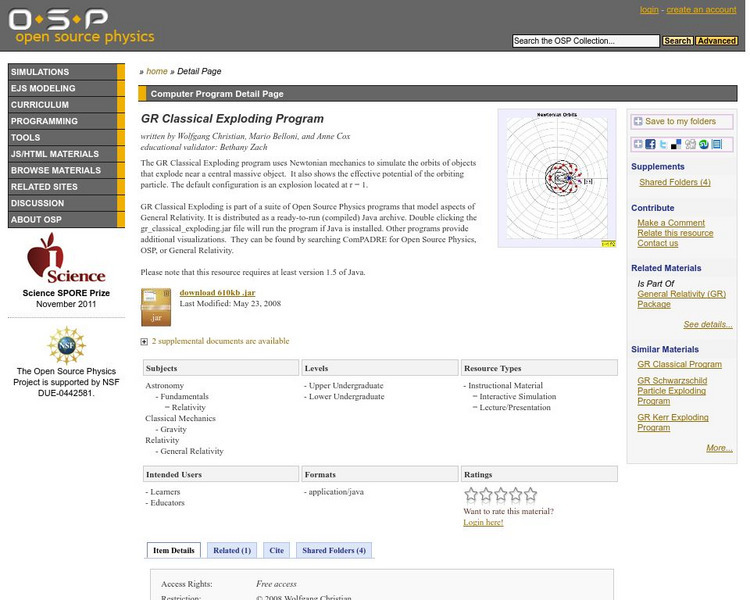
Com Padre Digital Library: Open Source Physics: Gr Classical Exploding Program
Simulation of the orbital dynamics of objects exploding near a large body in space.

Concord Consortium
Concord Consortium: Stem Resources: Launching a Satellite
Do you think you could fire an "unpowered" object into orbit? By controlling the angle and speed at which the satellite is launch, students will try to launch a satellite into space with this computer model. Activity includes questions...
University of Maryland
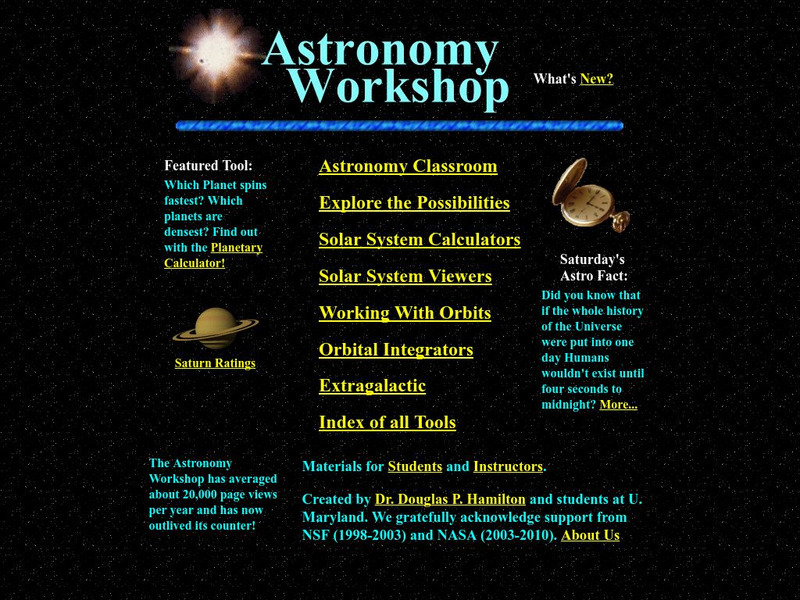
University of Maryland: The Astronomy Workshop
Find tools to calculate astronomical distances and sizes, to view various Solar System models, to compare gravity's affect on weight, and more. A good place to find interesting facts, simple animations, and astronomy links to physics and...
Read Works
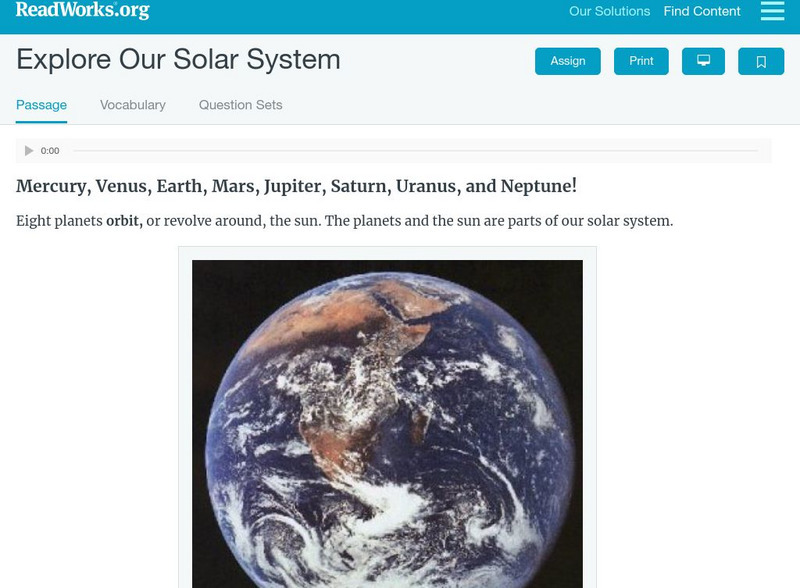
Read Works: Explore Our Solar System
[Free Registration/Login Required] This informational text passage shares facts about planets in the solar system. This passage is a stand-alone curricular piece that reinforces essential reading skills and strategies and establishes...
Curated OER
Science Kids: Science Images: Saturn
A beautiful photo of Saturn taken by Voyager 2 which gives a clear view of the planets amazing ring systems and even some of its moons as they orbit in front of the gas giant.
Kidport
Kidport: The Moon Landing
Travel back in history and see the first men on the moon. See photos of the crew, the launch, the landing and more.
Cosmo Learning
Cosmo Learning: Introduction to Astrophysics
A collection of audio lectures from an introduction to astrophysics course taught at the University of California, Berkeley. The course discusses the solar system, stars, quantum mechanics, gravitation, and cosmology focusing on how...
TeachEngineering
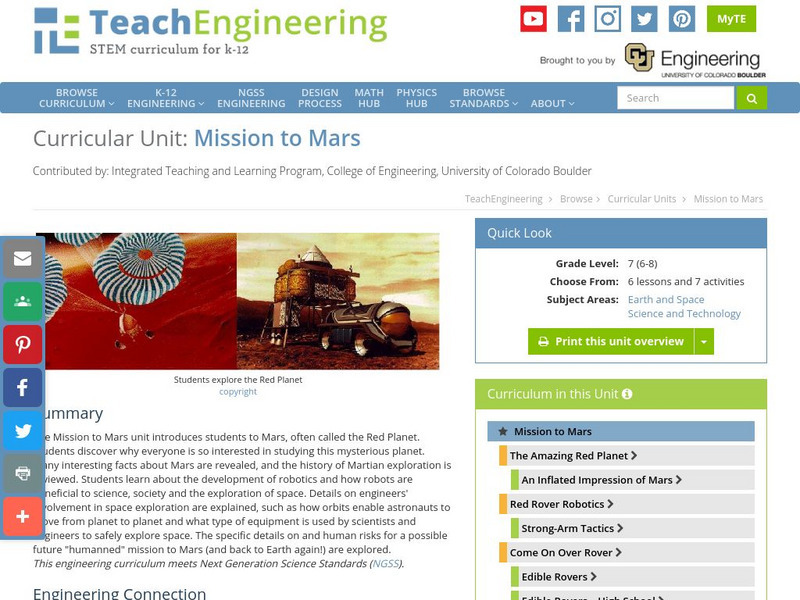
Teach Engineering: Mission to Mars
The Mission to Mars curricular unit introduces students to Mars-the Red Planet. Students discover why scientists are so interested in studying this mysterious planet. Many interesting facts about Mars are revealed, and the history of...