Hi, what do you want to do?





Science Buddies
Science Buddies: Craters and Meteorites
Have you ever heard that the moon is made of cheese? Even though the craters on the surface of the moon resemble holes in Swiss cheese, we know that this common myth is not true. Find out how craters are formed and why they are different...
Teachnology
Teachnology: Science Lesson Plans
Great lesson plans covering a wide-range of science-related subjects. A wonderful resource for wonderful teachers!
Science Buddies
Science Buddies: Observatory Satellite Measures Motion of Coronal Mass Ejection
The sun sometimes releases huge bursts of electrified gases into space. These bursts are called coronal mass ejections (or CMEs). When CMEs are directed towards Earth they can generate auroras, the spectacular atmospheric displays also...

Other
Hong Kong Space Museum
Besides an introduction to exhibitions and events at the museum, the site provides a guide to stargazing, an astronomy FAQ, space news, virtual tours (see site map) and research resources (including Chinese-English star and constellation...
Science Buddies
Science Buddies: A Puzzling Parallax
Did you know that ancient astronomers could measure the distance to other stars? They could also distinguish between stars and planets. How could they do that without modern technology of telescopes? See if you can discover the link...
NASA
Nasa Space Science Data Archive: Asteroid 253 Mathilde
This site contains facts about the asteroid 253 Mathilde from the National Space Science Data Center at NASA.
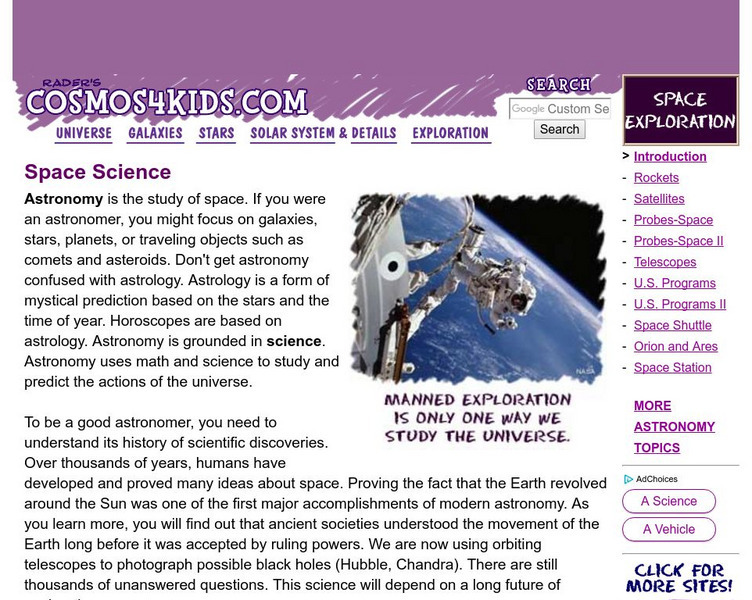
Cosmos 4 kids
Cosmos4 kids.com: Exploration
Space can be explored in many different ways. Read about space exploration and click on the topics on the right margin to find out how man finds out about his universe.

Ducksters
Ducksters: Astronomy for Kids: Astronauts
Kids learn about the astronauts who travel and explore outer space including spacesuits, fun facts, and famous adventurers like Buzz Aldrin, Yuri Gagarin, and Sally Ride.

Smithsonian Institution
National Air and Space Museum: Exploring the Planets: Ancient Times & the Greeks
In ancient times only five planets were known: Mercury, Venus, Mars, Jupiter, and Saturn. Learn about Greek astronomer Ptolemy's theory for the solar system that was to survive for fourteen centuries.
PBS
Pbs Teachers: Scientific American: Science in Paradise: Big Dish
Investigate the science of radio astronomy, and create a model of a curved reflecting dish that will work like the Arecibo detector to detect electromagnetic waves. Explore risk using a risk space grid.
Utah Education Network
Uen: Moon Light Through the Month
In this lesson, young scholars are asked to order cards showing different phases of the moon. Includes student handouts.
Cosmo Learning
Cosmo Learning: Introduction to Astrophysics
A collection of audio lectures from an introduction to astrophysics course taught at the University of California, Berkeley. The course discusses the solar system, stars, quantum mechanics, gravitation, and cosmology focusing on how...
Discovery Education
Discovery Education: Classroom Planetarium
Create a classroom model of the solar system while teaching about relative size of all the planets, and each planet's distance from the sun.
NASA
Nasa: Imagine the Universe: Supernovae (Basic)
A detailed description of a supernova developing from a single massive star. There is a quiz, related links, animation, lesson plans, and an FAQ sheet available also.