Hi, what do you want to do?





Science Buddies
Science Buddies: Craters and Meteorites
Have you ever heard that the moon is made of cheese? Even though the craters on the surface of the moon resemble holes in Swiss cheese, we know that this common myth is not true. Find out how craters are formed and why they are different...
Science Buddies
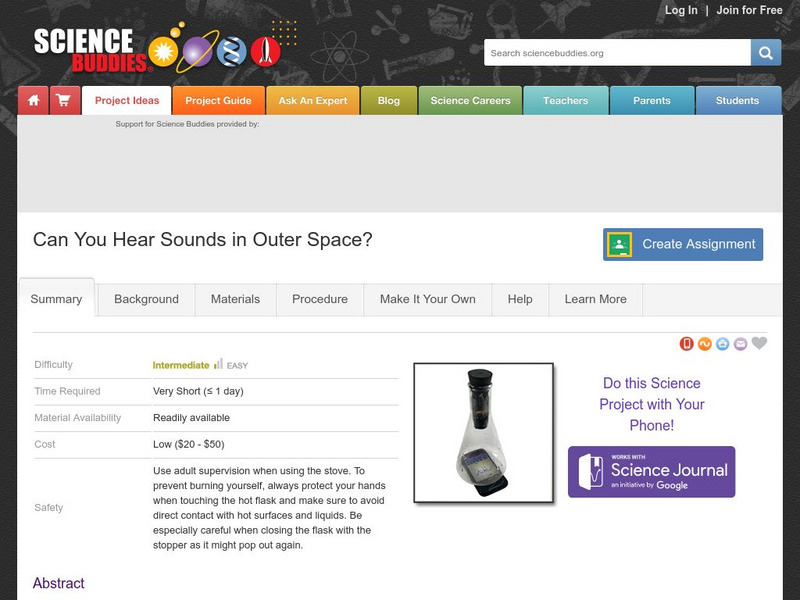
Science Buddies: Outer Space, the Silent Frontier: An Experiment on Sound Waves
In outer space there is utter silence. There are no sounds of traffic jams or thunderstorms or crashing waves. No buzzing bees or babies crying. Just silence. In this experiment, you will discover why empty space is void of sound.
Science Buddies
Science Buddies: Sand Structure: Measuring Density and Porosity of Sand
For many kids, a day at the beach would not be complete without building a sandcastle. Have you ever wondered how it is that you can pack sand into a mold for a sandcastle? Do some kinds of sand pack better than others? This project will...
Science Buddies
Science Buddies: Observatory Satellite Measures Motion of Coronal Mass Ejection
The sun sometimes releases huge bursts of electrified gases into space. These bursts are called coronal mass ejections (or CMEs). When CMEs are directed towards Earth they can generate auroras, the spectacular atmospheric displays also...

Science Buddies
Science Buddies: Only if They Think They Can Get Away With It?
How many times have you noticed someone who looks perfectly healthy using a parking space reserved for the handicapped at a busy shopping center? If this behavior gets you steamed, you might be interested in studying how to discourage...
Science Buddies
Science Buddies: M&m Geometry
Geometry is the study of how to use math to describe and investigate different points, lines and shapes. The way that a shape is described in geometry is with a formula, which is simply a mathematical way to calculate different...
Science Buddies
Science Buddies: A Puzzling Parallax
Did you know that ancient astronomers could measure the distance to other stars? They could also distinguish between stars and planets. How could they do that without modern technology of telescopes? See if you can discover the link...