Hi, what do you want to do?






Curated OER
Preterite Tense: All Verbs #1
Practice conjugating! Beginning Spanish speakers read the short paragraph, conjugating the verbs in parentheses. All verb types are included, so there are -ar, -ir, and -er verbs to conjugate in the preterite tense.

Curated OER
¿Ser o Estar?
¿Ser o estar? That is the question! These two are often confused, and if your learners really want to develop their language skills, they need to know the difference! Use this reference sheet to thoroughly explain each ver. The chart...

Curated OER
El condicional
What is the conditional tense? Your intermediate learners will benefit from having this reference guide. The conditional form is reviewed, and there's even a section introducing the irregular verbs in the conditional tense. This is the...

Curated OER
Irregular Familiar Commands
Irregular familiar commands are easy to understand with this chart, and there's a catchy tune provided to help you remember the irregular commands!

Curated OER
Las Caras (The Faces)
First graders create masks. They practice using Spanish words to describe facial expressions and their individual masks. They review the verb"tener," to show characteristics than can be expressed on a mask: "tengo calor" or "Tengo miedo."

Curated OER
El Modo Subjuntivo
The one-stop shop for teaching the subjunctive! This resource is packed with pertinent information, but its 55 slides are a lot to handle in one sitting. Break it up for your students and make sure you create a fill-in-the-blank...

Curated OER
Subjunctive in Noun Clauses
The subjunctive is used to express a wish, desire, or doubt. How is it used in noun clauses? This worksheet gives an example of the subjunctive in a noun clause and explains the parts of the sentence. After reviewing the information, see...

Curated OER
El subjuntivo
When the boss of a company takes a day off, there are so many things that need to get done! Read this memo that details a bunch of things that must happen. As your class reads, they can complete the missing words by using the subjunctive...

Curated OER
La Rana Azul
Who is Blaney? Why is she different from other frogs? Read the passage with your emergent readers, and answer the comprehension questions that follow. Consider reviewing the questions with your learners before they read the text, and...

Curated OER
Spanish and New Standards
Students, at the end of the lesson analizar una lectura period??stica.

Curated OER
¡Las mascotas de nuestra clase!
Do you have a pet? Have your third and fourth grade classes conduct a class survey, recording the results on a pre-made chart. Where do these animals live? With these basic questions, learners categorize animals into groups. Consider...

Curated OER
Future Tense: Regular and Irregular Verbs #1
The next tense your class must master: the future tense! Use this simple worksheet as an exit ticket out of class. After introducing the future tense and how it's conjugated, provide your class with this activity to assess their...

Curated OER
Ser vs. Estar #3
Ah, ser and estar are at it again! When do you use each verb? Discuss the function of each, and then give your class this practice opportunity to assess their growing knowledge.

Curated OER
Preterite Tense: irregular verbs
Learning irregular verbs are tough since they don't follow some sort of pattern. Use this as a bell-ringer or an exit ticket to determine how much your class understands the challenging verbs in the preterite tense. Verbs like traer,...

Curated OER
Preterite vs. Imperfect #3
Hm, to use the preterite or the imperfect? That is the question with this short practice activity! Use it as a bell-ringer or a short homework assignment. Learners simply read the paragraph and conjugate the verbs in parentheses to...

Curated OER
Preterite vs. Imperfect #9
What is the difference between the preterite tense and the imperfect? Compare the two, and then give your class this practice half-sheet. There are 12 verbs in parentheses, and your class must decide which should be in the preterite...

Curated OER
Dumbo, el Elefante
Who is Dumbo? Read the short passage about the famous elephant, and have your class answer the comprehension questions that follow. The short text is perfect for beginning learners!

Curated OER
Preterite vs. Imperfect #8
When do you use the preterite tense, and when do you use the imperfect? They're commonly confused, so give your class lots of practice opportunities to drill the difference into their memory! This short exercise would be a great...

Curated OER
¿Qué tienes que hacer?
What do you have to do to get ready? Here are four graphics to inspire your beginning Spanish speakers to write simple sentences using the verb tener. The first one is done for them, but they must rewrite it in the space provided. Note:...

Curated OER
Opposites
Review opposites vocabulary with this resource. It seems to need some sort of story to follow along with, as one could put in either word choice to complete the sentences listed. Perhaps you could use the answer key to create a story for...

Study Languages
Study Spanish: Preterite vs Imperfect Part Iii
This site is an introduction to verbs that change meaning according to which past tense is applied, preterite or imperfect. Examples in English and Spanish illustrate the change of meaning. A quiz at the end of the lesson tests the...
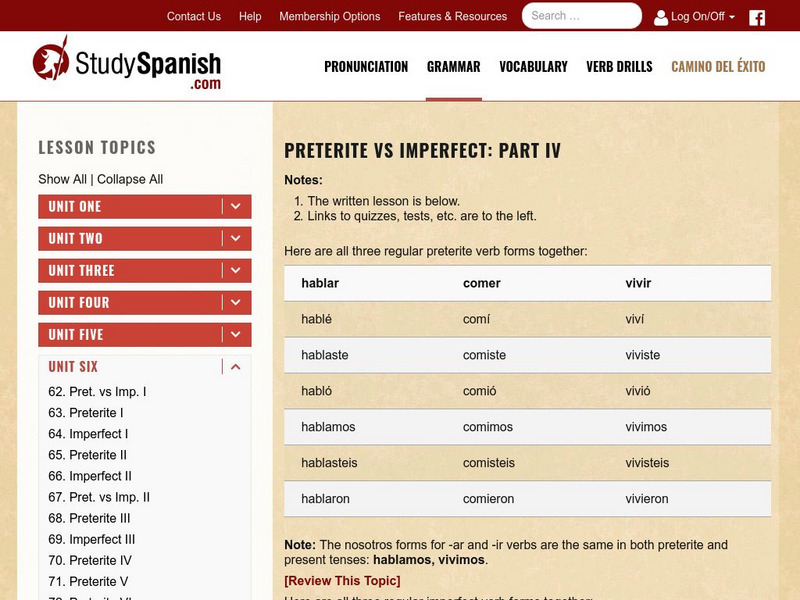
Study Languages
Study Spanish: Preterite vs Imperfect Review
Comprehensive review of the preterite and imperfect past tenses. Includes regular, irregular, and stem-changing conjugations. Rules for usage and time expressions in Spanish are listed. A quiz at the end of the lesson tests the student's...
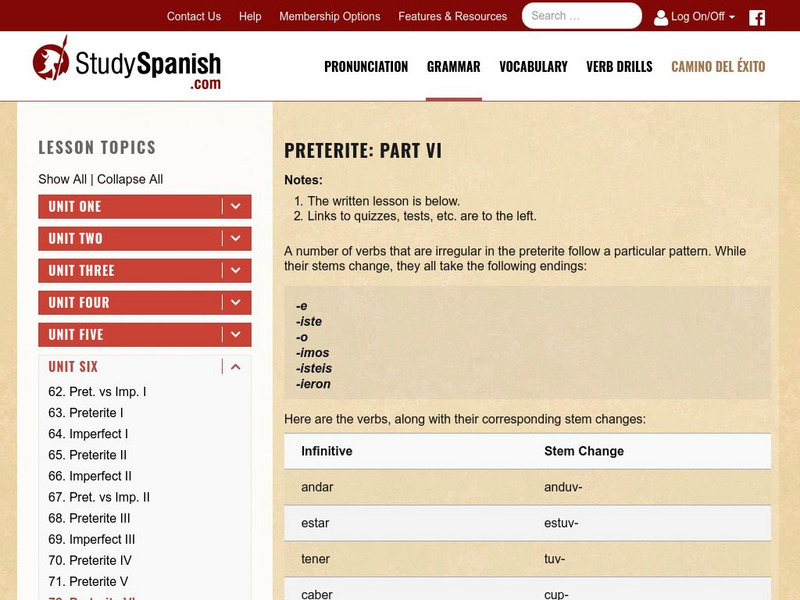
Study Languages
Study Spanish: Preterite Part 6
Great lesson on some of the most common irregular verbs in the preterite tense that follow the same pattern for their endings: andar, estar, tener, caber, haber, poder, poner, saber, hacer, querer, and venir. A quiz at the end of the...
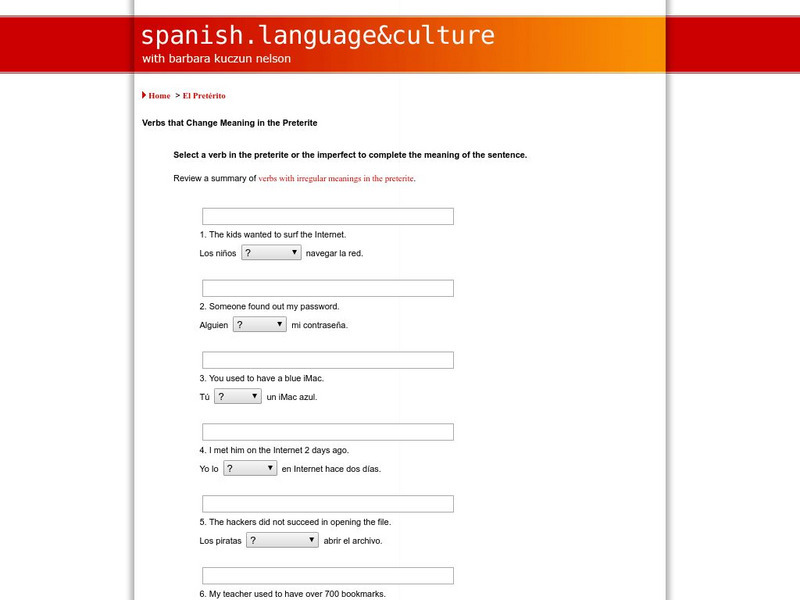
Colby College
Spanish Language & Culture: Preterites Irregular Meanings
Practice using verbs that change their meaning in the preterite tense: conocer, saber, querer, tener, and poder. Complete translations from English to Spanish by choosing the correct form of a verb in the preterite or imperfect. Answers...