Hi, what do you want to do?






American Museum of Natural History
Life in the City
Believe it or not, biodiversity exists even in areas of disturbed habitat. An interactive activity challenges learners to look for species with a magnifying lens in an image of a city habitat. Pop-up images and descriptions explain how...

American Museum of Natural History
Around with World with DNA
A mammalogist, ornithologist, ichthyologist, and a conservation geneticist share their work and their hopes that their research will help protect and save endangered species and their habitats.

American Museum of Natural History
All About Horses
Horses come in all shapes and sizes, but all belong to the same species. Young scholars explore the different traits and connect the information to genetic modification. The interactive gives them the option to read about 18 different...

American Museum of Natural History
What is Biodiversity?
Not all dogs are the same just like not all finches are the same. An interactive online lesson helps individuals learn about the causes and limitations to biodiversity. The clickable sections describe the basics of the genetics of...

American Museum of Natural History
Around the World with DNA
DNA analysis could be what saves some animals from extinction. An interactive lesson shows learners how DNA information proves variation among animals of the same species and how stakeholders use that information to make decisions. Easy...

American Museum of Natural History
DNA Detective
Match up the DNA code. Pupils read the website from the American Museum of Natural History about how DNA can determine whether a skin is from a particular type of reptile. Using the same technique, learners match up products with the...

American Museum of Natural History
Beyond T. Rex
Some dinosaurs get all the attention. Pupils use an interactive resource to study some of the lesser-known dinosaur species. Organizing the information in a cladogram allows learners to make connections among the species.

American Museum of Natural History
Wonderful World of Wasps
Shockingly, wasps sometimes challenge lions as the king of predators! Learners explore the life of a wasp in an interactive online lesson. They read about the characteristics of wasps and then complete activities to learn about their lives.

American Museum of Natural History
What is Marine Biology?
A marine environment covers the majority of the earth but is arguably the least understood. Teach young scientists about the characteristics of oceans and ocean species using an interactive online lesson. The in-person or remote learning...

American Museum of Natural History
Fascinating Fish
A fish is not just a fish. So many fish in remote places have unique characteristics. Take a trip with an ichthyologist to the Congo River to discover the species of one of the most diverse fish populations in the world. The online...

American Museum of Natural History
Talking to Fireflies
Fireflies are more than just mobile twinkle lights. An online interactive lesson teaches individuals about the light patterns fireflies use to communicate with each other. After they practice the patterns themselves, they could be...

American Museum of Natural History
What's This? Staying Safe
Amaze the class with the creative adaptations species employ to trick predators. An online interactive lesson introduces learners to six different species with unique adaptations. Each species highlights a different adaptation and its...

American Museum of Natural History
What's This? Life at the Limits
There are some amazing ways species evolve to survive. From large ears to sneezing salt, learners read about these interesting adaptations in an interactive lesson. Great to supplement an in-class lesson, it also works well as a remote...

American Museum of Natural History
What's This? Colorful Creatures
An online resource shows learners some species that are very good at using their camouflage as well as other ways species use their coloring for survival. Interactive and digital, the lesson is perfect as a remote learning resource.

American Museum of Natural History
What's This? Sensing
There is a scallop that relies on sight so much that it actually has more than 100 eyes! There are many species that rely heavily on one sense or another. An online interactive resource has youth read about several of these animals. The...

American Museum of Natural History
What's This? Feeding
Some species have pretty creative methods for catching food. Young scientists learn about some interesting ways organisms get the nutrients they need by navigating an online interactive lesson that would be suitable for a remote learning...

Other
Plant Watch
The Plant Watch website is designed to teach students how to record observations about plants. The site provides good information about the parts of plants and the section, "Plant Descriptions," will lead you to detailed information on...
PBS
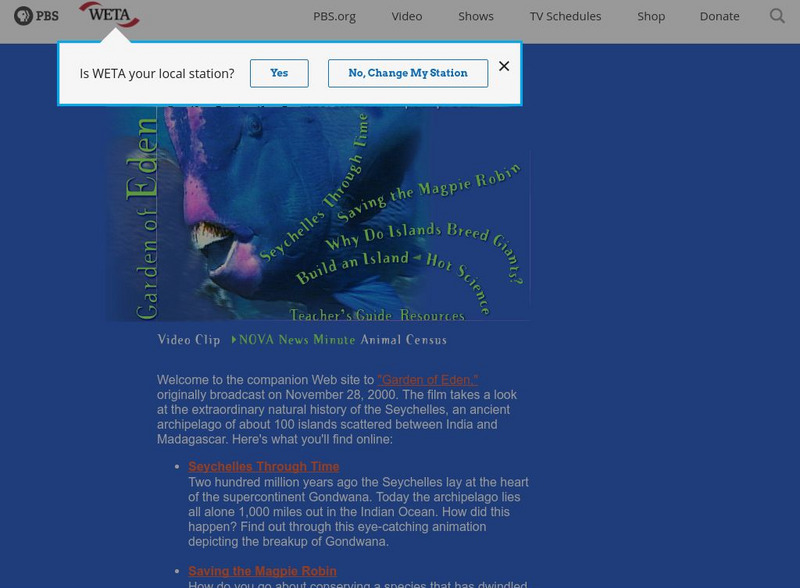
Garden of Eden: Seychelles
This interactive site on Seychelles discusses species diversity and much more! Learn all about how an island forms, how supercontinents divide, and why this atoll boasts both giant and miniature forms of species.

Other
Armadillo Online
Learn all about the twenty named species of armadillos. Browse through pictures of many of the species while learning about the natural history of this animal. Also includes facts, taxonomy, scientific research, and information on human...
NOAA
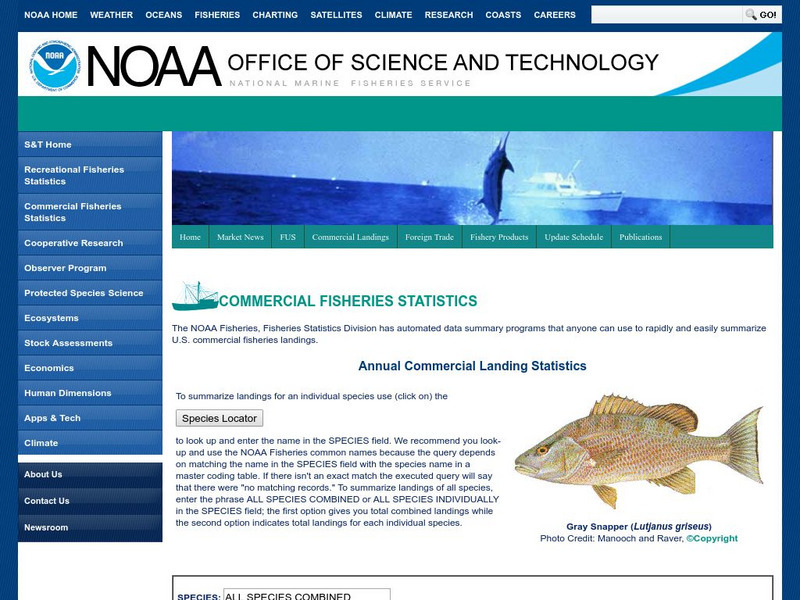
Noaa: Annual Commercial Landings Statistics
The NOAA Fisheries offers this interactive statistics page to find out about the catches and value of various species of fish and crustaceans taken by commercial fisheries since 1950.