Hi, what do you want to do?





Science Buddies
Science Buddies:skateboard Extremes:which Wheels Are Best for Speed & Turns?
You can cruise and carve while you investigate which skateboard wheels produce the fastest (and slowest) rides on your terrain in these experiments. You pick the wheels and design the tests you think will produce the most extreme results...
Science Buddies
Science Buddies: Tightening the Turns in Speed Skating
Fast turns around the track can become your laboratory tests in these experiments, whether you skate on ice, wood, or pavement. The goal is to determine which type of turns are best in a race - tight, medium, or wide - and then to figure...
Science Buddies
Science Buddies: Power Kicks: The Physics of Martial Arts
If the discipline, precision, and power of martial arts is your bag, try this project out for size. You won't be sparring with any opponent other than a swinging kick bag, but you'll learn a few powerful lessons about the physics of...

Science Buddies
Science Buddies: Baseball Bat Debate: What's Better, Wood or Aluminum?
Science and math abound in baseball. In this project, you can produce some interesting baseball statistics of your own and perhaps settle a long-standing debate. You'll set up experiments at your local playing field to find out which...
Science Buddies
Science Buddies: She Shoots, She Scores!
While watching an ice hockey game, have you ever wondered what differentiates a good player from a great player? For sure, the great player is athletically superior to the good player. But maybe it is a combination of athleticism and...
Google
Cs Education at Google: Cs First: Sports Theme
A set of eight activities that teach students basic computer science concepts using the programming language Scratch. Includes lots of additional supports for teachers. All materials are free and teachers sign in to create a class. This...
Science Buddies
Science Buddies: How Blue Is Your Sports Drink?
Do you read the list of ingredients in foods and drinks before you buy them at the grocery store? If you do, you may have noticed that many of the items that are blue in color have the same dye, called FD&C blue 1. In this chemistry...

Science Buddies
Science Buddies: Career Profile: Athletic Trainer
Summarizes the important work of an athletic trainer. This Science Buddies site lays out the requirements needed to become an athletic trainer, as well as the education and job description. Included are interviews with people who have...
Exploratorium
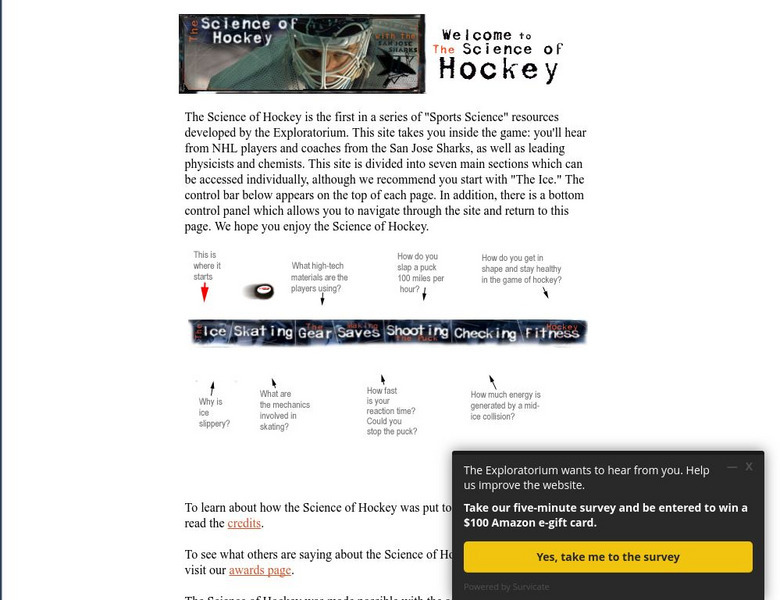
Exploratorium: The Science of Hockey
This resource analyzes the science of hockey from a variety of angles. Explains why ice is slippery, what affects the reaction times of goalies and more. Requires RealPlayer.
Exploratorium
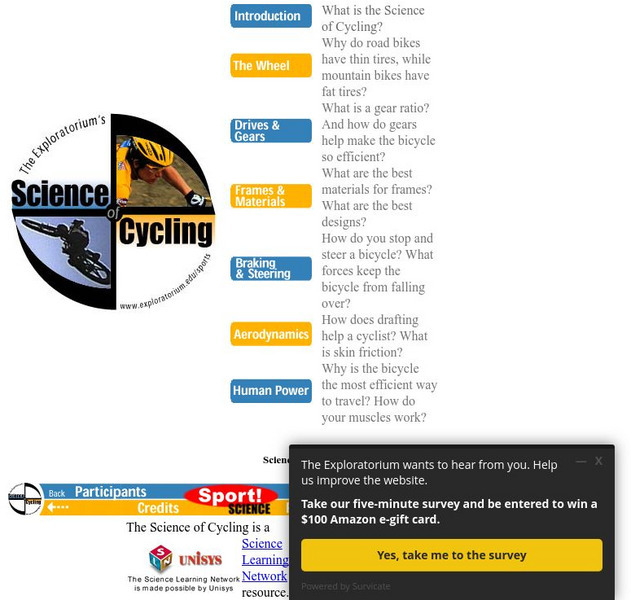
Exploratorium: Science of Cycling
Exceptionally well-designed site from Exploratorium, the museum of science, art, and human perception. Analyzes the physics of cycling associated with the use of gears, human-powered motion, braking and steering, and drafting.
Society for Science and the Public
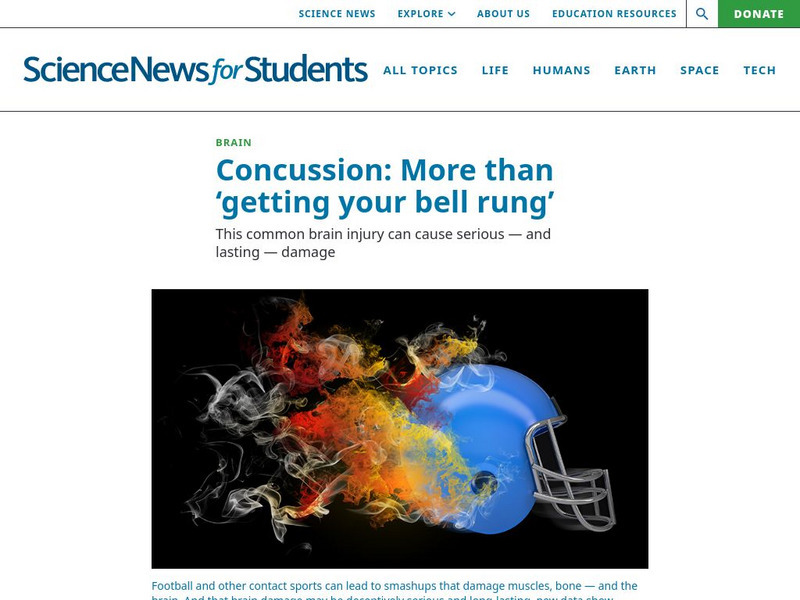
Science News for Students: Concussion: More Than 'Getting Your Bell Rung'
This article explains the science of concussions, including the damage they can do to the brain and symptoms of concussion. The article also describes the technology that scientists are using to detect concussion and how helmets are now...
Science Buddies
Science Buddies: Project Ideas: Paintball Ballistics
In this science fair project, use a paintball gun to compare the calculated vs. the actual range of a projectile. The Science Buddies project ideas are set up consistently beginning with an abstract, objective, and introduction, followed...
Science Buddies
Science Buddies: How Fast Can You Shoot a Hockey Puck?
In this project, you'll need: a puck, a hockey stick, a tape measure, at least one helper with a stopwatch and an empty rink. Have your friend start the watch just as you make contact with the puck, and stop it when the puck hits the...
Science Buddies
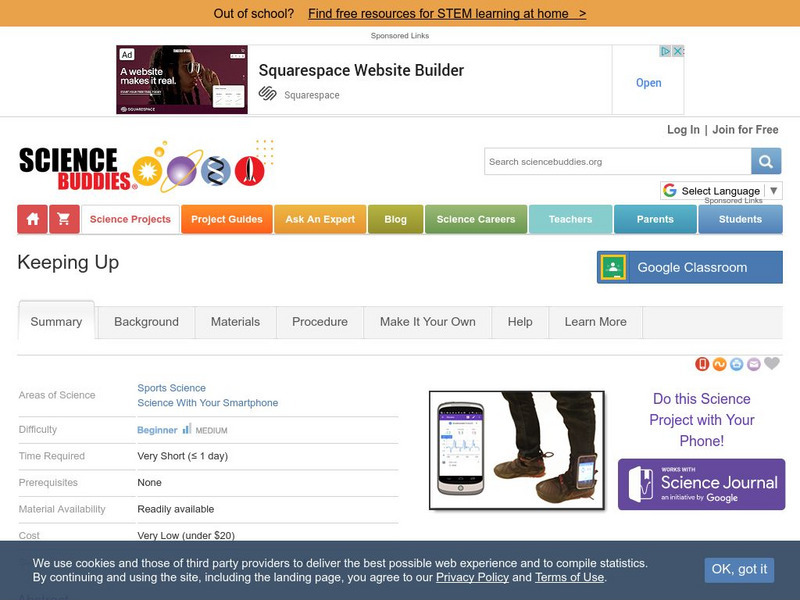
Science Buddies: Keeping Up
Do you ever feel like you need to walk faster than your parents just to keep up with them? This is because of the difference in leg length between you and your parents. In this experiment you will test if the height of a person is...

Science Buddies
Science Buddies: Heart Health: How Does Heart Rate Change With Exercise?
Your heart starts beating before you are born and keeps right on going through your whole life. Over an average lifetime, the human heart beats more than 2.5 billion times. Keeping your heart healthy means eating right, not smoking, and...

Science Buddies
Science Buddies:brain Body Connection: Can Exercise Make Our Brains Work Better?
We all know physical exercise is important to keeping our bodies fit. But how important is physical exercise to your brain? In other words, is there any connection between an active body and increased brain power? This is an easy project...

Science Buddies
Science Buddies: Are More Expensive Golf Balls Worth It?
There is a bewildering selection of different golf balls to choose from for playing the game. Some less expensive, some more expensive, all with different claims for the advantages they will bring to your game. This project can help you...
Science Buddies
Science Buddies: Asymmetric Dimple Patterns and Golf Ball Flight
Have you ever wondered why golf balls have a pattern of dimples on their surface? The dimples are important for determining how air flows around the ball when it is in flight. The dimple pattern, combined with the spin imparted to the...
Science Buddies
Science Buddies: Golf Clubs, Loft Angle, and Distance
If your idea of a great weekend morning is taking some practice swings at a driving range, or heading out to the links to play a round, this could be a good project for you. This project is designed to answer the question, what is the...
Science Buddies
Science Buddies: Tee Time: How Does Tee Height Affect Driving Distance?
If you're an avid golfer, this might be a fun project for you. When you're setting up to tee off out on the course, how much attention do you pay to putting the tee in the ground? The height of the tee can affect both where in the swing...

Science Buddies
Science Buddies: Balancing Act: Finding Your Center of Gravity
Like to have the balance of a tightrope walker? Try the more close - to - the - ground balancing test in this easy experiment to learn a few trade secrets of the high wire experts. In this project, you'll find your center of gravity and...
Science Buddies
Science Buddies: Back and Forth to Go Forward: A Snake on Wheels?
Have you ever ridden on a Roller Racer or Plasma Car? These are ride-on toys that you move ahead by moving the steering mechanism back and forth. You've probably seen skateboarders "slaloming" on level ground to keep rolling, it's...
Science Buddies
Science Buddies: Does Crossed Hand/eye Dominance Affect Basketball Shooting %?
Everyone's used to the idea that people are either right-handed or left-handed for particular tasks. That is, one hand is preferred (or dominant) over the other for a particular task. Did you know that people also have a dominant eye?...

Science Buddies
Science Buddies: Nothing but Net: The Science of Shooting Hoops
Swish. What a great sound when you hit the perfect shot and get nothing but net. Here's a project to get you thinking about how you can make that perfect shot more often.
Other popular searches
- Sports Science Fair Projects
- Science of Sports
- Science Energy Sports Them
- Sports Science Lesson Plans
- Sports Science Lessons
- Science Sports